
Imagine switching on a light at night. Within a second, your room is bright. Have you ever thought about where that electricity comes from? In many countries, a large portion of electrical power is generated in a thermal power station.
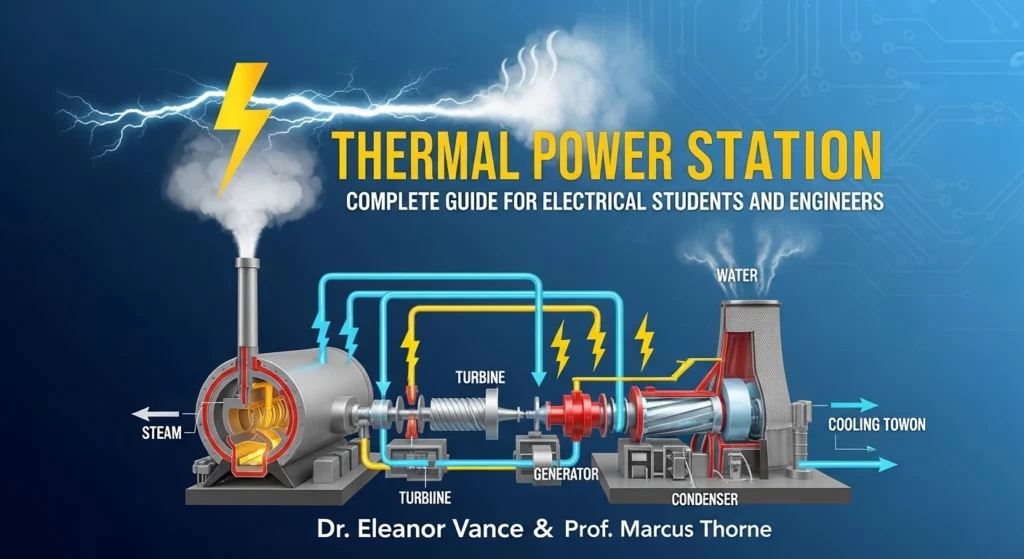
A thermal power station converts heat energy into electrical energy. The heat is usually produced by burning fuel such as coal, oil, or natural gas. This heat creates steam, which rotates a turbine connected to a generator. That generator produces electricity for homes, industries, hospitals, and cities.
Understanding how a thermal power station works is very important for electrical students, engineers, and technicians. It helps you understand power generation, load management, efficiency, and safety.
In this detailed guide, you will learn the thermal power station working principle, types, components, applications, advantages and disadvantages, and future trends in simple and clear language.
What is a Thermal Power Station?
A thermal power station is a power plant where electricity is produced by converting heat energy into electrical energy.
Simple Explanation
- Fuel is burned to produce heat.
- Heat converts water into high-pressure steam.
- Steam rotates a turbine.
- The turbine drives a generator.
- The generator produces electricity.
Practical Example
When coal burns, it produces heat. That heat boils water in a boiler. The steam produced turns a turbine. The turbine shaft is connected to an alternator, which produces electrical power.
This process follows a basic energy conversion chain:
Chemical Energy → Heat Energy → Mechanical Energy → Electrical Energy
Thermal Power Station Working Principle
The thermal power station working principle is based on the Rankine cycle, which is a thermodynamic cycle used to convert heat into work.
Let’s understand it step-by-step using a simple analogy.
Think of it like a pressure cooker connected to a fan:
Fuel Combustion
- Coal or gas burns in a furnace.
- Heat is produced.
Boiler Operation
- Water inside the boiler absorbs heat.
- Water turns into high-pressure steam.
Steam Expansion in Turbine
- Steam flows to the turbine.
- High-pressure steam pushes turbine blades.
- Turbine rotates.
Generator Action
- Turbine shaft is connected to a generator.
- When the turbine rotates, the generator produces electricity.
Condensation
- Used steam goes to a condenser.
- Steam cools down and becomes water again.
Feedwater Pump
- Water is pumped back into the boiler.
- The cycle repeats.
In Simple Points
- Burn fuel
- Produce steam
- Rotate turbine
- Generate electricity
- Condense steam
- Reuse water
This continuous cycle runs 24/7 in large power plants.
Types / Classification of Thermal Power Station
Thermal power stations can be classified based on fuel type and technology.
Coal-Fired Thermal Power Station
- Uses coal as fuel.
- Most common type worldwide.
- Large capacity (hundreds of MW).
Gas-Fired Power Station
- Uses natural gas.
- Cleaner than coal.
- Faster start-up time.
Oil-Fired Power Station
- Uses diesel or heavy fuel oil.
- Mostly used as backup plants.
Combined Cycle Power Plant
- Uses gas turbine and steam turbine together.
- Very high efficiency.
- Waste heat from gas turbine produces steam.
Nuclear Thermal Power Station
- Uses nuclear reactions instead of burning fuel.
- Produces heat to generate steam.
- No direct carbon emissions.
Main Components of a Thermal Power Station
Understanding components is essential for engineers.
Boiler
- Converts water into steam.
- Main heat exchange unit.
Furnace
- Burns fuel.
- Produces heat energy.
Steam Turbine
- Converts steam energy into mechanical energy.
- Rotates at high speed.
Generator (Alternator)
- Converts mechanical energy into electrical energy.
- Works on electromagnetic induction principle.
Condenser
- Converts steam back into water.
- Improves efficiency.
Cooling Tower
- Removes excess heat.
- Maintains condenser temperature.
Feedwater Pump
- Pumps water back to boiler.
- Maintains pressure.
Chimney
- Releases flue gases into the atmosphere.
- Helps in pollution control.
Advantages of Thermal Power Station
Here are the main thermal power station advantages and disadvantages. First, let’s discuss advantages.
- Lower initial cost compared to hydro or nuclear plants
- Can be installed near load centers
- Less dependent on weather
- Reliable continuous power generation
- Suitable for large-scale electricity production
- Easier operation compared to nuclear plants
These benefits make thermal plants important in many countries.
Disadvantages / Limitations
Every system has limitations.
- Produces air pollution (CO₂, SO₂)
- Requires large quantity of fuel
- Lower efficiency compared to combined cycle
- Requires large cooling water supply
- Environmental impact due to ash disposal
- High maintenance cost
Because of these issues, many countries are moving toward renewable energy.
Thermal Power Station Applications
Thermal power station applications are widespread.
Home Applications
- Domestic electricity supply
- Lighting and appliances
Industrial Applications
- Power for factories
- Heavy machinery operation
- Steel and cement plants
Commercial Applications
- Shopping malls
- Hospitals
- Data centers
Grid Support
- Base load power supply
- Frequency stability support
Thermal plants play a major role in national grids.
Comparison Section: Thermal vs Hydroelectric Power Station
Below is the difference between thermal power station and hydroelectric power station.
| Feature | Thermal Power Station | Hydroelectric Power Station |
| Energy Source | Fuel (coal, gas, oil) | Water |
| Fuel Cost | High | Very low |
| Pollution | High | Very low |
| Location | Anywhere | Near dams |
| Initial Cost | Moderate | Very high |
| Operating Cost | High | Low |
| Start Time | Moderate | Fast |
This comparison helps in understanding plant selection.
Selection Guide
Choosing the right power plant depends on several factors.
Consider These Points
- Fuel availability
- Environmental regulations
- Land and water availability
- Power demand
- Budget
- Grid connection
Tips for Beginners
- Study load requirement first.
- Calculate fuel cost.
- Consider environmental impact.
- Compare efficiency.
Engineers must always consider long-term sustainability.
Common Problems & Solutions (FAQs Style)
Why is efficiency low in thermal plants?
Because heat energy conversion has losses in boiler, turbine, and condenser.
Solution:
Use superheaters, reheaters, and high-efficiency turbines.
Why does the condenser vacuum reduce?
Due to air leakage or poor cooling.
Solution:
Check seals and cooling water flow.
Why is ash handling important?
Ash accumulation reduces efficiency.
Solution:
Use proper ash handling systems.
What causes turbine vibration?
Imbalance or misalignment.
Solution:
Perform regular maintenance and balancing.
Future Trends
The power generation industry is changing.
Supercritical and Ultra-Supercritical Boilers
- Higher efficiency
- Lower emissions
Carbon Capture Technology
- Reduces CO₂ emissions
- Improves environmental performance
Hybrid Systems
- Thermal + Solar integration
- Improved fuel efficiency
Automation and Smart Monitoring
- AI-based monitoring systems
- Predictive maintenance
The future of thermal power stations focuses on cleaner and more efficient operation.
Conclusion
A thermal power station is one of the most important sources of electricity in the modern world. It converts heat energy into electrical energy using a boiler, turbine, and generator system. Understanding the thermal power station working principle helps engineers design, operate, and maintain power plants effectively.
We discussed types, components, thermal power station applications, and thermal power station advantages and disadvantages. We also compared it with hydroelectric plants and explored future trends.
As a student or junior engineer, mastering this topic builds a strong foundation in power generation. Keep learning about efficiency improvement and clean energy technologies to stay ahead in the electrical engineering field.