
Every time you switch on a light, charge your phone, or run a fan during a hot day, you are using electricity. It has become such a normal part of daily life that we rarely stop to think about what it actually is or how it works. From powering homes and hospitals to running industries and communication systems, electricity is the backbone of modern civilization.
Understanding electricity is essential for electrical students, engineers, technicians, and beginners because it forms the foundation of all electrical and electronic systems. Without a clear understanding of this concept, it is impossible to design, install, maintain, or troubleshoot electrical equipment safely and effectively.
In this article, you will learn what electricity is, how it works, its types, components, advantages and limitations, real-world applications, and future trends. The goal is to explain the concept in simple and clear language while maintaining professional accuracy.
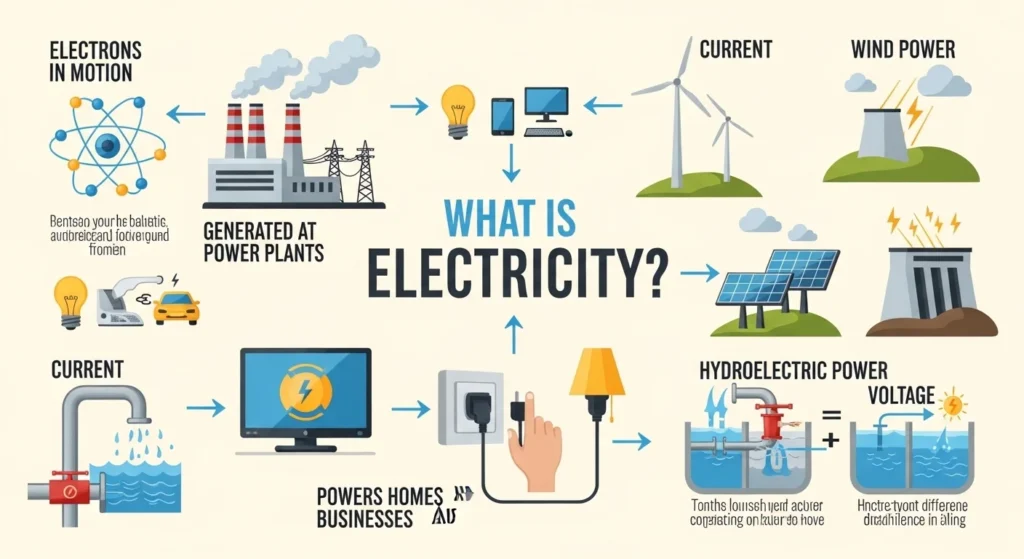
Electricity is the flow of electric charge, usually carried by tiny particles called electrons moving through a conductor such as a wire.
Simple Explanation
Atoms contain electrons that can move from one place to another. When these electrons move in an organized way through a conductor, an electric current is created. This movement of electrons is what we call electricity.
Practical Example
When you plug in a mobile charger, electricity flows through the wire and delivers energy to charge the battery.
In short:
Electricity is a form of energy created by moving electrons.
Electricity Working Principle
The electricity working principle is based on the movement of electrons due to a potential difference (voltage).
Think of electricity like water flowing in a pipe:
- Voltage = water pressure
- Current = water flow
- Wire = pipe
- Switch = valve
Step-by-Step Process
- A power source (battery or generator) creates voltage.
- Voltage pushes electrons through a conductor.
- Electrons flow in a closed path called a circuit.
- Electrical devices use this energy to perform work.
- The current returns to the source to complete the loop.
Key Requirements for Electricity Flow
- Power source
- Conductive path
- Load (device)
- Closed circuit
Without a complete path, electricity cannot flow.
Types of Electricity
Electricity can be classified into two main types:
1. Static Electricity
Static electricity is the buildup of electric charge on the surface of an object.
Examples:
- Lightning
- Shock felt after walking on carpet
- Balloon sticking to a wall
It occurs when electrons accumulate on a surface instead of flowing continuously.
### 2. Current Electricity
Current electricity is the continuous flow of electrons through a conductor.
It is used to power electrical equipment and is further divided into:
Direct Current (DC)
- Flows in one direction
- Produced by batteries and solar panels
- Used in electronics and vehicles
Alternating Current (AC)
- Changes direction periodically
- Produced by power stations
- Used in homes and industries
Understanding the difference between AC and DC electricity is essential for electrical system design and safety.
Main Components of an Electrical Circuit
Electricity works through a circuit made up of essential components.
1. Power Source
Provides electrical energy.
Examples: battery, generator, solar panel.
2. Conductors
Allow electricity to flow.
Examples: copper and aluminum wires.
3. Load
Consumes electrical energy to perform work.
Examples: bulbs, motors, heaters.
4. Switch
Controls the flow of electricity by opening or closing the circuit.
5. Protection Devices
Prevent damage and hazards.
Examples: fuses, circuit breakers.
Electricity Advantages and Disadvantages
Advantages
- Clean and convenient energy at point of use
- Easy transmission over long distances
- Powers modern technology and automation
- High efficiency in energy conversion
- Enables lighting, heating, cooling, and communication
- Supports industrial productivity
Disadvantages / Limitations
- Requires infrastructure for generation and distribution
- Can cause electric shock and fire hazards
- Power outages disrupt daily life and industry
- Some generation methods cause environmental pollution
- Energy storage remains a challenge
Electricity Applications
Electricity applications span every sector of modern life.
Home Uses
- Lighting and fans
- Refrigerators and air conditioners
- Cooking appliances
- Phone and laptop charging
Industrial Uses
- Running motors and machinery
- Welding and manufacturing processes
- Automation systems
- Industrial heating and cooling
Modern Technology
- Computers and data centers
- Telecommunications and internet
- Medical equipment
- Electric vehicles and renewable energy systems
Without electricity, modern society cannot function.
Comparison: Static vs Current Electricity
| Feature | Static Electricity | Current Electricity |
| Flow of electrons | No continuous flow | Continuous flow |
| Duration | Temporary | Continuous |
| Examples | Lightning, static shock | Home power supply |
| Path required | No | Yes (closed circuit) |
| Practical use | Limited | Widly used |
Selection Guide: Choosing the Right Electrical Supply
Selecting the correct electrical system depends on application needs.
For Homes
- Use AC supply (standard grid power)
- Ensure proper earthing and protection
For Electronics
- Use DC power from adapters or batteries
- Match voltage ratings carefully
For Industrial Systems
- Use three-phase AC for heavy loads
- Ensure overload protection and grounding
Tips for Beginners
- Always check voltage rating before connecting devices
- Use certified cables and protection devices
- Avoid overloading circuits
- Follow electrical safety standards
Common Problems & Solutions
Why is my device not turning on?
Possible causes: loose connection, blown fuse, power outage
Solution: check plug, circuit breaker, and supply.
Why do circuit breakers trip frequently?
Cause: overload or short circuit
Solution: reduce load and inspect wiring.
Why do lights flicker?
Cause: voltage fluctuations or loose wiring
Solution: tighten connections and check supply stability.
What causes electric shock?
Cause: contact with live wires or faulty insulation
Solution: ensure grounding and proper insulation.
Future Trends in Electricity
Electricity systems are evolving rapidly with new technologies.
Renewable Energy Integration
Solar and wind power are reducing dependence on fossil fuels.
Smart Grids
Digital monitoring improves efficiency and reliability.
Energy Storage Solutions
Advanced batteries allow better storage and backup power.
Electric Vehicles (EVs)
Transportation is shifting toward electricity-based mobility.
Automation & Smart Homes
Energy-efficient systems optimize power usage.
The future of electricity focuses on sustainability, efficiency, and intelligent control.
Conclusion
Electricity is one of the most important discoveries that powers modern life. It is the movement of electrons that delivers energy to operate everything from small household devices to large industrial machines. Understanding the electricity working principle, types, components, applications, and safety aspects is essential for students, engineers, and technicians.
While electricity offers enormous benefits such as efficiency, convenience, and technological advancement, it must be handled with care due to safety risks and infrastructure challenges. With the growth of renewable energy, smart grids, and electric transportation, electricity will continue to shape the future of the world.
A strong foundation in electrical basics helps you design safer systems, troubleshoot effectively, and build innovative solutions for tomorrow.