
Imagine standing near a large hydroelectric dam. You hear the powerful sound of flowing water, and deep inside the powerhouse, a massive rotating machine is generating electricity for thousands of homes. That rotating machine is called a turbine.
A turbine is one of the most important machines in power generation. Whether electricity is produced from water, steam, gas, or wind, a turbine plays a central role. Without turbines, modern power plants would not exist.
For electrical students, engineers, and technicians, understanding what is turbine and how it works is essential. Turbines connect mechanical energy to electrical energy through generators. In this article, you will learn the turbine working principle, types, main components, turbine applications, and turbine advantages and disadvantages in simple and clear language.
Think of this as a practical lesson from a senior engineer explaining the fundamentals step by step.
What is Turbine?
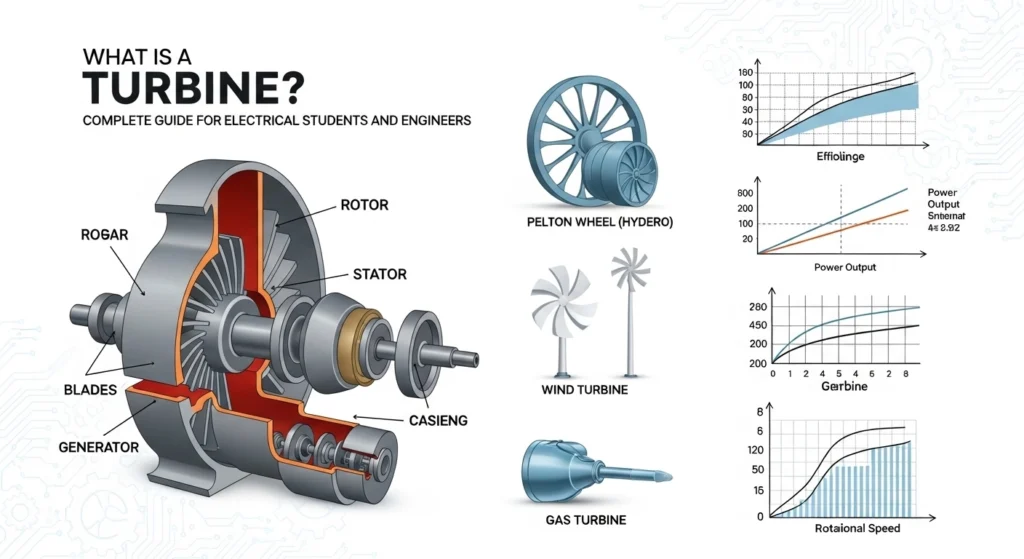
A turbine is a mechanical device that converts the energy of a moving fluid (water, steam, gas, or air) into rotational mechanical energy.
Simple Explanation
When a fast-moving fluid hits specially designed blades, it pushes them and makes them rotate. This rotation is used to drive a generator, pump, or other machine.
Practical Example
In a hydroelectric power plant:
- Water stored at height flows down with high speed.
- It strikes turbine blades.
- The turbine rotates.
- The connected generator produces electricity.
Energy conversion chain:
Fluid Energy → Mechanical Energy → Electrical Energy
This is the basic concept behind every turbine system.
Turbine Working Principle
The turbine working principle is simple: fluid energy is converted into rotational motion by transferring force to blades.
Let’s understand step-by-step using an easy analogy.
Imagine a pinwheel placed in front of a fan. When air blows, the pinwheel rotates. A turbine works on a similar concept, but on a much larger and more powerful scale.
Step-by-Step Process
Fluid Supply
- Water, steam, gas, or air flows toward the turbine.
Nozzle or Guide Vanes
- Direct the fluid at proper angle and speed.
Blade Impact
- Fluid strikes turbine blades.
- Force is transferred to blades.
Rotor Rotation
- Blades are connected to a rotor shaft.
- Shaft rotates at high speed.
Mechanical Output
- The rotating shaft drives a generator.
- Electrical power is produced.
In Simple Points
- Fluid flows
- Blades receive energy
- Rotor spins
- Generator produces electricity
This is the core turbine working principle used in all power plants.
Types / Classification of Turbine
Turbines are classified based on fluid type and working method.
Water Turbine
Used in hydroelectric power plants.
Types include:
- Pelton turbine
- Francis turbine
- Kaplan turbine
Water pressure or velocity rotates the blades.
Steam Turbine
Used in thermal and nuclear power plants.
- Steam produced in a boiler rotates turbine blades.
- Common in large-scale electricity generation.
Gas Turbine
Used in power plants and aircraft.
- Hot gases from combustion rotate blades.
- High-speed operation.
Wind Turbine
Used in renewable energy systems.
- Wind rotates large blades.
- Generator produces electricity.
Impulse and Reaction Turbine
Impulse Turbine
- Fluid hits blades directly.
- Works mainly on velocity.
Reaction Turbine
- Uses both pressure and velocity change.
- More efficient for large systems.
Understanding the difference between impulse turbine and reaction turbine is important for design selection.
Main Components of Turbine
Every turbine has key parts that perform specific functions.
Rotor
- Rotating part of turbine.
- Holds the blades.
Blades
- Receive energy from fluid.
- Convert fluid energy into mechanical motion.
Shaft
- Connected to rotor.
- Transfers mechanical power to generator.
Casing
- Outer cover of turbine.
- Controls fluid flow and ensures safety.
Nozzle / Guide Vanes
- Direct fluid at correct angle.
- Control speed and efficiency.
Bearings
- Support rotating shaft.
- Reduce friction.
Each component must work correctly to ensure smooth operation.
Turbine Advantages
Here are the main turbine advantages and disadvantages. First, let’s discuss advantages.
- High efficiency in energy conversion
- Suitable for large power generation
- Long operating life
- Reliable and continuous operation
- Can use different energy sources
- Low operating cost (especially hydro and wind)
Real-world benefit: Large cities depend on turbines for stable electricity supply.
Disadvantages / Limitations
No machine is perfect.
- High initial installation cost
- Requires regular maintenance
- Efficiency depends on fluid conditions
- Large size for high power output
- Noise and vibration issues
For example, wind turbines require proper location for effective operation.
Turbine Applications
Turbine applications are very wide in modern engineering.
Power Generation
- Thermal power plants
- Hydroelectric plants
- Nuclear plants
- Wind farms
Industrial Applications
- Driving compressors
- Oil and gas industries
- Chemical plants
Transportation
- Aircraft engines (gas turbines)
- Marine propulsion systems
Renewable Energy
- Wind energy systems
- Small hydro systems
Turbines are the backbone of global power production.
Comparison Section: Turbine vs Engine
Many beginners confuse turbines with engines. Let’s understand the difference between turbine and engine.
| Feature | Turbine | Engine |
| Energy Source | Fluid energy | Fuel combustion |
| Main Output | Rotational motion | Mechanical motion |
| Application | Power plants | Vehicles |
| Speed | Very high | Moderate |
| Maintenance | Moderate | Higher |
| Efficiency | High in large systems | Good for mobile systems |
A turbine converts fluid energy, while an engine usually burns fuel inside cylinders.
Selection Guide
Choosing the right turbine depends on application.
Consider These Factors
- Type of fluid (water, steam, gas, wind)
- Required power output
- Available pressure and flow rate
- Installation location
- Budget
- Environmental conditions
Tips for Beginners
- Always calculate load requirement first.
- Match turbine type with energy source.
- Consider maintenance cost.
- Check efficiency rating.
Correct selection ensures safe and efficient operation.
Common Problems & Solutions (FAQs Style)
Why does turbine vibration increase?
Cause: Shaft imbalance or worn bearings.
Solution: Perform alignment and bearing inspection.
Why does efficiency drop?
Cause: Blade erosion or leakage.
Solution: Regular inspection and cleaning.
Why is turbine overheating?
Cause: Poor lubrication or excessive load.
Solution: Check oil system and reduce load.
What causes noise in turbines?
Cause: Loose parts or airflow disturbance.
Solution: Tighten components and inspect casing.
Regular maintenance increases lifespan.
Future Trends
Turbine technology is continuously improving.
High-Efficiency Designs
- Advanced blade shapes
- Better aerodynamics
Smart Monitoring Systems
- Sensors for vibration analysis
- Real-time performance monitoring
Hybrid Power Systems
- Solar + steam turbine
- Wind + battery storage
Eco-Friendly Designs
- Low noise turbines
- Reduced emission gas turbines
Future turbines will focus on higher efficiency and lower environmental impact.
Conclusion
A turbine is a powerful mechanical device that converts fluid energy into rotational mechanical energy. It plays a critical role in electricity generation across thermal, hydro, nuclear, gas, and wind power plants.
We discussed what is turbine, turbine working principle, types, turbine applications, and turbine advantages and disadvantages in detail. Understanding these fundamentals is essential for every electrical student and engineer.
As a junior engineer, focus on mastering energy conversion concepts and practical operation. Turbines are not just machines; they are the heart of modern power systems. Keep learning, observing real systems, and improving your technical knowledge.