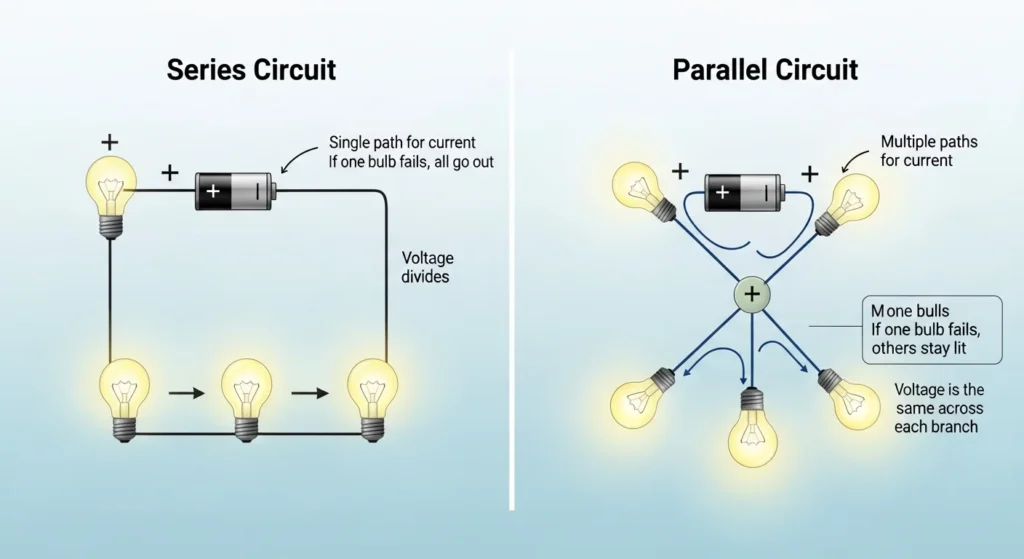

Imagine you turn on the lights in your house and one bulb suddenly burns out. Surprisingly, all the other lights still work perfectly. But in some older decorative light strings, if one bulb fails, the entire string stops working. Why does this happen?
The answer lies in how the electrical circuit is connected—either series or parallel.
Understanding Series vs Parallel Circuit is one of the most fundamental concepts in electrical engineering. These two connection methods determine how current flows, how voltage is distributed, and how electrical devices behave when connected together.
For electrical students, technicians, and engineers, knowing the difference between series and parallel circuit is essential. It helps in designing electrical systems, troubleshooting faults, and selecting the right circuit configuration for different applications.
In this article, you will learn the series vs parallel circuit working principle, types of circuits, components involved, series vs parallel circuit applications, advantages and disadvantages, troubleshooting tips, and future trends in circuit design.
The goal is to explain these concepts in simple, clear, and practical language, just like a senior electrical engineer teaching a junior technician.
What is Series vs Parallel Circuit?
A Series vs Parallel Circuit refers to two different ways electrical components such as resistors, bulbs, or devices are connected in a circuit.
Series Circuit Definition
A series circuit is a circuit where electrical components are connected one after another in a single path. The current flows through each component sequentially.
Parallel Circuit Definition
A parallel circuit is a circuit where components are connected across multiple paths. The current can flow through several branches at the same time.
Simple Explanation
- Series circuit: One path for current flow
- Parallel circuit: Multiple paths for current flow
Practical Example
- Series circuit example: Decorative Christmas lights where bulbs are connected one after another.
- Parallel circuit example: Home wiring where appliances receive electricity independently.
Understanding these two circuit types helps engineers design safe and efficient electrical systems.
Series vs Parallel Circuit Working Principle
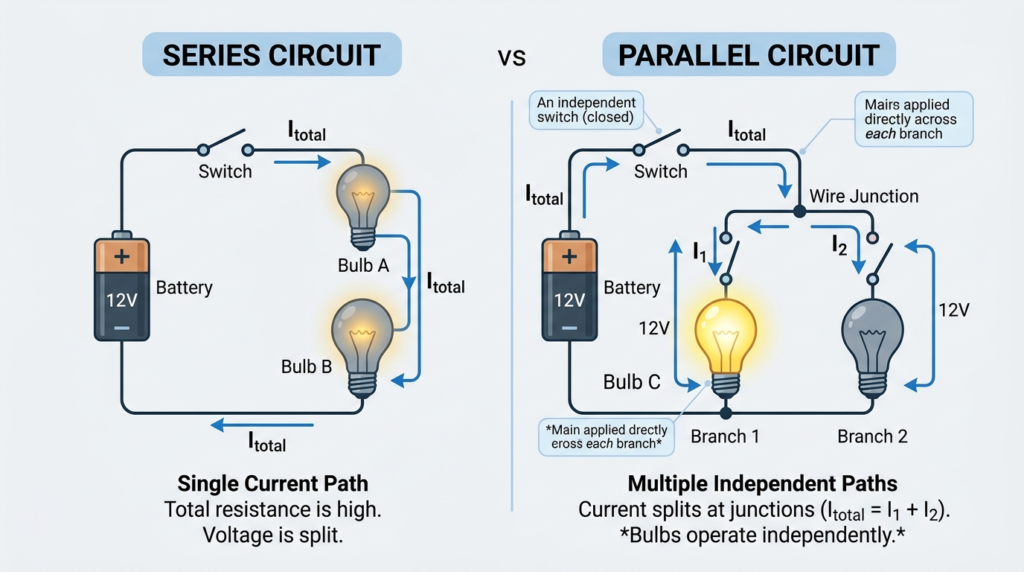
The series vs parallel circuit working principle is based on how current and voltage behave in different circuit connections.The series vs parallel circuit working principle explains how electrical components are connected and how current and voltage behave differently in each type of circuit. In a series circuit, components are connected one after another in a single path, so the same current flows through every component. If one component fails or the circuit breaks, the entire circuit stops working because there is only one path for current flow. In contrast, a parallel circuit connects components across multiple separate branches, allowing current to flow through different paths simultaneously. In a parallel circuit, each branch receives the same voltage, and if one component fails, the other branches continue operating normally. Series circuits are commonly used in simple electronic devices and decorative lighting, while parallel circuits are widely used in home wiring, industrial systems, and power distribution because they provide better reliability and independent operation of devices. The main difference between series and parallel circuits is that series circuits share current in one path, whereas parallel circuits share voltage across multiple paths. Understanding the series vs parallel circuit working principle is important for electrical students, engineers, and technicians because it forms the foundation of electrical circuit design, troubleshooting, and safe electrical installation.
Series Circuit Working Principle
In a series circuit:
- There is only one path for current flow.
- The same current flows through all components.
- The voltage is divided across the components.
Step-by-Step Operation
After passing through each device, current returns to the power source.
Electrical power is supplied from the source.
Current flows through the first component.
It continues through all components in sequence.
Parallel Circuit Working Principle
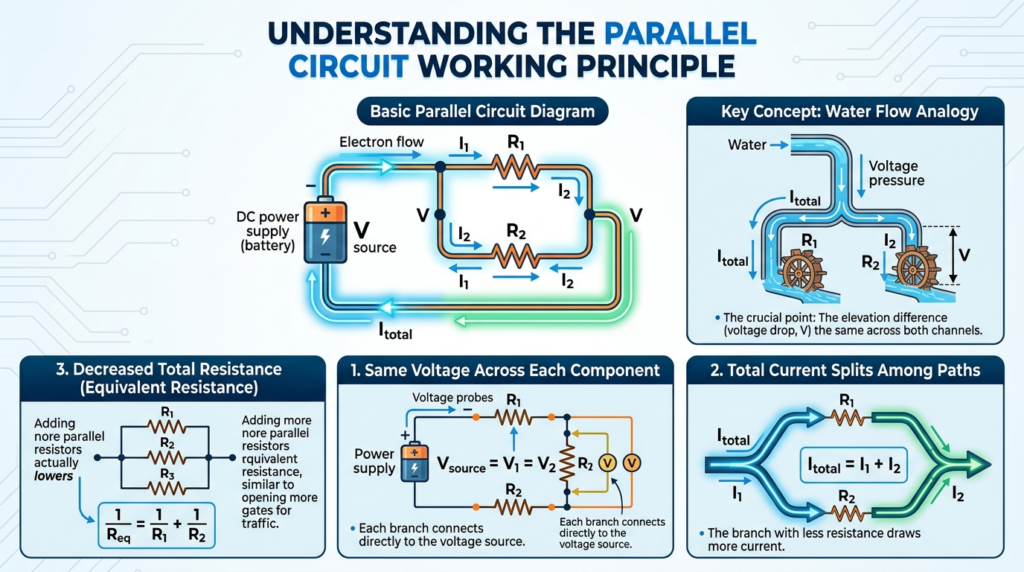
The parallel circuit working principle is based on connecting electrical components across the same voltage source through separate branches, allowing current to flow through multiple paths simultaneously. In a parallel circuit, each component receives the same supply voltage, but the current divides according to the resistance of each branch. If one branch or device stops working, the remaining branches continue operating normally because each path is independent. This is why parallel circuits are widely used in home wiring systems, lighting circuits, industrial power distribution, and electronic devices where reliable and uninterrupted operation is important. For example, in household wiring, lights and appliances are connected in parallel so that switching OFF one appliance does not affect others. The total current in a parallel circuit is equal to the sum of the currents flowing through all branches. Parallel circuits provide better flexibility, stable voltage distribution, and easy control of multiple devices. Understanding the parallel circuit working principle is important for electrical students, engineers, and technicians because it is a fundamental concept used in electrical installation, circuit design, troubleshooting, and power distribution systems.
- There are multiple paths for current flow.
- Each component receives the same voltage.
- Current divides among the branches.
Step-by-Step Operation
Electrical power enters the circuit.
Current splits into multiple branches.
Each branch powers a separate component.
Current from all branches returns to the source.
Simple Analogy
Think of water flowing through pipes.
- Series circuit: Water flows through one pipe and passes through all valves in sequence.
- Parallel circuit: Water flows through several pipes simultaneously.
Types and Classification of Electrical Circuits (2026)
Electrical circuits are classified according to the way electrical components such as resistors, switches, lamps, motors, and other devices are connected. The arrangement of these components determines how electric current flows, how voltage is distributed, and how the circuit behaves under different operating conditions. Understanding the different types of electrical circuits is essential for electrical engineering, electronics, industrial automation, and residential wiring because each circuit configuration has unique characteristics, advantages, and applications. The three primary classifications are Series Circuits, Parallel Circuits, and Series-Parallel (Combination) Circuits.
Series Circuit
A series circuit is an electrical circuit in which all components are connected one after another in a single continuous path. Because there is only one path for the flow of current, the same current passes through every component in the circuit. However, the supply voltage is divided among the connected components according to their resistance values.
If one component fails or the circuit is opened at any point, the entire circuit stops working because the current can no longer flow.
Characteristics of a Series Circuit
- Components are connected in a single path.
- Electric current remains the same throughout the circuit.
- Supply voltage is divided among all components.
- Total resistance equals the sum of individual resistances.
- Failure of one component interrupts the entire circuit.
- Simple circuit design and easy analysis.
Total Resistance Formula
Rₜ = R₁ + R₂ + R₃ + ...
Common Applications
- Flashlights (torches).
- Decorative string lights.
- Basic electronic training circuits.
- Battery-powered devices.
- Protective fuse circuits.
Advantages
- Simple to design and install.
- Requires less wiring.
- Easy to calculate circuit values.
- Suitable for simple electrical systems.
Limitations
- Failure of one component stops the entire circuit.
- Voltage is divided across components.
- Not suitable for powering multiple independent devices.
Parallel Circuit
A parallel circuit consists of multiple branches connected across the same voltage source. Each branch provides a separate path for electric current, allowing electrical devices to operate independently. In a parallel circuit, the voltage across every branch remains the same, while the total current supplied by the source is equal to the sum of the branch currents.
Because each branch operates independently, if one component fails, the remaining branches continue to function normally.
Characteristics of a Parallel Circuit
- Components are connected in separate branches.
- Voltage is the same across every branch.
- Current divides among the branches.
- Total resistance decreases as additional branches are added.
- Failure of one branch does not affect others.
- Widely used in residential and commercial wiring.
Equivalent Resistance Formula
1 / Rₜ = 1 / R₁ + 1 / R₂ + 1 / R₃ +
Common Applications
- Household electrical wiring.
- Office buildings.
- Commercial lighting systems.
- Power outlets.
- Industrial control panels.
Advantages
- Independent operation of connected devices.
- Constant voltage across all loads.
- Easy expansion by adding new branches.
- Improved system reliability.
Limitations
- Requires more wiring.
- More complex installation.
- Higher installation cost compared to simple series circuits.
Series-Parallel Circuit (Combination Circuit)
A series-parallel circuit, also called a combination circuit, contains both series and parallel connections within the same electrical system. This configuration combines the advantages of both circuit types and is commonly used in practical electrical and electronic applications where different components require different electrical characteristics.
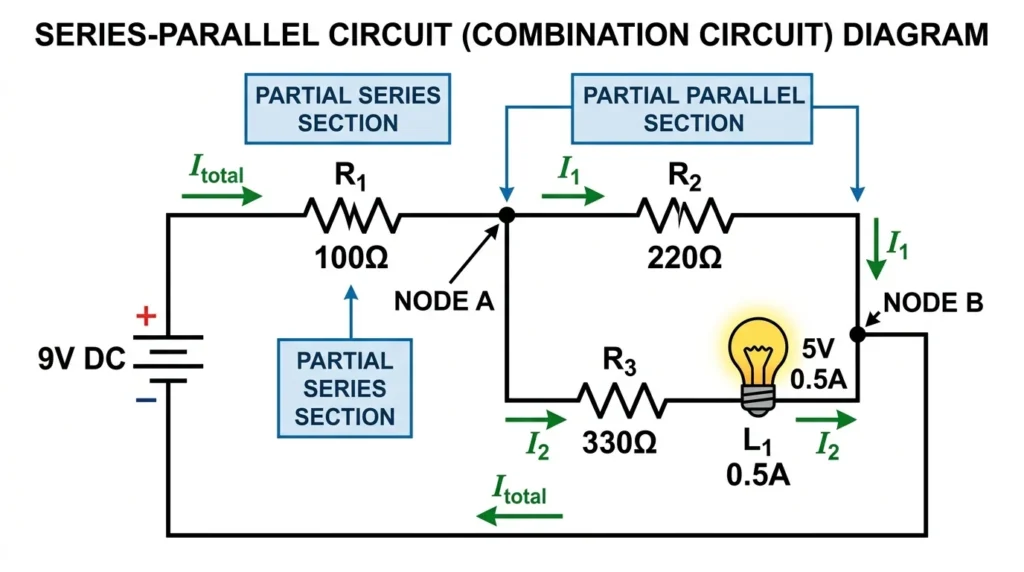
Series-parallel circuits allow designers to distribute voltage efficiently while maintaining independent operation of selected devices.
Characteristics of a Series-Parallel Circuit
- Contains both series and parallel sections.
- Combines constant current and constant voltage characteristics.
- More flexible than simple circuit configurations.
- Supports complex electrical system designs.
- Common in industrial and commercial applications.
Common Applications
- Electronic devices.
- Industrial machinery.
- Motor control circuits.
- Power distribution systems.
- Automotive electrical systems.
- Renewable energy installations.
- Building electrical systems.
Advantages
- High flexibility in circuit design.
- Efficient power distribution.
- Improved reliability.
- Suitable for complex electrical networks.
Limitations
- More complicated analysis and troubleshooting.
- Requires careful circuit design.
- Installation may be more expensive.
Importance of Understanding Circuit Classification
Understanding the different types of electrical circuits helps engineers, electricians, and students to:
- Design efficient electrical systems.
- Select the appropriate circuit configuration.
- Calculate voltage, current, and resistance accurately.
- Troubleshoot electrical faults more effectively.
- Improve electrical safety.
- Optimize power distribution.
- Ensure reliable operation of electrical equipment.
Main Components in Series and Parallel Circuits
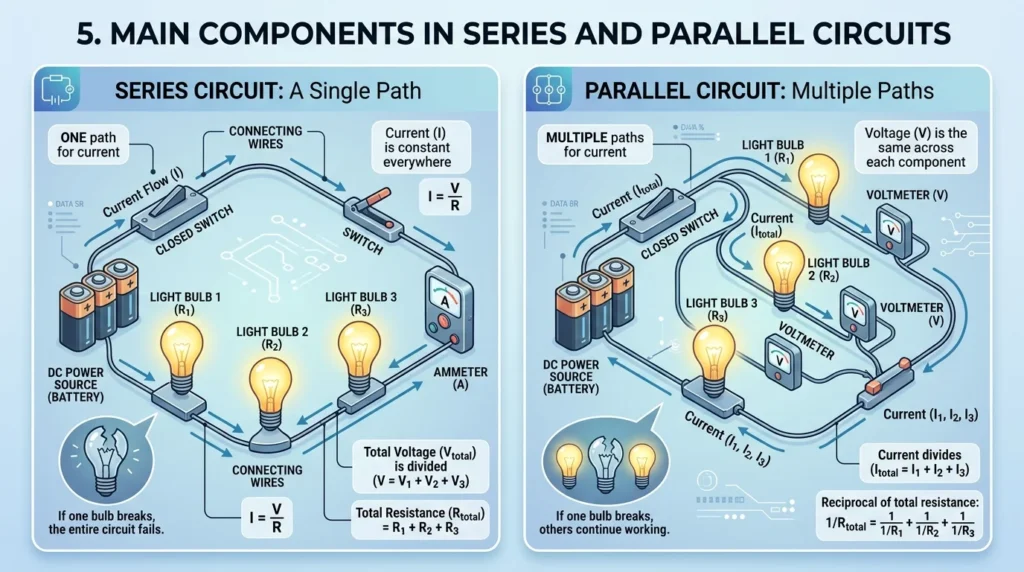
Electrical circuits include several important components.The main components in series and parallel circuits include essential electrical elements such as resistors, switches, capacitors, inductors, wires, and the power supply, which work together to control the flow of current and voltage in a circuit. In both series and parallel circuits, the power supply provides the electrical energy, while conductors or wires connect all components and allow current to flow. Resistors are used to limit or control current, switches are used to start or stop the flow of electricity, and capacitors and inductors are used in more advanced circuits for energy storage and filtering purposes. In a series circuit, these components are connected in a single path, so the same current passes through each element, making every component dependent on the others. In a parallel circuit, the same components are connected across different branches, allowing each device to operate independently while receiving the same voltage from the source. Proper selection and arrangement of these components are very important for circuit performance, safety, and efficiency. Understanding the main components in series and parallel circuits is essential for electrical students, engineers, and technicians because it helps in designing, analyzing, and troubleshooting electrical systems effectively.
Power Source
The power source provides electrical energy.
Examples:
- Batteries
- Generators
- Power supply units
Conductors (Wires)
Wires allow electrical current to flow between components.
Electrical Load
Loads consume electrical energy.
Examples:
- Bulbs
- Motors
- Heaters
Switches
Switches control the flow of electricity by opening or closing the circuit.
Protection Devices
Devices such as fuses and circuit breakers protect circuits from faults.
Advantages and Disadvantages of Series vs Parallel Circuits (2026)
Choosing between a series circuit and a parallel circuit is one of the most important decisions in electrical system design. Each circuit configuration offers unique advantages and limitations depending on the application, required reliability, installation cost, maintenance, and power distribution requirements. Understanding the strengths and weaknesses of both circuit types helps engineers, electricians, technicians, and students select the most suitable configuration for residential, commercial, industrial, and electronic systems.
Advantages of Series Circuits
A series circuit connects all electrical components in a single path, allowing the same current to flow through every component. Because of its simple structure, it is commonly used in basic electrical and electronic applications.
Key Advantages
- Simple and straightforward circuit design.
- Requires fewer wires, reducing material costs.
- Easy to install and troubleshoot.
- Simple mathematical analysis using Ohm’s Law.
- Same current flows through every component.
- Suitable for educational experiments and basic electronic circuits.
- Ideal for applications where identical current is required.
Typical Applications:
- Flashlights.
- Decorative light strings.
- Simple electronic training circuits.
- Battery-powered devices.
Advantages of Parallel Circuits
A parallel circuit provides multiple paths for current flow, allowing each connected device to operate independently. This makes it the preferred choice for most modern electrical installations.
Key Advantages
- Electrical devices operate independently.
- Failure of one component does not interrupt the remaining circuit.
- Each load receives the full supply voltage.
- Easy to add additional devices without affecting existing loads.
- Improved reliability and system flexibility.
- Better overall electrical performance.
- Ideal for residential, commercial, and industrial wiring.
Typical Applications:
- Home electrical systems.
- Commercial buildings.
- Office lighting.
- Industrial power distribution.
- Motor control systems.
Disadvantages and Limitations of Series and Parallel Circuits (2026)
Although both circuit types are widely used, each has certain limitations that should be considered during system design.
Disadvantages of Series Circuits
Series circuits have several operational limitations because every component depends on a single current path.
Common Limitations
- Failure of one component stops the entire circuit.
- Voltage is divided among connected devices.
- Difficult to operate multiple independent loads.
- Not suitable for large electrical installations.
- Limited flexibility for future expansion.
Disadvantages of Parallel Circuits
Parallel circuits provide greater reliability but require more materials and planning.
Common Limitations
- Requires additional wiring.
- Installation is more complex than a series circuit.
- Higher installation cost.
- Greater number of electrical connections.
- Troubleshooting may require more detailed inspection.
Despite these limitations, parallel circuits remain the standard choice for modern electrical systems because of their safety, reliability, and operational flexibility.
Applications of Series and Parallel Circuits (2026)
Series and parallel circuits are used in a wide variety of electrical and electronic systems. The choice depends on the desired voltage, current, reliability, and operational requirements of the application.
Home Electrical Wiring
Modern residential electrical systems are designed using parallel circuits so that every appliance receives the full supply voltage and operates independently.
Examples:
- Lighting circuits.
- Power outlets.
- Ceiling fans.
- Air conditioners.
- Kitchen appliances.
- Home entertainment systems.
Benefits:
- One faulty appliance does not affect the others.
- Stable voltage supply.
- Improved electrical safety.
Decorative Lighting
Series circuits are commonly used in decorative lighting systems because of their simple wiring arrangement.
Examples:
- Christmas light strings.
- Festival decorations.
- Holiday lighting displays.
- Decorative LED chains.
These applications are suitable where all lights are intended to operate together.
Battery Systems
Battery banks can be connected in different configurations depending on the required electrical output.
Batteries Connected in Series
- Increase total voltage.
- Current capacity remains the same.
- Used in electric vehicles and backup power systems.
Batteries Connected in Parallel
- Increase current capacity (Ah).
- Voltage remains constant.
- Used in solar energy storage systems and UPS installations.
Electronic Circuits
Most modern electronic equipment uses a combination of series and parallel circuits to achieve efficient operation.
Examples:
- Computers.
- Smartphones.
- Television circuits.
- Audio equipment.
- Printed circuit boards (PCBs).
- Consumer electronics.
Industrial Electrical Systems
Industrial facilities primarily use parallel circuits because they provide reliable operation of multiple machines and allow individual equipment to be controlled separately.
Examples:
- Manufacturing plants.
- Conveyor systems.
- Motor control centers.
- Automation systems.
- Industrial lighting.
- Power distribution networks.
Benefits:
- Independent machine operation.
- Reduced production downtime.
- Easier maintenance.
- Improved operational reliability.
Importance of Understanding Circuit Applications
A clear understanding of where each circuit type should be used helps professionals to:
Optimize power distribution.
Select the most efficient circuit configuration.
Improve electrical safety.
Reduce maintenance costs.
Increase system reliability.
Simplify troubleshooting.
Support future system expansion.
Comparison Between Series and Parallel Circuits (2026)
Selecting the appropriate circuit configuration is one of the most important decisions in electrical and electronic system design. The two primary circuit types—series circuits and parallel circuits—have different characteristics, advantages, and practical applications. A series circuit provides a single path for current flow, while a parallel circuit offers multiple current paths, allowing electrical devices to operate independently. Understanding the differences between these circuit types helps engineers, electricians, students, and technicians design safer, more efficient, and more reliable electrical systems for residential, commercial, industrial, and electronic applications.
Comparison Table: Series Circuit vs Parallel Circuit
| Feature | Series Circuit | Parallel Circuit |
|---|---|---|
| Current Path | Single continuous path for current flow. | Multiple independent paths for current flow. |
| Voltage Distribution | Supply voltage is divided among components. | Each branch receives the full supply voltage. |
| Current Flow | Same current flows through every component. | Current divides among the different branches. |
| Effect of Component Failure | Entire circuit stops working if one component fails. | Other branches continue operating even if one branch fails. |
| Resistance | Total resistance increases as more components are added. | Total resistance decreases as additional branches are added. |
| Wiring Complexity | Simple and requires fewer wires. | More wiring and a more complex installation. |
| Reliability | Lower reliability because one fault affects the entire circuit. | Higher reliability due to independent circuit branches. |
| Common Applications | Decorative lights, flashlights, basic electronic circuits. | Home wiring, offices, industries, commercial buildings, power distribution systems. |
Why Understanding the Difference Is Important
Both circuit configurations serve different purposes. Series circuits are ideal for simple, low-power applications where the same current is required throughout the circuit, while parallel circuits are preferred for modern electrical installations because they provide constant voltage and allow connected devices to operate independently. Choosing the correct circuit type improves system efficiency, enhances safety, simplifies maintenance, and increases overall reliability.
Selection Guide: Choosing Between Series and Parallel Circuits (2026)
Choosing the right circuit configuration depends on several technical factors, including the type of electrical load, voltage requirements, reliability, future expansion, and installation cost. Proper circuit selection ensures efficient power distribution, safe operation, and long-term performance.
Choose a Series Circuit When
A series circuit is the best choice when a simple electrical arrangement is required and all connected components are intended to operate together.
Recommended Situations:
- A simple circuit design is sufficient.
- Voltage division is required between components.
- Low-power electrical devices are being used.
- Educational demonstrations or laboratory experiments are being performed.
- Basic electronic circuits require the same current through each component.
- Cost-effective wiring is preferred for small applications.
Typical Applications:
- Flashlights.
- Decorative light strings.
- Basic training circuits.
- Simple battery-powered devices.
Choose a Parallel Circuit When
A parallel circuit is the preferred option whenever reliability, independent device operation, and a stable voltage supply are required.
Recommended Situations:
- Electrical devices must operate independently.
- Full supply voltage is required across every load.
- High system reliability is important.
- Future circuit expansion may be necessary.
- Residential, commercial, or industrial wiring is being installed.
- Multiple appliances need to operate simultaneously.
Typical Applications:
- Household electrical wiring.
- Commercial buildings.
- Office power systems.
- Industrial machinery.
- Motor control systems.
- Modern lighting installations.
Factors to Consider Before Selecting a Circuit
Before choosing a series or parallel circuit, engineers typically evaluate several important factors:
- Required operating voltage.
- Expected current demand.
- Type of electrical load.
- Reliability requirements.
- Installation complexity.
- Maintenance requirements.
- Future system expansion.
- Budget and installation cost.
- Compliance with electrical safety standards.
Evaluating these factors helps ensure that the selected circuit configuration meets both technical and operational requirements.
Why Parallel Circuits Are Preferred Today
Most modern electrical systems use parallel circuit configurations because they offer several practical advantages:
- Independent operation of electrical devices.
- Stable voltage across all connected loads.
- Improved electrical safety.
- Easier troubleshooting and maintenance.
- Greater flexibility for future expansion.
- Higher overall reliability.
- Continuous operation even if one branch develops a fault.
These benefits make parallel circuits the standard choice for residential, commercial, and industrial electrical installations worldwide.
Common Problems and Solutions in Series and Parallel Circuits (2026)
Series and parallel circuits are the foundation of modern electrical systems, but they can experience various operational problems due to faulty components, improper wiring, overloads, or incorrect circuit design. These issues can reduce circuit performance, interrupt the power supply, damage electrical equipment, and increase maintenance costs. Understanding the most common problems in both series and parallel circuits—and knowing how to solve them—is essential for students, electricians, technicians, and engineers. Regular inspection, proper circuit design, and the use of protective devices help ensure safe, reliable, and efficient circuit operation.
Why Does the Entire Series Circuit Stop Working
In a series circuit, all electrical components are connected in a single continuous path. Because there is only one path for current flow, the failure of any component immediately breaks the circuit, preventing current from reaching the remaining devices.
Possible Causes
- Burned-out lamp or resistor.
- Broken wire or loose connection.
- Faulty switch.
- Blown fuse.
- Open circuit caused by damaged components.
Recommended Solutions
- Replace the faulty electrical component.
- Inspect the entire circuit for loose or broken connections.
- Test each component individually using a multimeter.
- Replace damaged wiring if necessary.
- Ensure all connections are secure before restoring power.
Why Does Voltage Drop in a Series Circuit
In a series circuit, the total supply voltage is divided among all connected components based on their individual resistance values. As additional components are added, each device receives only a portion of the total voltage.
Possible Causes
- Voltage division across multiple components.
- High resistance in one or more devices.
- Long conductor lengths causing additional voltage drop.
- Poor electrical connections.
- Excessive circuit loading.
Recommended Solutions
- Design the circuit according to the required voltage distribution.
- Select components with appropriate resistance values.
- Minimize unnecessary conductor length.
- Tighten loose electrical connections.
- Use conductors with the correct wire size to reduce voltage loss.
Why Does One Device Fail While Others Continue Working in a Parallel Circuit
Unlike a series circuit, a parallel circuit provides multiple current paths. If one branch develops a fault, the remaining branches continue operating normally.
Possible Causes
- Faulty appliance or load.
- Open circuit in one branch.
- Loose wiring.
- Defective switch or fuse.
Recommended Solutions
- Test the affected branch independently.
- Replace the faulty electrical device.
- Inspect branch wiring and connectors.
- Replace damaged switches or protective devices.
How Can Circuit Problems Be Prevented
Most electrical circuit faults can be avoided through proper installation and routine maintenance.
Best Practices:
- Use correctly rated wires and components.
- Avoid overloading electrical circuits.
- Install suitable fuses and circuit breakers.
- Inspect electrical connections regularly.
- Replace worn or damaged components promptly.
- Follow approved electrical safety standards and wiring regulations.
Importance of Troubleshooting Circuit Problems
Understanding common series and parallel circuit problems helps to:
Lower maintenance and repair costs.
Improve electrical safety.
Prevent equipment damage.
Reduce downtime.
Simplify fault diagnosis.
Increase system reliability.
Extend the lifespan of electrical installations.
Future Trends in Electrical Circuit Design (2026)
Electrical circuit design is evolving rapidly as new technologies transform the way electrical energy is generated, distributed, controlled, and utilized. Modern circuit designs are becoming smarter, more efficient, and highly automated to meet the growing demand for reliable power, energy efficiency, and sustainable infrastructure. Advances in smart grids, renewable energy integration, artificial intelligence (AI), Internet of Things (IoT), and miniaturized electronics are changing the way series and parallel circuits are designed and implemented. These innovations are helping engineers develop electrical systems that are safer, more reliable, and capable of supporting future energy requirements.
Smart Electrical Systems
One of the biggest trends in electrical engineering is the development of smart electrical systems. Modern homes, offices, and industrial facilities use intelligent control systems that automatically monitor and manage electrical circuits.
Key Developments:
- Smart switches and sockets.
- Automated lighting systems.
- Intelligent energy management.
- Remote monitoring and control.
- Smart home automation.
Benefits:
- Improved energy efficiency.
- Greater user convenience.
- Reduced electricity consumption.
- Enhanced electrical safety.
Renewable Energy Systems
The increasing adoption of renewable energy has significantly influenced modern circuit design. Solar photovoltaic (PV) systems, wind energy installations, and battery storage solutions use carefully designed combinations of series and parallel circuits to achieve the required voltage and current levels.
Applications:
- Solar panel arrays.
- Battery energy storage systems.
- Wind power installations.
- Hybrid renewable energy systems.
- Residential solar power systems.
Benefits:
- Higher system efficiency.
- Better energy utilization.
- Increased renewable energy integration.
- Improved power reliability.
Intelligent Power Distribution
Modern electrical grids are becoming more intelligent through the use of advanced circuit configurations, digital communication, and automated control technologies. Smart power distribution systems can detect faults, balance electrical loads, and restore power more efficiently.
Key Technologies:
- Smart grids.
- Automated substations.
- Digital protection systems.
- Intelligent circuit breakers.
- Remote fault monitoring.
- Load management systems.
Benefits:
- Reduced power outages.
- Faster fault detection.
- Improved grid reliability.
- More efficient electricity distribution.
Miniaturized Electronics
Electronic devices continue to become smaller, faster, and more powerful. To achieve this, engineers design highly compact printed circuit boards (PCBs) that combine series and parallel circuit configurations with advanced semiconductor technologies.
Applications:
- Smartphones.
- Laptop computers.
- Wearable devices.
- Medical equipment.
- Consumer electronics.
- Internet of Things (IoT) devices.
Benefits:
- Smaller device size.
- Improved performance.
- Lower power consumption.
- Higher reliability.
Artificial Intelligence and Automated Circuit Design
Artificial Intelligence (AI) is increasingly being used to assist engineers in designing, analyzing, and optimizing electrical circuits. AI-powered software can automatically identify design improvements, predict failures, and reduce development time.
Applications:
- Automated circuit optimization.
- Predictive maintenance.
- Fault diagnosis.
- Intelligent load management.
- Power quality analysis.
Benefits:
- Faster design process.
- Improved system efficiency.
- Lower maintenance costs.
- Increased operational reliability.
Internet of Things (IoT) Integration
IoT technology is enabling electrical circuits to communicate with sensors, controllers, and cloud-based monitoring systems in real time.
Examples:
- Smart meters.
- Remote energy monitoring.
- Industrial automation.
- Smart appliances.
- Building management systems.
Benefits:
- Real-time monitoring.
- Better energy management.
- Remote diagnostics.
- Improved operational efficiency.
Importance of Future Circuit Technologies
The future of electrical circuit design focuses on developing systems that are:
- More energy-efficient.
- Highly reliable.
- Intelligent and automated.
- Compatible with renewable energy sources.
- Easy to monitor and maintain.
- Environmentally sustainable.
- Secure against electrical and cyber threats.
These advancements will support the growing global demand for electricity while improving the safety and performance of electrical systems.
Conclusion
Series and parallel circuits are fundamental concepts in electrical engineering. They determine how electrical components are connected and how electricity flows through a system.
A series circuit provides a single path for current, while a parallel circuit provides multiple paths. Each configuration has its own advantages and limitations depending on the application.
Understanding the series vs parallel circuit working principle, series vs parallel circuit applications, and the difference between series and parallel circuit helps engineers design reliable electrical systems.
From home wiring to industrial equipment and electronic devices, these circuit types form the foundation of electrical engineering.
For students and beginners, mastering these concepts is an important step toward building strong knowledge in electrical systems and circuit design.