
Imagine turning ON a ceiling fan at home and noticing a small delay before it reaches full speed. Now think about charging your mobile phone, where energy is stored inside tiny electronic components before being used. Both situations involve two very important electrical concepts: capacitive circuits and inductive circuits. These circuits are widely used in homes, industries, power systems, communication equipment, and modern electronics.
Understanding capacitive vs inductive circuits is essential for electrical students, engineers, technicians, and beginners because these circuits affect voltage, current flow, power factor, energy storage, and electrical system performance. Incorrect understanding of these circuits can lead to poor circuit design, equipment malfunction, and energy losses.
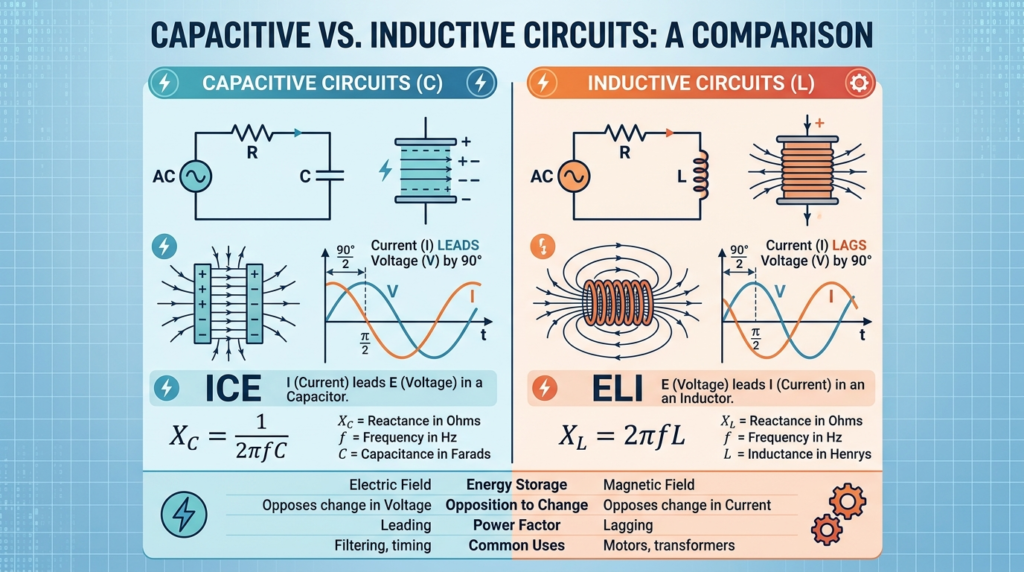
The capacitive vs inductive circuits working principle explains how capacitors and inductors behave differently when AC current flows through them. Capacitive circuits store energy in electric fields, while inductive circuits store energy in magnetic fields. Both play major roles in filters, motors, transformers, power supplies, and electronic control systems.
In this article, you will learn the difference between capacitive and inductive circuits, their working principles, types, components, advantages and disadvantages, applications, troubleshooting methods, selection guide, and future technologies in simple and easy English.
What Are Capacitive and Inductive Circuits?
Capacitive and inductive circuits are AC electrical circuits in which capacitors and inductors have an important effect on voltage, current, reactance, phase angle, and power factor. Understanding the difference between a capacitive circuit and an inductive circuit is essential for electrical students, engineers, and technicians working with AC systems.
A capacitive circuit mainly uses a capacitor, which stores electrical energy in an electric field. An inductive circuit mainly uses an inductor or coil, which stores energy in a magnetic field.
The two circuits respond differently to alternating current. The most important difference is their effect on the phase relationship between voltage and current.
Simple Explanation
A capacitor stores energy in an electric field and opposes changes in voltage.
An inductor stores energy in a magnetic field and opposes changes in current.
In an AC circuit:
- Capacitive circuit: Current leads voltage.
- Inductive circuit: Current lags voltage.
- Capacitive reactance: Decreases as frequency increases.
- Inductive reactance: Increases as frequency increases.
These differences are important when analyzing AC circuits, power factor, impedance, and reactive power.
Practical Examples of Capacitive Circuits
Capacitive circuits are commonly found in electrical and electronic systems where capacitors are used for energy storage, filtering, starting, or power factor correction.
Common examples include:
- Fan capacitor circuits: Capacitors help create the required phase shift for certain single-phase motors.
- Power factor correction systems: Capacitors can compensate for inductive reactive power.
- Electronic power supplies: Capacitors are commonly used for filtering and smoothing.
- Motor starting circuits: Capacitors can provide phase-shifting effects in suitable motor designs.
- Filter circuits: Capacitors are used to control AC signal behavior.
Practical Examples of Inductive Circuits
Inductive circuits contain coils or windings that produce a magnetic field when current flows through them.
Common examples include:
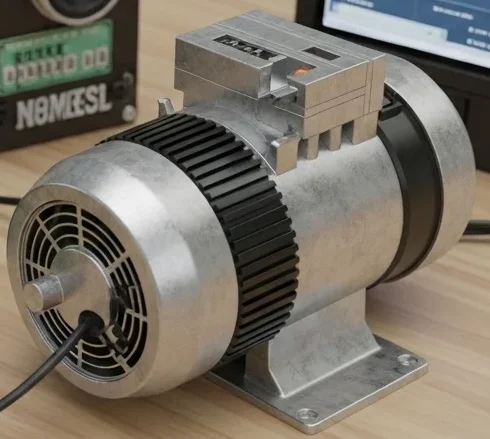
- Electric motors: Motor windings have inductive characteristics.
- Transformers: Transformer windings behave as inductive elements.
- Electromagnetic relays: Relay coils produce magnetic fields.
- Solenoids: Coils create magnetic force for mechanical movement.
- Chokes: Inductors are used to limit or control AC current.
Capacitive vs Inductive Circuits Working Principle
The working principle of capacitive and inductive circuits is based on how capacitors and inductors store and release energy when connected to an AC supply.
Although both components store energy, they do so in different forms and produce opposite phase relationships between voltage and current.
Capacitive Circuit Working Principle
A capacitor consists of conductive plates separated by an insulating material called a dielectric. When voltage is applied, electrical charge accumulates on the plates and an electric field develops between them.
In an AC circuit, the capacitor repeatedly charges and discharges as the supply voltage changes.
Voltage Is Applied
When an AC voltage is connected across a capacitor, the voltage causes charge to build up on the capacitor plates.
The amount of charge stored depends on the applied voltage and the capacitance of the component.
Electric Field Is Formed
As charge accumulates on the plates, an electric field develops between them. This electric field stores electrical energy.
The capacitor can later release this stored energy back into the circuit as the AC voltage changes.
Charging and Discharging Occur
With an AC supply, the capacitor does not remain permanently charged. Instead, it continuously charges and discharges as the polarity and magnitude of the supply change.
This repeated charging and discharging creates the characteristic capacitive response.
Current Leads Voltage
One of the most important characteristics of a capacitive circuit is that current leads voltage.
In an ideal capacitive circuit, the current reaches its maximum value before the voltage reaches its maximum value. This phase relationship is important when analyzing AC circuits and power factor.
Capacitive Reactance
A capacitor opposes the flow of AC through a quantity called capacitive reactance.
The capacitive reactance formula is:
Positive source: away; strength 2.26.
Q+−
+−
Give feedback
X₍C₎ = 1 / (2πfC)
Where:
- X₍C₎ = Capacitive reactance in ohms (Ω)
- f = Frequency in hertz (Hz)
- C = Capacitance in farads (F)
- π = Approximately 3.1416
How Frequency Affects Capacitive Reactance
Capacitive reactance has an inverse relationship with frequency.
When frequency increases, capacitive reactance decreases. When frequency decreases, capacitive reactance increases.
This is why capacitors behave differently at different AC frequencies and are widely used in filtering and power factor correction applications.
Inductive Circuit Working Principle
An inductive circuit contains an inductor, coil, or winding that stores electrical energy in a magnetic field.
When AC current flows through the coil, a magnetic field develops around it. The changing current continuously changes the magnetic field, producing an induced voltage that opposes changes in current.
Current Flows Through the Coil
When current flows through an inductor, a magnetic field is produced around the coil.
The strength of this magnetic field depends on the current and inductance of the component.
Magnetic Field Stores Energy
The inductor stores electrical energy in its magnetic field. As the AC current changes, the magnetic field also changes.
Induced Voltage Opposes Current Change
An inductor resists changes in current by producing an induced voltage. This behavior is known as inductive reactance.
Current Lags Voltage
In an ideal inductive circuit, current lags voltage by 90 degrees.
This is the opposite of an ideal capacitive circuit, where current leads voltage by 90 degrees.
Inductive Reactance
The inductive reactance of an inductor is calculated using:
X₍L₎ = 2πfL
Where:
- X₍L₎ = Inductive reactance in ohms (Ω)
- f = Frequency in hertz (Hz)
- L = Inductance in henries (H)
- π = Approximately 3.1416
How Frequency Affects Inductive Reactance
Inductive reactance has a direct relationship with frequency.
As frequency increases, inductive reactance increases. As frequency decreases, inductive reactance decreases.
This property makes inductors useful in applications where AC current needs to be limited or controlled.
Key Difference Between Capacitive and Inductive Circuits
The easiest way to remember the difference is:
Capacitive circuit → Current leads voltage
Inductive circuit → Current lags voltage
| Feature | Capacitive Circuit | Inductive Circuit |
|---|---|---|
| Main component | Capacitor | Inductor/coil |
| Stored energy | Electric field | Magnetic field |
| Reactance | Capacitive reactance (X₍C₎) | Inductive reactance (X₍L₎) |
| Frequency effect | Reactance decreases with frequency | Reactance increases with frequency |
| Current relationship | Current leads voltage | Current lags voltage |
| Common applications | Filtering, power factor correction, motor circuits | Motors, transformers, relays, chokes |
| Reactive power behavior | Capacitive | Inductive |
Inductive Circuit Working Principle
An inductive circuit is an electrical circuit that contains an inductor, coil, or another component that produces inductance. An inductor stores electrical energy in the form of a magnetic field when current flows through its winding.
The working principle of an inductive circuit is based on electromagnetic induction. When the current through a coil changes, the magnetic field also changes. This change produces an induced voltage that opposes the change in current.
In an AC inductive circuit, the most important characteristic is the relationship between voltage and current. In an ideal inductor, current lags voltage by 90°. This phase difference is important when understanding inductive reactance, power factor, motors, transformers, and other AC electrical systems.
Step-by-Step Working of an Inductive Circuit
1. Current Flows Through the Coil


4
When electric current flows through an inductor’s coil, it produces a magnetic field around the winding. The strength of this magnetic field depends mainly on the current flowing through the coil, the number of turns, and the magnetic properties of the core.
If the coil is wound around an iron or magnetic core, the core helps concentrate the magnetic flux and can significantly increase the inductance.
In simple terms, current flowing through a coil makes the coil behave like an electromagnet.
Inductive components based on this principle are widely used in:
- Electric motors
- Transformers
- Relays
- Solenoids
- Chokes
- Inductors and filters
2. Magnetic Field Develops
As current increases through the coil, a magnetic field develops around the winding. The changing current produces a changing magnetic field.
This magnetic field is the main reason an inductor can store energy and oppose sudden changes in current.
For an ideal inductor, the stored magnetic energy is:
W = ½LI²
Where:
- W = Stored magnetic energy in joules (J)
- L = Inductance in henries (H)
- I = Current in amperes (A)
3. Magnetic Energy Is Stored
The magnetic field around the coil temporarily stores energy. When the current changes, the inductor releases or absorbs energy depending on the direction of current change.
This energy-storage property makes inductors useful in power supplies, filters, switching circuits, and electrical control systems.
Unlike a resistor, an ideal inductor does not continuously consume electrical energy as heat. Instead, it stores and returns energy to the circuit.
4. Induced Voltage Opposes Current Change
One of the most important properties of an inductor is that it opposes changes in current.
When the current through the coil changes, an induced voltage is produced. According to Lenz’s law, this induced voltage acts in a direction that opposes the change that produced it.
The basic inductor voltage relationship is:
V = L(di/dt)
Where:
- V = Inductor voltage in volts (V)
- L = Inductance in henries (H)
- di/dt = Rate of change of current
This explains why an inductor does not allow current to change instantly in an ideal circuit.
5. Current Lags Voltage
In an AC inductive circuit, the voltage and current are not in phase.
For an ideal inductor, current lags voltage by 90°. This means the voltage reaches its peak before the current reaches its peak.
This is one of the key differences between capacitive and inductive circuits:
- Inductive circuit: Current lags voltage.
- Capacitive circuit: Current leads voltage.
In practical circuits, resistance and other components can reduce the phase angle, so the difference may not be exactly 90°.
Inductive Reactance Formula
The opposition offered by an inductor to AC is called inductive reactance. It is represented by XL and is measured in ohms (Ω).
The formula is:
XL = 2πfL
Where:
- XL = Inductive reactance in ohms (Ω)
- f = Frequency in hertz (Hz)
- L = Inductance in henries (H)
- π = Approximately 3.1416
How Frequency Affects Inductive Reactance
Inductive reactance increases when the frequency of an AC supply increases.
For example, if the frequency increases while inductance remains constant, the inductor provides greater opposition to the flow of AC current.
Therefore:
Higher frequency → Higher inductive reactance
Lower frequency → Lower inductive reactance
This property is useful in AC filters, communication circuits, power supplies, and other electrical systems where frequency control is important.
Simple Example of an Inductive Circuit
Consider a coil connected to an AC power supply. When AC voltage is applied, current flows through the coil and creates a magnetic field. As the AC current continuously changes direction and magnitude, the magnetic field also changes.
The changing magnetic field produces an opposing induced voltage. As a result, the current does not change instantly and lags behind the voltage.
Easy Analogy
Capacitor Analogy
A capacitor behaves like a water storage tank that fills and empties quickly.
Inductor Analogy
An inductor behaves like a heavy flywheel that resists sudden movement changes.
Types of Capacitive and Inductive Circuits
Capacitive and inductive circuits can be classified according to the components they contain and how they behave when connected to an AC supply. Common types include pure capacitive circuits, RC circuits, RL circuits, and RLC circuits.
The behavior of these circuits depends on resistance, capacitance, inductance, frequency, and the relationship between capacitive reactance (XC) and inductive reactance (XL).
Types of Capacitive Circuits
Pure Capacitive Circuit


6
A pure capacitive circuit contains an ideal capacitor connected to an AC power supply without resistance or inductance. When AC voltage is applied, the capacitor continuously charges and discharges as the supply voltage changes.
In an ideal pure capacitive circuit, the current leads the voltage by 90°. The capacitor stores energy in its electric field during part of the AC cycle and returns that energy to the source during another part of the cycle.
An ideal capacitor does not consume real power. Instead, it exchanges reactive power with the AC source.
Key Features
- Contains only capacitance.
- Current leads voltage by 90° in an ideal circuit.
- Capacitive reactance is given by XC = 1/(2πfC).
- Ideal average real power consumption is zero.
- Energy is stored in an electric field.
- Used to understand basic capacitive behavior in AC circuits.
RC Circuit


4
An RC circuit contains a resistor and a capacitor connected together. The resistor controls the current and affects the charging and discharging rate of the capacitor.
In a DC RC circuit, the capacitor charges gradually through the resistor. When the supply is removed, the stored energy is released through the circuit.
In an AC RC circuit, the capacitor creates a phase difference between voltage and current, while the resistor consumes real power. The circuit therefore behaves partly as a resistive circuit and partly as a capacitive circuit.
Main Characteristics
- Contains resistance and capacitance.
- The resistor limits current.
- The capacitor stores electrical energy.
- The circuit has a capacitive phase angle.
- Used in both AC and DC applications.
Applications of RC Circuits
- Timing circuits
- Signal filters
- Audio circuits
- Electronic control circuits
- Oscillator circuits
- Power supply filtering
- Signal processing
RLC Capacitive Circuit


An RLC circuit contains a resistor (R), inductor (L), and capacitor (C). The circuit behaves as a capacitive RLC circuit when the capacitive reactance is greater than the inductive reactance:
XC > XL
Under this condition, the net reactance is capacitive, so the circuit has a leading phase angle. In other words, the current leads the supply voltage by an angle that depends on the resistance and net reactance.
The resistor dissipates real power, while the capacitor and inductor store and exchange energy through their electric and magnetic fields.
Key Characteristics
- Contains resistance, inductance, and capacitance.
- XC > XL
- Net reactance is capacitive.
- Current leads voltage by the circuit’s phase angle.
- Used in frequency-selective and resonance-related applications.
Applications
- AC filters
- Tuning circuits
- Communication systems
- Signal-processing circuits
- Resonance circuits
- Power factor correction systems
Types of Inductive Circuits
Pure Inductive Circuit


4
A pure inductive circuit contains an ideal inductor connected to an AC power supply without resistance or capacitance.
When AC current flows through the inductor, a magnetic field develops around its winding. The inductor stores energy in this magnetic field and releases it back to the circuit as the current changes.
In an ideal pure inductive circuit, the current lags the voltage by 90°.
The inductive reactance is:
XL = 2πfL
Key Features
- Contains only inductance.
- Current lags voltage by 90° in an ideal circuit.
- Stores energy in a magnetic field.
- Inductive reactance increases as frequency increases.
- Ideal average real power consumption is zero.
- Exchanges reactive power with the AC source.
RL Circuit


5
An RL circuit consists of a resistor and an inductor connected together. The resistor limits current and consumes real power, while the inductor stores energy in its magnetic field.
When current changes through the inductor, the inductor produces an induced voltage that opposes the change in current.
In an AC RL circuit, the current generally lags the voltage because of the inductive effect. The actual phase angle depends on the resistance and inductive reactance.
Main Characteristics
- Contains resistance and inductance.
- Resistor controls current and dissipates power.
- Inductor stores magnetic energy.
- Current lags voltage.
- Used in electrical control and power circuits.
Applications of RL Circuits
- Motor circuits
- Relay circuits
- Solenoid circuits
- Electromagnetic control systems
- Choke circuits
- Filter circuits
RLC Inductive Circuit


4
An RLC inductive circuit contains a resistor, inductor, and capacitor. The circuit behaves predominantly as an inductive circuit when:
XL > XC
Under this condition, the net reactance is inductive and the current lags the voltage by the circuit’s phase angle.
The resistor dissipates real power, while the inductor and capacitor exchange stored energy between their magnetic and electric fields.
Key Characteristics
- Contains resistance, inductance, and capacitance.
- XL > XC
- Net reactance is inductive.
- Current lags voltage.
- The circuit has a lagging power factor.
- Used in AC power and frequency-selective circuits.
Applications
- Motor circuits
- AC filters
- Tuning networks
- Power system circuits
- Industrial electrical equipment
- Communication circuits
Capacitive, Inductive, and RLC Circuit Classification
The following table makes the classification easier to understand:
| Circuit Type | Main Components | Circuit Behavior | Phase Relationship |
|---|---|---|---|
| Pure Capacitive | C | Capacitive | Current leads voltage by 90° |
| RC Circuit | R + C | Partly capacitive | Current leads voltage |
| Pure Inductive | L | Inductive | Current lags voltage by 90° |
| RL Circuit | R + L | Partly inductive | Current lags voltage |
| RLC Capacitive | R + L + C | Capacitive | Current leads voltage |
| RLC Inductive | R + L + C | Inductive | Current lags voltage |
| RLC at Resonance | R + L + C | Resistive at series resonance | Voltage and current are in phase |
Important: In a practical circuit, the phase angle is usually less than 90° because resistance and other circuit elements are present.
Main Components of Capacitive and Inductive Circuits
Several electrical components are used to build capacitive, inductive, and mixed AC circuits.
Capacitor
A capacitor is an electrical component that stores energy in an electric field. It consists of conductive plates separated by an insulating material called a dielectric.
Capacitors are commonly used for filtering, energy storage, timing, coupling, motor applications, and power factor correction.
Common Capacitor Types
- Ceramic capacitor
- Electrolytic capacitor
- Film capacitor
- Tantalum capacitor
- Motor-run capacitor
- Motor-start capacitor
Inductor
An inductor is a coil of wire that stores energy in a magnetic field when current flows through it.
Inductors oppose changes in current and are widely used in filters, power supplies, motors, transformers, and control circuits.
Common Inductor Types
- Air-core inductor
- Iron-core inductor
- Ferrite-core inductor
- Toroidal inductor
- Choke coil
Resistor
A resistor limits current flow and produces a voltage drop in an electrical circuit. It also converts electrical energy into heat.
In RC, RL, and RLC circuits, resistance affects the current, power consumption, and phase angle of the circuit.
AC Power Supply
An AC power supply provides alternating voltage to the circuit. The frequency of the supply directly affects capacitive and inductive reactance.
For example:
Capacitive reactance:
XC = 1/(2πfC)
As frequency increases, XC decreases.
Inductive reactance:
XL = 2πfL
As frequency increases, XL increases.
Conductors and Wiring
Conductors provide the electrical path between the power source and circuit components. Proper conductor size, insulation, and connection methods are important for safe and reliable operation.
Loose or undersized wiring can cause overheating, voltage drop, poor performance, or electrical hazards.
Protection Devices
Protection devices help protect capacitive and inductive circuits from abnormal current and electrical faults.
Common Protection Devices
- Fuse
- Circuit breaker
- MCB
- Overload protection
- Surge protection devices
The correct protection method depends on the circuit design, voltage, current, equipment type, and applicable electrical standards.
Advantages of Capacitive and Inductive Circuits
Understanding the advantages and disadvantages of capacitive and inductive circuits helps electrical students, engineers, and technicians select the correct circuit for a particular application.
Advantages of Capacitive Circuits
- Useful for energy storage.
- Effective in filtering unwanted AC components.
- Can provide reactive power compensation.
- Useful in timing and signal-processing circuits.
- Capacitive reactance decreases as frequency increases.
- Widely used in electronic and electrical systems.
Advantages of Inductive Circuits
- Store energy in magnetic fields.
- Useful for filtering and controlling AC current.
- Essential for motors and transformers.
- Used in relays, solenoids, and electromagnetic devices.
- Inductors can limit high-frequency current.
- Important for electrical power and control systems.
Disadvantages of Capacitive and Inductive Circuits
Disadvantages of Capacitive Circuits
- Capacitors can retain electrical charge after the power supply is disconnected.
- Incorrect capacitor selection can cause circuit problems.
- Electrolytic capacitors can be damaged by incorrect polarity.
- Capacitive circuits can produce unwanted reactive current.
- High capacitance can affect inrush current and circuit behavior.
Disadvantages of Inductive Circuits
- Inductive loads can produce a lagging power factor.
- Large inductive loads may require reactive power compensation.
- Inductors can be physically large at low frequencies.
- Switching inductive loads can produce voltage spikes.
- Excessive inductive reactance can limit AC current.
Capacitive vs Inductive Circuits: Quick Comparison
| Feature | Capacitive Circuit | Inductive Circuit |
|---|---|---|
| Main component | Capacitor | Inductor |
| Energy storage | Electric field | Magnetic field |
| Opposition to AC | Capacitive reactance | Inductive reactance |
| Formula | XC = 1/(2πfC) | XL = 2πfL |
| Frequency effect | XC decreases with frequency | XL increases with frequency |
| Current relationship | Current leads voltage | Current lags voltage |
| Ideal phase angle | +90° current lead | 90° current lag |
| Power factor | Leading | Lagging |
| Common applications | Filters, timing, PFC | Motors, transformers, relays |
SEO Keywords to Use Naturally
For this section, I recommend targeting:
difference between capacitive and inductive circuits
Types of capacitive and inductive circuits
types of capacitive circuits
types of inductive circuits
capacitive circuit types
inductive circuit types
RC circuit
RL circuit
RLC circuit
RLC capacitive circuit
RLC inductive circuit
capacitive vs inductive circuits
Advantages of Capacitive Circuits
Improves power factor
Reduces reactive power
Useful in filtering applications
Supports voltage stabilization
Compact design
Advantages of Inductive Circuits
Energy storage capability
Useful in transformers and motors
Controls current changes
Electromagnetic operation support
Efficient magnetic energy transfer
Disadvantages / Limitations
Both circuit types also have practical limitations.
Disadvantages of Capacitive Circuits
Sensitive to voltage spikes
Limited energy storage
Capacitor aging problems
Leakage current issues
Disadvantages of Inductive Circuits
Magnetic losses occur
Voltage spikes during switching
Large inductors require more space
Electromagnetic interference possible
Capacitive vs Inductive Circuits Applications
Capacitive and inductive circuits are used in many electrical systems.
Home Applications
Capacitive Circuit Uses
Ceiling fan capacitors
LED drivers
Home appliances
Inductive Circuit Uses
Refrigerators
Washing machines
Air conditioners
Industrial Applications
Capacitive Applications
Power factor correction
Harmonic filters
Inductive Applications
Industrial motors
Transformers
Relays
Modern Technology Applications
Wireless charging systems
Communication equipment
Renewable energy systems
Electric vehicles
Smart electronics
Comparison Section
Difference Between Capacitive and Inductive Circuits
| Feature | Capacitive Circuit | Inductive Circuit |
| Main Component | Capacitor | Inductor |
| Energy Storage | Electric field | Magnetic field |
| Current Relationship | Current leads voltage | Voltage leads current |
| Reactance Formula | 1/2πfC | 2πfL |
| Power Factor Effect | Leading | Lagging |
| Common Applications | Filters, capacitors | Motors, transformers |
| Switching Behavior | Fast response | Slower response |
| Energy Loss | Low | Magnetic losses possible |
Selection Guide for Capacitive and Inductive Circuits
Choosing between a capacitive circuit, inductive circuit, RC circuit, RL circuit, or RLC circuit depends on the application, operating frequency, voltage, current, power factor, and required circuit behavior.
Before selecting a capacitor or inductor, always check its voltage, current, frequency, temperature, capacitance or inductance value, and applicable manufacturer specifications.
Choose Capacitive Circuits When
A capacitive circuit may be suitable when the application requires:
- Power factor correction for suitable inductive loads
- AC filtering and noise reduction
- Energy storage
- Timing and signal-processing functions
- Capacitive coupling or decoupling
- Reactive power compensation
- Compact electronic filtering
For power factor correction, capacitors are commonly used to offset part of the reactive power associated with inductive loads.
Choose Inductive Circuits When
An inductive circuit may be suitable when the application requires:
- Magnetic energy storage
- Current limiting or smoothing
- Motor operation
- Transformer operation
- Relay and solenoid operation
- Choking or filtering of AC signals
- Electromagnetic control
Inductors are especially important in electrical equipment where magnetic fields are used to transfer, store, or control energy.
Choose RLC Circuits When
An RLC circuit is useful when resistance, inductance, and capacitance need to work together for controlled frequency response.
RLC circuits are commonly used for:
- Frequency filtering
- Tuning circuits
- Resonance applications
- Communication systems
- Signal processing
- Frequency-selective networks
Tips for Beginners
Understanding a few basic concepts can make capacitive vs inductive circuits much easier to study and troubleshoot.
Study Voltage and Current Phase Relationships
The phase relationship between voltage and current is one of the most important concepts in AC circuits.
Remember:
Capacitive circuit: Current leads voltage.
Inductive circuit: Current lags voltage.
For ideal components, the phase difference is 90°. In practical circuits containing resistance, the phase angle is normally less than 90°.
Use Proper Component Ratings
Always select components according to the circuit’s operating conditions.
Check:
- Voltage rating
- Current rating
- Capacitance or inductance value
- Frequency rating
- Temperature rating
- Insulation requirements
- Manufacturer specifications
Using an incorrectly rated capacitor or inductor can cause overheating, insulation failure, poor performance, or component damage.
Avoid Overheating
Excessive temperature can shorten the life of capacitors, inductors, wiring, and other electrical components.
To reduce overheating:
- Use correctly rated components.
- Avoid continuous operation beyond rated limits.
- Provide adequate ventilation.
- Check for loose connections.
- Keep cooling paths clean.
- Investigate abnormal current or temperature.
Follow Electrical Safety Rules
Always disconnect and isolate the power supply before working on an electrical circuit.
For capacitors, remember that some types can remain charged after power is removed. Follow the manufacturer’s discharge procedure and use appropriate test equipment before touching the circuit.
For inductive circuits, switching can create high transient voltages, so suitable protection may be required.
Learn Capacitive and Inductive Reactance
Reactance is essential for understanding AC circuit behavior.
Capacitive reactance:
XC = 1/(2πfC)
As frequency increases, capacitive reactance decreases.
Inductive reactance:
XL = 2πfL
As frequency increases, inductive reactance increases.
Understanding these two formulas helps explain why capacitors and inductors respond differently to AC frequency.
Common Capacitive and Inductive Circuit Problems and Solutions
Why Is the Capacitor Overheating?
A capacitor may become excessively hot because of electrical stress, excessive ripple current, unsuitable operating conditions, poor ventilation, or an incorrect component rating.
Common Causes
- Overvoltage
- Excessive ripple current
- Incorrect capacitance
- High ambient temperature
- Poor ventilation
- Aging or damaged capacitor
- Harmonic currents in some power-system applications
Solution
- Check the capacitor’s voltage rating.
- Check its ripple-current rating where applicable.
- Verify the capacitance value.
- Improve ventilation and cooling.
- Inspect for physical damage or leakage.
- Replace a faulty capacitor with a correctly rated component.
Important: High frequency alone does not automatically mean a capacitor will overheat. The actual heating depends on factors such as ripple current, equivalent series resistance (ESR), frequency, temperature, and component construction.
Why Does the Inductor Produce Noise?
An inductor may produce humming, buzzing, or other audible noise when its magnetic field causes mechanical vibration.
Common Causes
- Loose winding
- Loose core or mounting
- Magnetostriction in the magnetic core
- Switching-frequency vibration
- Excessive current
- Damaged or poorly secured components
Solution
- Check the inductor mounting.
- Inspect the winding and core.
- Check operating current.
- Verify the component is suitable for the switching frequency.
- Replace a damaged or excessively noisy inductor when necessary.
Why Is the Power Factor Poor?
Poor power factor is commonly associated with inductive loads such as motors, transformers, and other magnetic equipment.
Common Causes
- Large inductive loads
- Lightly loaded motors
- Poor reactive power management
- Incorrectly sized compensation equipment
Solution
For suitable installations, power factor can be improved using correctly designed capacitor banks or automatic power factor correction systems.
The compensation system should be properly sized and designed for the actual load and harmonic conditions.
Why Does Voltage Drop Occur in an Inductive Circuit?
Voltage drop can occur because of conductor resistance, high current, long cable runs, or inductive reactance.
Common Causes
- Long conductors
- Undersized cables
- High circuit current
- High inductive reactance
- Loose electrical connections
- Poor circuit design
Solution
- Select an appropriate conductor size.
- Reduce unnecessary cable length where practical.
- Check and tighten electrical connections.
- Reduce excessive circuit current.
- Analyze inductive reactance in AC systems.
- Use appropriate compensation or circuit-design methods where required.
Why Does Switching an Inductive Load Produce Sparks?
Switching an inductive load such as a relay coil, solenoid, motor, or contactor can produce a high-voltage transient.
An inductor opposes sudden changes in current. When the current path is interrupted, the stored magnetic energy can produce a voltage spike. Across mechanical contacts, this voltage may cause arcing or sparking.
Common Causes
- Inductive voltage spikes
- Switching a coil without suppression
- Incorrect contact rating
- Rapid switching
- Long wiring connected to an inductive load
Solution
Depending on the circuit, suitable suppression may include:
- RC snubber
- Flyback diode for appropriate DC coils
- Varistor (MOV)
- TVS diode
- Properly rated contactor or relay
The suppression device must be selected according to the AC/DC voltage, coil type, switching arrangement, and manufacturer’s requirements.
Future Trends in Capacitive and Inductive Circuit Technology
Capacitive and inductive components remain important as electrical systems become more efficient, compact, automated, and connected.
Smart Power Factor Correction
Modern power systems increasingly use automatic power factor correction (APFC) systems.
These systems monitor electrical conditions and automatically switch capacitor stages according to changing load requirements.
This can help reduce unnecessary reactive power demand and improve overall system operation when properly designed.
Advanced Magnetic Materials
Modern inductors and magnetic components increasingly use improved core materials designed for lower losses and better high-frequency performance.
Advanced ferrite and other magnetic materials can help make inductors:
- Smaller
- More efficient
- Better suited to high-frequency operation
- Lower in power loss
These developments are particularly important in switching power supplies and power-electronic equipment.
Wireless Power Transfer
Wireless charging systems can use inductive coupling or capacitive coupling to transfer energy without a direct electrical connection.
Inductive wireless power transfer is widely used in applications such as:
- Wireless phone charging
- Electric toothbrush chargers
- Industrial charging systems
- Some electric vehicle charging technologies
The choice between inductive and capacitive coupling depends on the power level, distance, efficiency, frequency, and system design.
Electric Vehicle Technology
Electric vehicles use many capacitive and inductive components within their power-electronic systems.
Inductors are used in converters, filters, and energy-management circuits, while capacitors are used for DC-link filtering, energy buffering, noise suppression, and other functions.
Electric vehicle charging systems also use advanced power electronics to control voltage, current, and energy transfer.
Miniaturized Electronic Components
Modern electronic devices require smaller components while maintaining reliable electrical performance.
Advances in capacitor and inductor manufacturing allow designers to create increasingly compact:
- Smartphones
- Computers
- Power supplies
- Communication equipment
- Industrial controllers
- Consumer electronics
Miniaturization is especially important for high-frequency circuits and portable electronic devices.
Renewable Energy Integration
Solar and wind power systems use both capacitive and inductive components.
For example, power-electronic converters can contain inductors for current filtering and capacitors for DC-link voltage stabilization and filtering.
These components help power converters manage voltage, current, switching effects, and power quality when integrating renewable energy sources with electrical grids.
Advanced Power Electronics
Future electrical systems will increasingly depend on high-speed power electronics, intelligent control, and efficient passive components.
Improved capacitors, inductors, magnetic materials, sensors, and control systems can help make electrical equipment more efficient and reliable.
Key Takeaways
Correct component ratings and electrical safety practices are essential for reliable circuit operation.
Capacitive circuits store energy in an electric field.
Inductive circuits store energy in a magnetic field.
In an ideal capacitive circuit, current leads voltage by 90°.
In an ideal inductive circuit, current lags voltage by 90°.
XC decreases as frequency increases.
XL increases as frequency increases.
Capacitors can be used for suitable power factor correction.
Inductors are essential in motors, transformers, filters, and power electronics.
RLC circuits can behave as capacitive, inductive, or resistive depending on the relationship between XC and XL.
Conclusion
Capacitive and inductive circuits are fundamental parts of modern electrical and electronic systems. They control energy storage, voltage behavior, current flow, filtering, and power management in homes, industries, communication systems, and renewable energy applications.
The capacitive vs inductive circuits working principle explains how capacitors store energy in electric fields while inductors store energy in magnetic fields. Understanding the difference between capacitive and inductive circuits, their applications, advantages and disadvantages, and troubleshooting methods helps electrical students, engineers, technicians, and beginners develop strong technical knowledge and practical skills.
As electrical technology continues advancing, smart electronics, wireless charging systems, electric vehicles, renewable energy systems, and intelligent power management will increasingly depend on capacitive and inductive circuit technologies.