

Imagine you plug in an electric heater at home, and suddenly the circuit breaker trips. Why did it happen? Most likely, too much current was flowing in the circuit. Understanding how to calculate circuit current helps you prevent such problems and design safe electrical systems.
For electrical students, engineers, technicians, and beginners, learning how to calculate circuit current is one of the most important foundational skills. It is used in everything—from simple home wiring to complex industrial machines.
Knowing the current flowing in a circuit helps you choose the right wires, protect devices, and avoid overheating or damage. Without proper calculation, electrical systems can become unsafe and inefficient.
In this article, you will learn the how to calculate circuit current working principle, step-by-step methods, types of circuits, real-life applications, and common mistakes. By the end, you will be able to confidently calculate current in different types of electrical circuits.
2. What is How to Calculate Circuit Current?
How to calculate circuit current means finding the amount of electric current flowing through a circuit using known values like voltage and resistance.
Simple Explanation
Electric current is the flow of electrons in a conductor. To calculate it, you use basic electrical formulas that relate voltage, resistance, and current.
Practical Example
If you have:
- Voltage (V) = 12 volts
- Resistance (R) = 6 ohms
You can calculate current using a simple formula. The result tells you how much current flows through the circuit.
In simple terms, how to calculate circuit current is the process of determining how much electricity is moving through a wire or component.
3. Working Principle
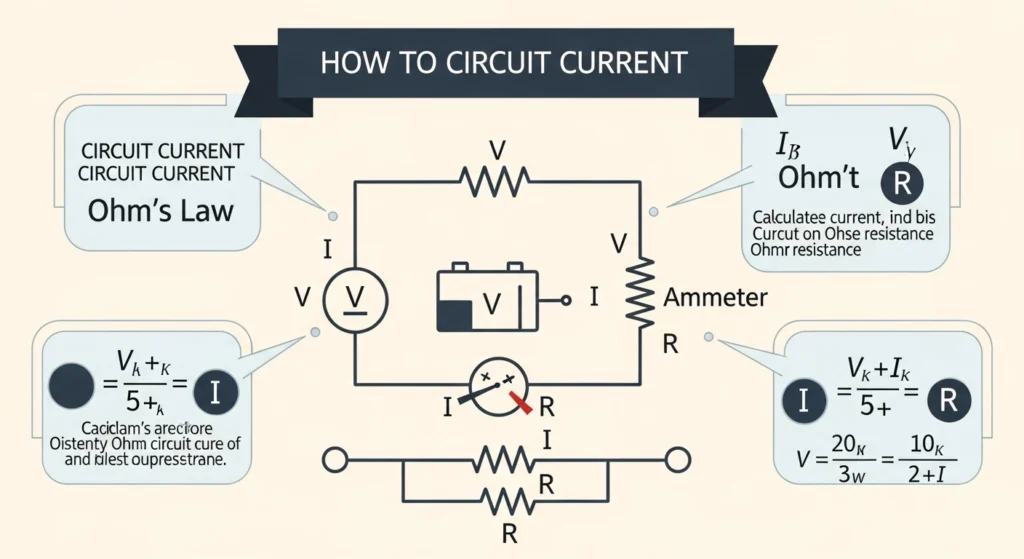
The how to calculate circuit current working principle is based mainly on Ohm’s Law.
genui{“math_block_widget_always_prefetch_v2”: {“content”: “I = \frac{V}{R}”}}
This formula shows:
- I = Current (Amperes)
- V = Voltage (Volts)
- R = Resistance (Ohms)
Step-by-Step Process
- Step 1: Identify known values
Find voltage and resistance in the circuit - Step 2: Apply the formula
Use Ohm’s Law - Step 3: Calculate current
Divide voltage by resistance - Step 4: Check units
Ensure values are in correct units
Easy Analogy
Think of water flowing through a pipe:
- Voltage = Water pressure
- Resistance = Pipe size
- Current = Water flow
Higher pressure or lower resistance increases the flow.
4. Types / Classification
There are different ways to calculate current depending on the circuit type.
Based on Circuit Type
Series Circuit
- Components are connected in one path
- Same current flows through all components
Formula:
- Total resistance = sum of all resistances
- Current = V / R_total
Parallel Circuit
- Components are connected in multiple paths
- Voltage is the same across each branch
- Total current = sum of branch currents
Series-Parallel Circuit
- Combination of both types
- Requires step-by-step simplification
Based on Current Type
DC Current Calculation
- Uses simple Ohm’s Law
- Values remain constant
AC Current Calculation
- Uses impedance instead of resistance
- More complex due to phase differences
5. Main Components
To calculate current, you need to understand the circuit elements.
Voltage Source
- Provides energy
- Example: Battery or power supply
Resistor
- Opposes current flow
- Determines current value
Conductor (Wire)
- Path for current flow
- Ideally has low resistance
Load
- Device consuming power
- Example: Bulb, motor
Measuring Instruments
- Ammeter: Measures current
- Voltmeter: Measures voltage
6. Advantages
How to Calculate Circuit Current Advantages and Disadvantages (Advantages)
- Helps design safe electrical systems
- Prevents overloading and damage
- Improves efficiency of circuits
- Essential for troubleshooting
- Supports proper component selection
- Reduces risk of electrical hazards
7. Disadvantages / Limitations
How to Calculate Circuit Current Advantages and Disadvantages (Limitations)
- Can be complex for large circuits
- Requires accurate input values
- AC calculations are more difficult
- Mistakes in units can lead to errors
- Real-world conditions may differ from theory
8. Applications
How to Calculate Circuit Current Applications
Home Applications
- Designing home wiring
- Selecting circuit breakers
- Checking appliance safety
Industrial Applications
- Machine operation analysis
- Power system design
- Load management
Modern Technology
- Electronics design
- Electric vehicles
- Renewable energy systems
- Smart devices and IoT
9. Comparison Section
Difference Between Current Calculation in Series vs Parallel Circuits
| Feature | Series Circuit | Parallel Circuit |
| Current | Same throughout | Divides into branches |
| Voltage | Divides across components | Same across all branches |
| Resistance | Adds up | Decreases overall |
| Calculation | Simple | Slightly complex |
| Failure Impact | Entire circuit stops | Other branches continue |
10. Selection Guide
Choosing the right method depends on your circuit.
Use Series Calculation When:
- Only one path exists
- Simple circuits are involved
Use Parallel Calculation When:
- Multiple branches exist
- Load sharing is required
Tips for Beginners
- Always draw the circuit diagram first
- Label all known values clearly
- Use consistent units (Volts, Ohms)
- Double-check calculations
- Start with simple problems
11. Common Problems & Solutions
Why is my calculated current incorrect?
Check units and formulas. Ensure resistance and voltage values are correct.
What is the difference between current in AC and DC?
DC is constant, while AC changes direction and magnitude over time.
Why does current increase when resistance decreases?
According to Ohm’s Law, current is inversely proportional to resistance.
Can I measure current directly?
Yes, using an ammeter connected in series with the circuit.
Why is current different in parallel branches?
Each branch has different resistance, so current divides accordingly.
12. Future Trends
The way we calculate and manage current is improving with technology.
- Smart meters for real-time current monitoring
- AI-based circuit analysis tools
- Advanced simulation software
- Smart grids and energy systems
- Integration with renewable energy
Engineers now use digital tools along with manual calculations for better accuracy and efficiency.
13. Conclusion
Learning how to calculate circuit current is a fundamental skill in electrical engineering. It helps you understand how electricity flows and ensures safe and efficient circuit design.
From simple series circuits to complex systems, the same basic principles apply. The how to calculate circuit current working principle using Ohm’s Law is the starting point for all calculations.
While there are challenges, especially in complex circuits, practice and understanding of basics make the process easier. Knowing the how to calculate circuit current applications also helps you apply this knowledge in real-world situations.
Keep practicing with different circuits, and over time, you will develop confidence and accuracy in your calculations.