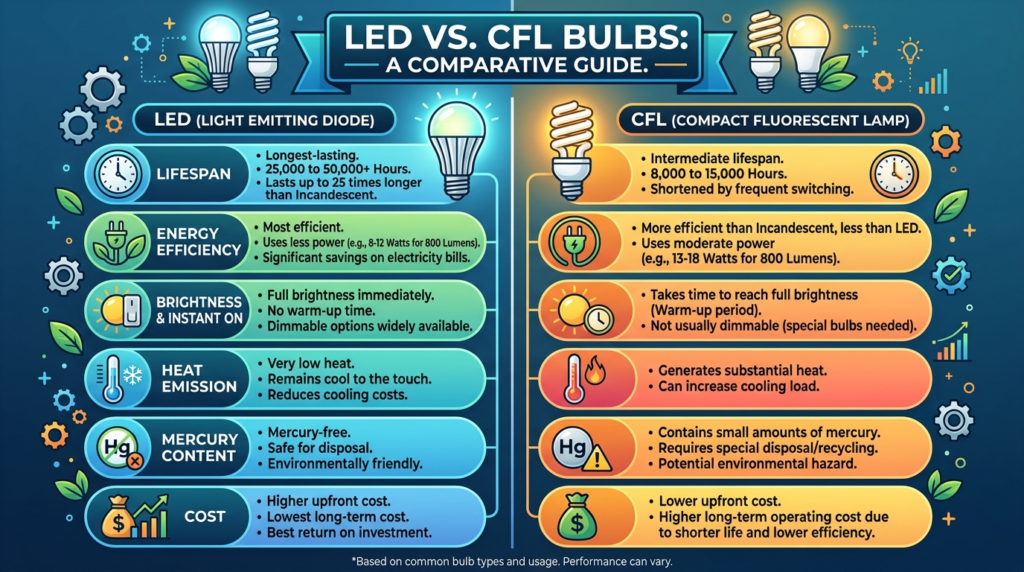

Imagine replacing an old room bulb and noticing that your electricity bill becomes lower while the room becomes brighter. This is a common experience when people switch from traditional lighting systems to modern energy-efficient bulbs like LED and CFL lamps. Today, LED and CFL bulbs are widely used in homes, offices, industries, schools, hospitals, and commercial buildings because they consume less electricity and provide better lighting performance.
Understanding the difference between LED and CFL bulbs is important for electrical students, engineers, technicians, and beginners. Choosing the right lighting technology affects energy consumption, maintenance costs, brightness, safety, and environmental impact. Many people become confused while selecting between LED and CFL bulbs because both are energy-saving options, but they work differently and offer different advantages.
Learning the LED vs CFL bulbs working principle helps users understand how these technologies convert electrical energy into light. It also helps in selecting the best bulb for homes, industries, and modern smart systems.
In this article, you will learn the complete comparison of LED vs CFL bulbs, including working principles, types, components, advantages and disadvantages, applications, troubleshooting, selection guide, and future lighting trends in simple and easy English.
What is LED vs CFL Bulbs?
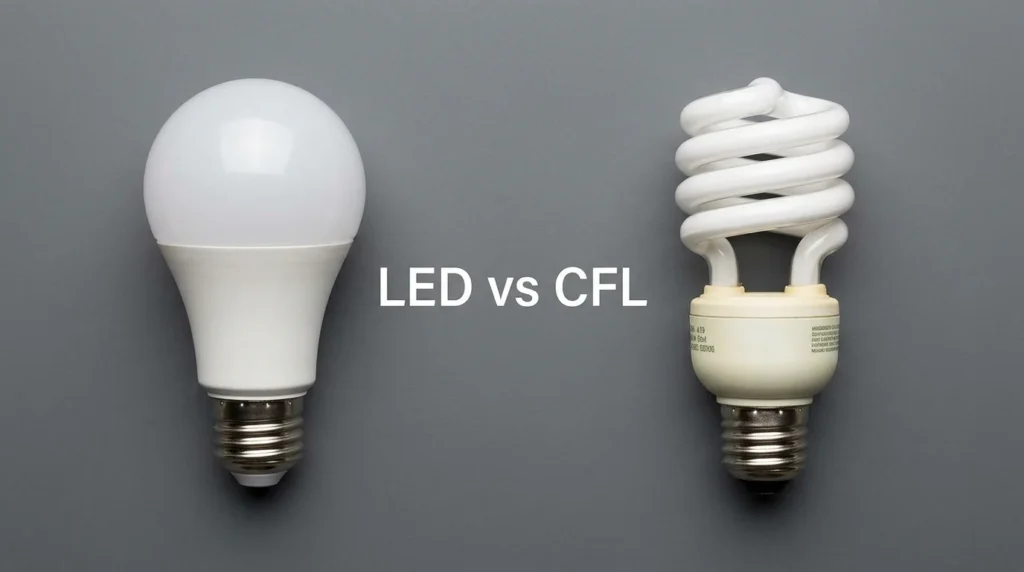
LED (Light Emitting Diode) and CFL (Compact Fluorescent Lamp) bulbs are two popular types of energy-efficient lighting, but they differ in performance and technology. LED bulbs produce light by passing electric current through semiconductor diodes, while CFL bulbs generate light by passing current through mercury vapor, which produces ultraviolet (UV) rays that are converted into visible light by a phosphor coating. LED bulbs consume less electricity, last much longer, turn on instantly, generate very little heat, and do not contain mercury. In contrast, CFL bulbs use more power than LEDs, take a short time to reach full brightness, produce more heat, and contain a small amount of mercury, requiring careful disposal. Because of their higher efficiency, longer lifespan, and environmental benefits, LED bulbs are now the preferred choice for most homes, offices, and industries.
What is an LED Bulb?
LED stands for Light Emitting Diode. An LED bulb produces light when electric current passes through a semiconductor material.
Unlike traditional bulbs, LEDs do not use a filament or gas to generate light. They are highly energy-efficient and long-lasting.
Practical Example
LED bulbs are commonly used in homes, street lights, televisions, decorative lighting, and smart lighting systems.
What is a CFL Bulb?
CFL stands for Compact Fluorescent Lamp. A CFL bulb produces light by passing electric current through a gas-filled tube.
The gas produces ultraviolet light, which then reacts with a phosphor coating inside the bulb to create visible light.
Practical Example
CFL bulbs are widely used in offices, homes, schools, and commercial buildings for general lighting purposes.
LED vs CFL Bulbs Working Principle
Understanding the LED vs CFL bulbs working principle makes it easier to compare their performance and efficiency.
LED Bulb Working Principle
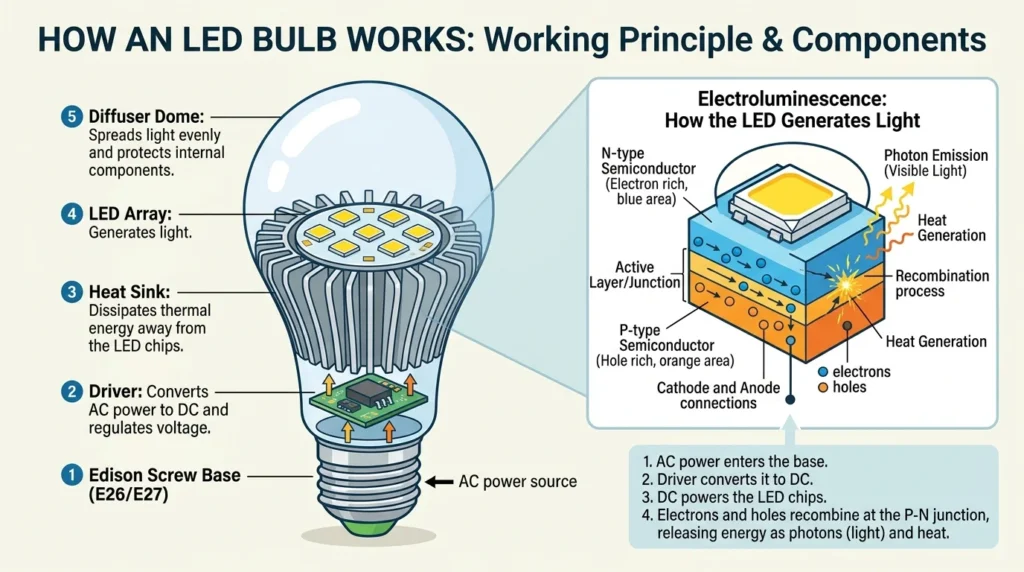
An LED (Light Emitting Diode) bulb works by passing electric current through a semiconductor diode. When the current flows across the p-n junction, electrons combine with holes and release energy in the form of visible light. This process is called electroluminescence. Inside the bulb, an LED driver converts the AC supply voltage into a suitable DC voltage and regulates the current to ensure safe and efficient operation. LED bulbs produce bright light instantly, consume very little electricity, generate less heat, and have a long service life, making them one of the most energy-efficient lighting technologies available.
An LED bulb works using semiconductor technology.
Step-by-Step Process
Electrical current enters the LED driver.
The driver controls voltage and current.
Current passes through the semiconductor diode.
Electrons release energy in the form of light.
The bulb produces illumination with minimal heat.
Easy Analogy
Think of LEDs like a controlled water nozzle that delivers light directly and efficiently without wasting much energy.
Important Feature
LEDs convert most electrical energy into light instead of heat.
CFL Bulb Working Principle
A CFL (Compact Fluorescent Lamp) bulb works by passing electric current through mercury vapor enclosed inside the glass tube. This produces ultraviolet (UV) rays, which are invisible to the human eye. The phosphor coating on the inside of the tube absorbs the UV rays and converts them into visible light through a process called fluorescence. An electronic ballast inside the CFL bulb regulates the current and provides the proper starting voltage for efficient operation. CFL bulbs consume less electricity than incandescent bulbs, produce less heat, and have a longer lifespan, making them a popular energy-saving lighting option.
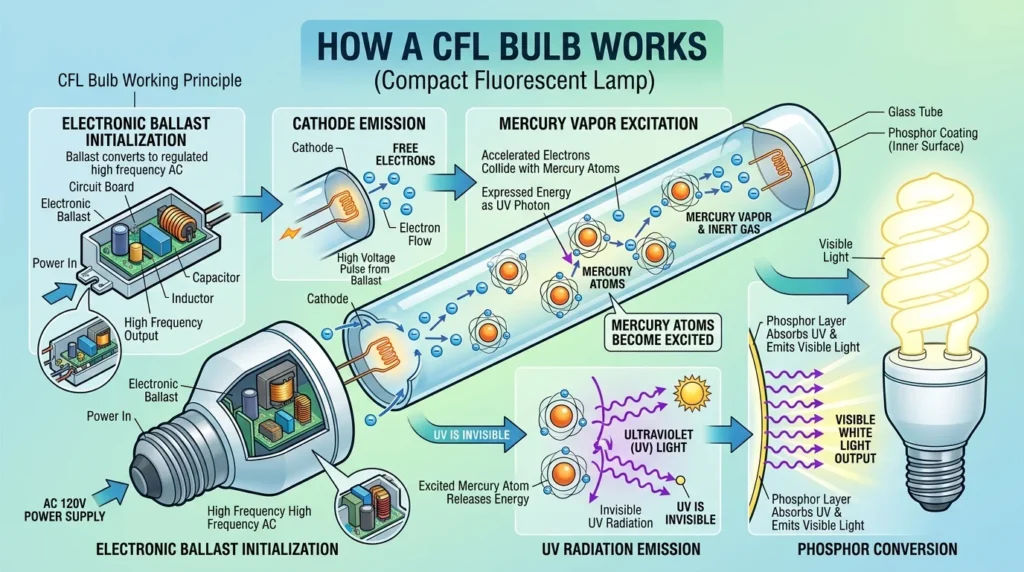
A CFL bulb works using gas discharge technology.
Step-by-Step Process
Electricity flows into the ballast circuit.
The ballast controls current flow.
Current passes through mercury vapor inside the tube.
Ultraviolet light is produced.
The phosphor coating converts UV light into visible light.
Easy Analogy
A CFL bulb works like a glowing gas tube where electricity excites gases to create light.
Important Feature
CFL bulbs generate more heat compared to LEDs.
Types / Classification
Types of LED Bulbs
Standard LED Bulbs
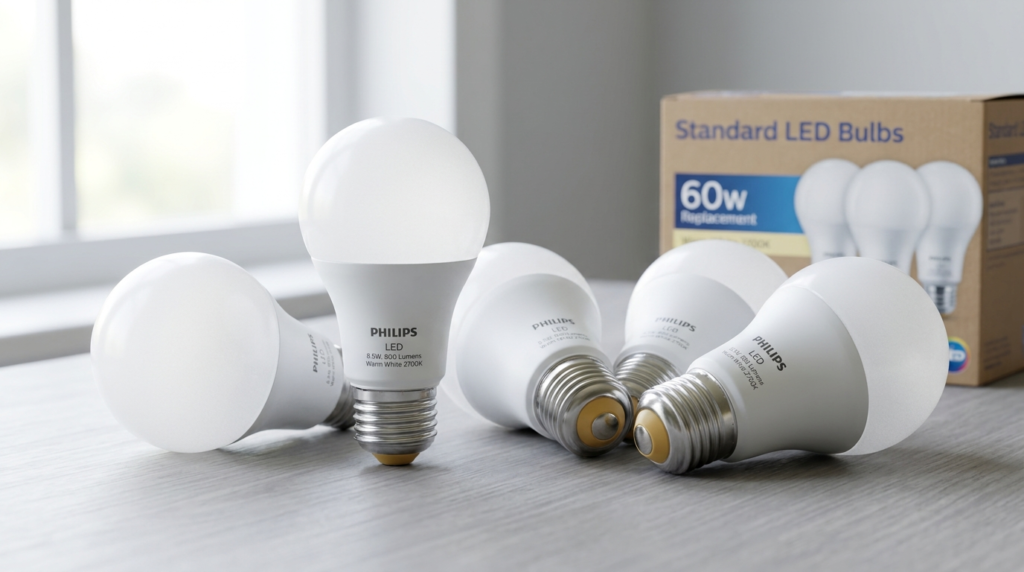
Standard LED bulbs are the most common type of LED lighting used in homes, offices, schools, and commercial buildings. They produce light by passing electric current through light-emitting diodes (LEDs), which convert electrical energy directly into visible light. An internal LED driver regulates the voltage and current for safe and efficient operation. Standard LED bulbs provide instant brightness, consume very little electricity, generate less heat, and have a much longer lifespan than incandescent and CFL bulbs. They are available in different wattages, color temperatures, and shapes, making them suitable for a wide range of general lighting applications.
These are the most common LED bulbs used in homes and offices.
Applications
Room lighting
Ceiling fixtures
Lamps
Smart LED Bulbs
Smart LEDs can connect with mobile apps or voice assistants.
Features
Remote control
Color changing
Brightness adjustment
Dimmable LED Bulbs
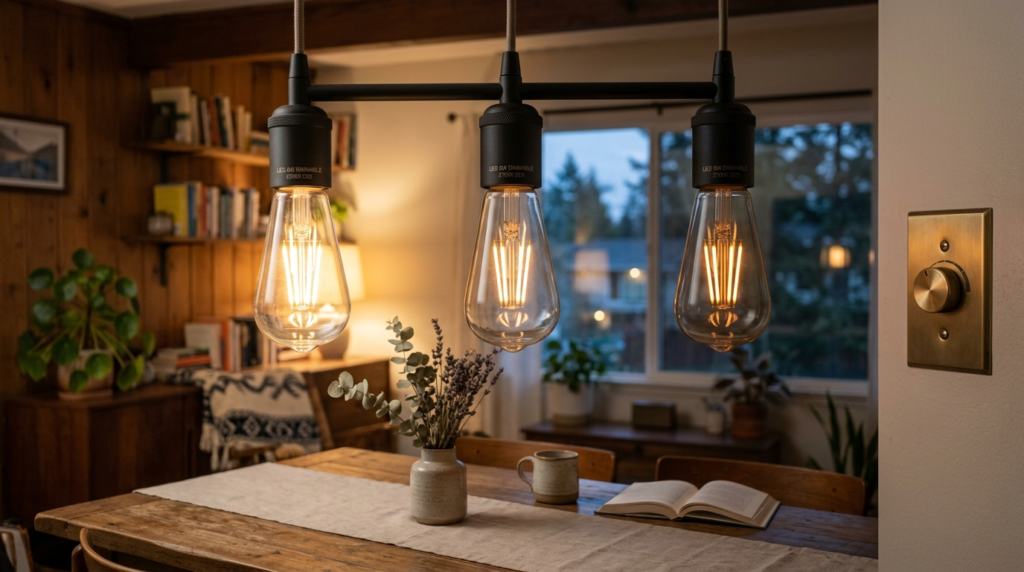
Dimmable LED bulbs are specially designed LED lamps that allow the brightness level to be adjusted using a compatible LED dimmer switch. They work like standard LED bulbs but include electronic circuits that respond to the dimmer by controlling the amount of current supplied to the LEDs. This allows users to increase or decrease the light output without affecting the bulb’s performance. Dimmable LED bulbs consume less electricity, produce less heat, have a long lifespan, and provide flexible lighting for homes, offices, hotels, restaurants, and other spaces where adjustable brightness is required.
These LEDs allow brightness control.
Applications
Decorative lighting
Restaurants
Conference rooms
High-Power LED Bulbs
Designed for industrial and outdoor lighting.
Applications
Street lights
Warehouses
Stadiums
Types of CFL Bulbs
Spiral CFL
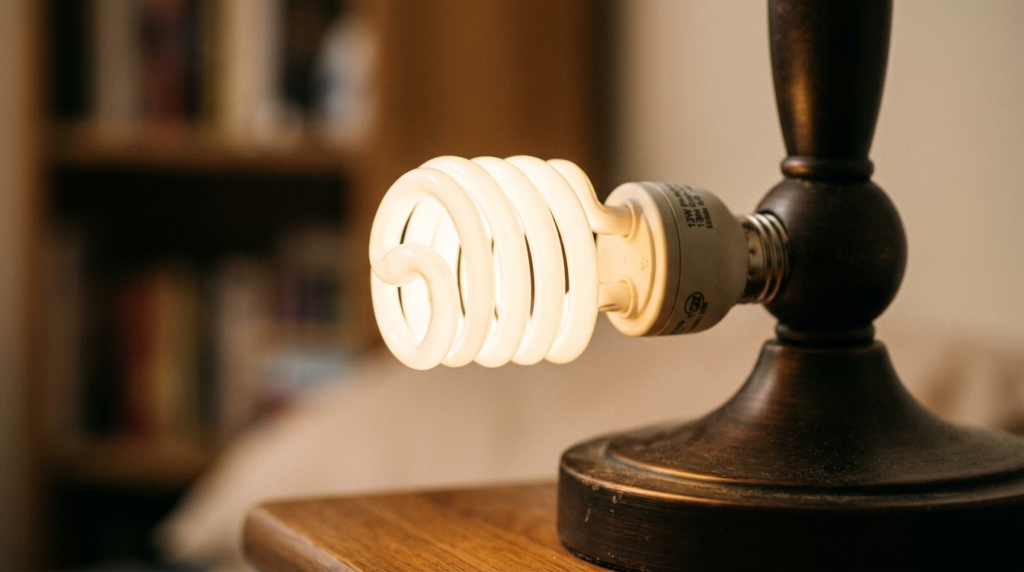
A Spiral CFL (Compact Fluorescent Lamp) is an energy-efficient light bulb that uses a spiral-shaped fluorescent tube to produce bright illumination while consuming less electricity than traditional incandescent bulbs. Inside the bulb, electric current passes through mercury vapor to generate ultraviolet (UV) rays, which are then converted into visible light by the phosphor coating on the inside of the tube. The spiral design allows a longer fluorescent tube to fit into a compact size, providing higher light output. Spiral CFL bulbs produce less heat, have a longer lifespan, and are commonly used in homes, offices, schools, and commercial buildings for energy-saving lighting.
The most common household CFL design.
Applications
Homes
Offices
Shops
Tube CFL
Long tubular shape for larger lighting systems.
Applications
Commercial buildings
Schools
Factories
Reflector CFL
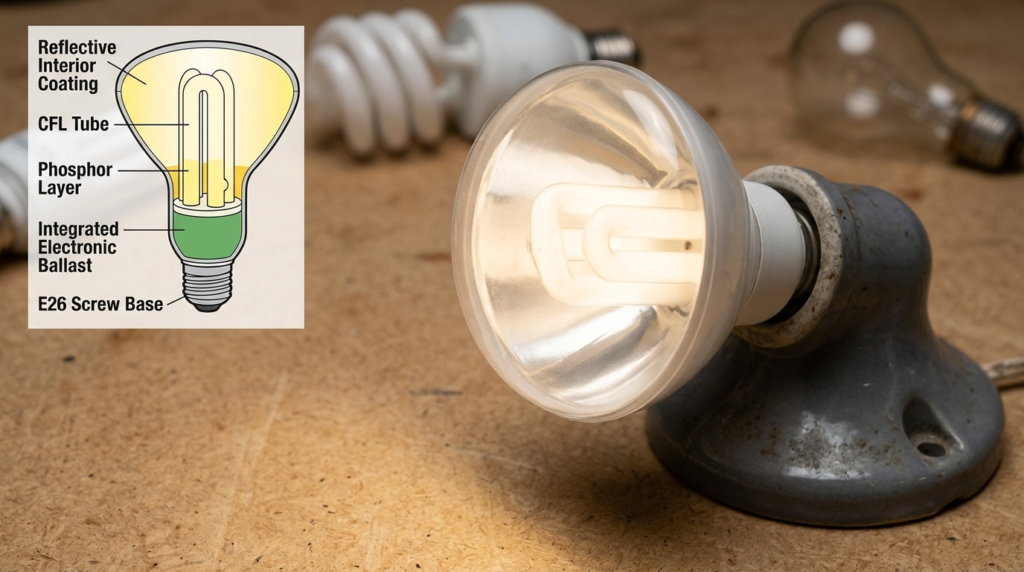
A Reflector CFL (Compact Fluorescent Lamp) is a type of energy-efficient light bulb designed with a built-in reflective surface that directs light in a specific direction instead of spreading it in all directions. It works on the same principle as a standard CFL, where electric current passes through mercury vapor to produce ultraviolet (UV) rays, and the phosphor coating converts these rays into visible light. The reflector improves light focus, making it ideal for spot lighting, recessed fixtures, display lighting, and task lighting. Reflector CFL bulbs consume less electricity, produce less heat, and have a longer lifespan than traditional incandescent reflector bulbs.
Designed to focus light in one direction.
Applications
Spot lighting
Display lighting
Integrated CFL
Contains a built-in ballast for easy installation.
Applications
Household use
Small commercial systems
Main Components
Main Components of LED Bulbs
LED Chip
The semiconductor component that produces light.
Driver Circuit
Controls voltage and current supplied to LEDs.
Heat Sink
Removes excess heat to improve lifespan.
Diffuser
Spreads light evenly in all directions.
Housing
Protects internal parts from damage.
Main Components of CFL Bulbs
Glass Tube
Contains gas and phosphor coating.
Mercury Vapor
Helps generate ultraviolet light.
Ballast
Controls starting voltage and current flow.
Electrodes
Start the electrical discharge process.
Base Connector
Connects the bulb to the power supply.
Advantages
Understanding LED vs CFL bulbs advantages and disadvantages helps users make better lighting decisions.
Advantages of LED Bulbs
Very high energy efficiency
Long lifespan
Low heat generation
Instant full brightness
Environmentally safer
Durable and shock resistant
Works well with smart systems
Lower maintenance costs
Better brightness control
Suitable for frequent switching
Advantages of CFL Bulbs
Lower energy consumption than incandescent bulbs
Lower initial cost than some LEDs
Available in many sizes
Good brightness output
Suitable for general lighting
Better efficiency than traditional bulbs
Disadvantages / Limitations
Disadvantages of LED Bulbs
Higher initial purchase cost
Sensitive to poor-quality drivers
Heat management required in high-power LEDs
Cheap LEDs may flicker
Disadvantages of CFL Bulbs
Contains mercury
Slower startup time
Shorter lifespan than LEDs
More heat generation
Sensitive to frequent ON/OFF switching
Difficult disposal process
Reduced efficiency in cold temperatures
LED vs CFL Bulbs Applications
LED vs CFL bulbs applications are found in almost every lighting system today.
LED Applications
Home Applications
Room lighting
Kitchen lighting
Smart homes
Commercial Applications
Offices
Shopping malls
Hotels
Industrial Applications
Warehouses
Factories
High-bay lighting
Modern Technology Uses
Smart lighting systems
Automotive lighting
Display systems
Solar lighting
CFL Applications
Home Uses
General room lighting
Table lamps
Commercial Uses
Schools
Offices
Retail shops
Outdoor Uses
Garden lighting
Public buildings
Comparison Section
Difference Between LED and CFL Bulbs
| Feature | LED Bulb | CFL Bulb |
| Full Form | Light Emitting Diode | Compact Fluorescent Lamp |
| Working Method | Semiconductor | Gas discharge |
| Energy Efficiency | Very high | Moderate |
| Lifespan | 25,000–50,000 hours | 6,000–15,000 hours |
| Heat Production | Very low | Higher |
| Startup Time | Instant | Slight delay |
| Environmental Safety | Safer | Contains mercury |
| Durability | High | Moderate |
| Frequent Switching | No problem | Reduces lifespan |
| Cost | Higher initial cost | Lower initial cost |
| Maintenance | Low | Moderate |
| Smart Compatibility | Excellent | Limited |
Selection Guide
Choosing the right bulb depends on application, budget, and energy requirements.
Choose LED Bulbs When
Long lifespan is important
Energy savings are required
Smart systems are used
Frequent switching occurs
Low maintenance is preferred
Choose CFL Bulbs When
- Initial budget is limited
- Basic lighting is needed
- Moderate energy efficiency is acceptable
Tips for Beginners
Check Wattage
Lower wattage LEDs can produce high brightness.
Consider Color Temperature
- Warm white for homes
- Cool white for offices
Look for Certifications
Buy quality products from reliable manufacturers.
Think About Long-Term Savings
LEDs cost more initially but save money over time.
Common Problems & Solutions
Why Does an LED Bulb Flicker?
Poor driver quality
Voltage fluctuations
Loose connection
Use quality drivers
Tighten connections
Check supply voltage
Why Does a CFL Bulb Start Slowly?
CFL bulbs require time to ionize internal gas.
Allow startup time
Replace aging bulb if necessary
Why Do Bulbs Overheat?
Poor ventilation or overload can cause overheating.
Improve airflow
Use correct wattage
Why Does an LED Bulb Dim Over Time?
Dust, heat, or driver failure may reduce brightness.
Clean fixtures
Replace damaged driver
Why Is CFL Disposal Important?
CFL bulbs contain mercury, which is harmful to the environment.
Solution
Dispose of CFLs using proper recycling methods.
Future Trends
Lighting technology is rapidly improving with modern energy-saving systems.
Smart LED Technology
Modern LEDs support automation and remote control systems.
Features
- Voice control
- Wi-Fi connectivity
- Motion sensing
Human-Centric Lighting
Future lighting systems will adjust brightness and color according to human comfort and health.
Solar-Powered Lighting
LEDs are becoming popular in solar lighting systems because of low power consumption.
Internet of Things (IoT)
IoT-based lighting systems allow remote monitoring and automatic control.
Sustainable Lighting Solutions
Future lighting technology focuses on energy efficiency, environmental protection, and reduced carbon emissions.
Conclusion
Understanding LED vs CFL bulbs is important for selecting the right lighting solution for homes, industries, and modern technology systems. LED bulbs offer excellent energy efficiency, longer lifespan, lower maintenance, and better environmental safety compared to CFL bulbs. On the other hand, CFL bulbs provide a lower initial cost and are still useful for basic lighting applications.
The difference between LED and CFL bulbs mainly depends on their working principle, efficiency, durability, heat production, and environmental impact. As electrical technology continues to advance, LED lighting is becoming the preferred choice in most applications due to its smart features and long-term cost savings.
For students, technicians, engineers, and beginners, learning about lighting systems improves practical electrical knowledge and helps in making better energy-efficient decisions for the future.