
Imagine a 3D printer carefully building a model layer by layer. Every tiny movement of the print head must be precise—just a fraction of a millimeter. If it moves too much or too little, the entire print fails. This precise motion control is made possible by a special type of motor called a stepper motor.
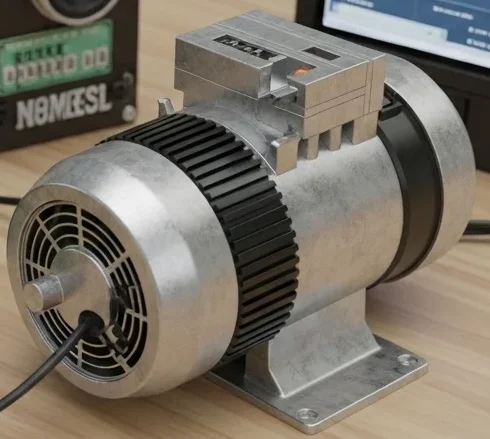
The Stepper Motor explained concept is very important for electrical students, engineers, and technicians working in automation, robotics, CNC machines, and embedded systems. Unlike normal motors that rotate continuously, stepper motors move in fixed steps, allowing extremely accurate control of position and speed.
Understanding stepper motors helps in designing systems where precision is more important than speed. From printers and cameras to industrial machines, they are widely used in modern technology.
In this article, you will learn what a stepper motor is, how it works, its types, components, advantages and disadvantages, applications, comparison with other motors, and practical selection tips. By the end, you will have a strong and practical understanding of stepper motor technology.
2. What is Stepper Motor?
Definition
A stepper motor is an electric motor that rotates in fixed angular steps instead of continuous motion.
Simple Explanation
- It moves in small, equal steps
- Each electrical pulse moves the motor by one step
- It allows precise control of position
Practical Example
In a 3D printer:
- Each step moves the print head slightly
- Thousands of steps create accurate shapes
- No need for sensors in many cases
3. Working Principle
Stepper Motor Working Principle
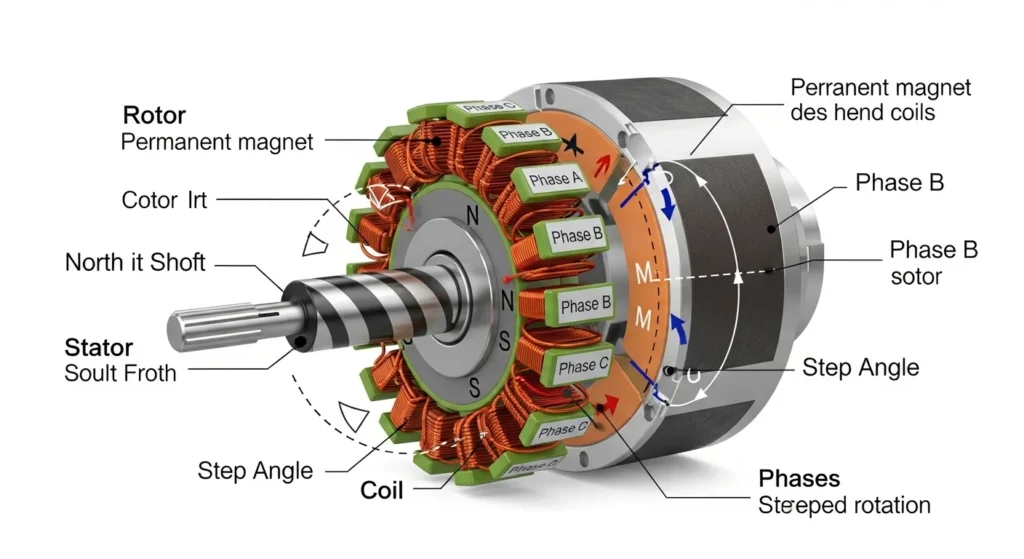
The stepper motor working principle is based on electromagnetic attraction and controlled switching of windings.
Step-by-Step Explanation
- Electrical pulses are sent to motor windings
- Each pulse energizes a coil in sequence
- Magnetic fields are created in stator poles
- Rotor aligns itself with the magnetic field
- Each pulse rotates the motor by a fixed angle
Easy Analogy
Think of a stepper motor like walking on stairs:
- Each step = one fixed movement
- You cannot move smoothly like a ramp
- You move step-by-step in a controlled way
Key Points
- Motion is controlled by pulses
- Position is known without feedback (in many cases)
- High accuracy in positioning
4. Types / Classification
Types of Stepper Motors
Permanent Magnet Stepper Motor
A Permanent Magnet Stepper Motor (PM Stepper Motor) is a type of stepper motor that uses a permanent magnet rotor to produce motion in precise step-by-step movements. In this motor, the rotor is made of a permanent magnet material, while the stator contains multiple windings. When electrical pulses are applied to the stator windings in a specific sequence, a rotating magnetic field is created. This field interacts with the permanent magnet rotor, causing it to align with the magnetic poles and move in fixed angular steps.
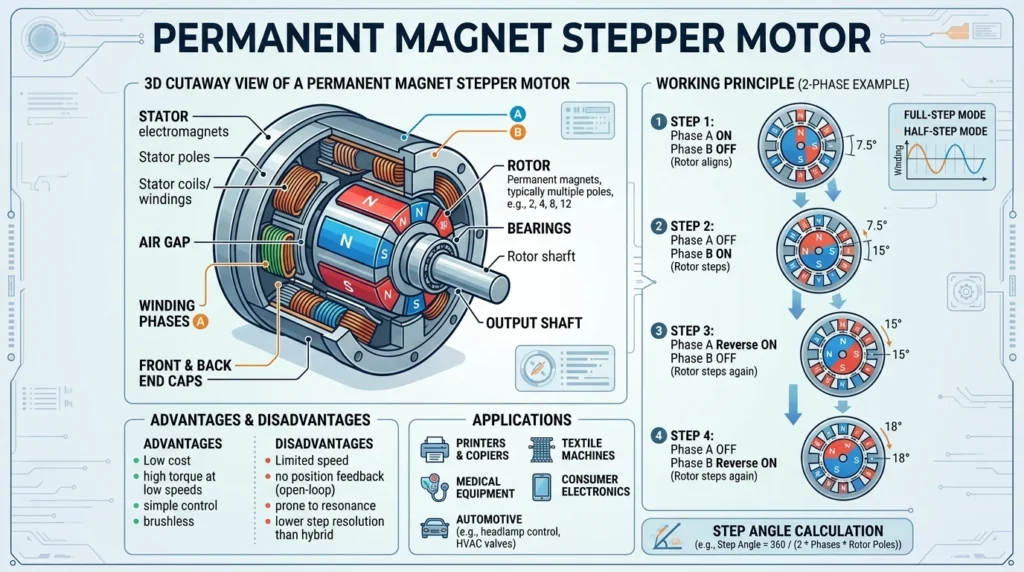
Each input pulse rotates the motor by a specific angle called the step angle. By controlling the number of pulses, we can accurately control the position, speed, and direction of the motor. Permanent magnet stepper motors are widely used in applications requiring precise positioning and control, such as printers, CNC machines, robotics, cameras, and automation systems. Their simple construction, high reliability, and accurate control make them very useful in modern electromechanical systems.
- Uses permanent magnets in rotor
- Good torque at low speed
- Simple design
Variable Reluctance Stepper Motor
A Variable Reluctance Stepper Motor (VR Stepper Motor) is a type of stepper motor that works on the principle of minimizing magnetic reluctance in the magnetic circuit. In this motor, the rotor is made of soft iron with no permanent magnet, and it has a toothed structure. The stator contains multiple windings that are energized in a specific sequence to create a rotating magnetic field. When current is supplied to the stator windings, the rotor aligns itself with the position of minimum reluctance, meaning it tries to move to the path where magnetic resistance is lowest.
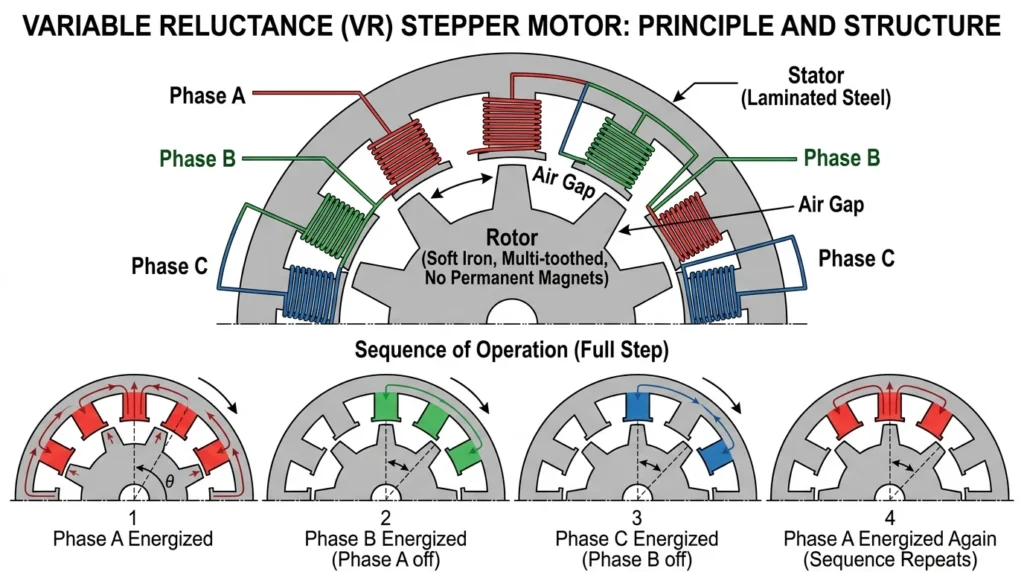
As the stator phases are energized one after another, the rotor moves in small, precise steps, allowing accurate control of position and speed. Since the rotor has no permanent magnet, it is lightweight and can respond quickly to changes in the magnetic field. Variable reluctance stepper motors are commonly used in applications such as instrumentation systems, automation equipment, robotics, and control systems where precise positioning and fast response are required.
- Rotor made of soft iron
- No permanent magnets
- Lower cost but less torque
Hybrid Stepper Motor
A Hybrid Stepper Motor is a combination of both Permanent Magnet and Variable Reluctance stepper motor designs, making it more efficient and precise than either type alone. It uses a rotor that has both a permanent magnet and toothed soft iron structure, which helps in achieving high torque and accurate positioning. The stator contains multiple windings that are energized in sequence, creating a rotating magnetic field. This field interacts with the rotor, causing it to move in small, controlled step angles.
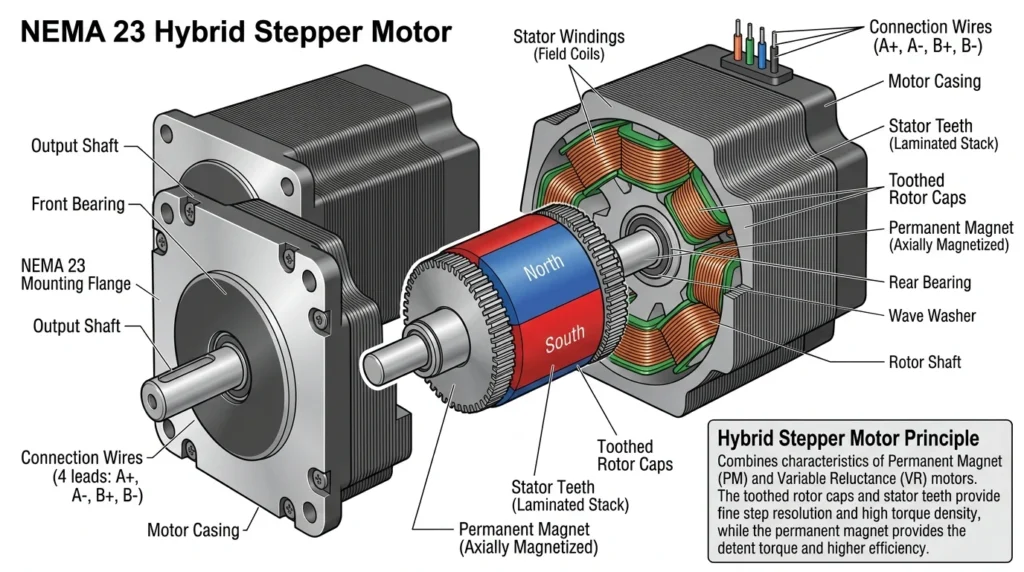
The hybrid design improves performance by providing higher torque at low speeds, better accuracy, and smoother operation. Each input pulse moves the rotor by a fixed step angle, allowing precise control of position, speed, and direction. Due to these advantages, hybrid stepper motors are widely used in CNC machines, 3D printers, robotics, medical equipment, and industrial automation systems. Their reliability, efficiency, and precision make them the most commonly used type of stepper motor in modern applications.
- Combination of permanent magnet and variable reluctance
- High precision and torque
- Most commonly used type
Unipolar Stepper Motor
A Unipolar Stepper Motor is a type of stepper motor in which each phase winding has a center tap, allowing current to flow in one direction through half of the winding at a time. This design makes the driving circuit simpler because the direction of current does not need to be reversed. Instead, the motor works by energizing different halves of the windings in a specific sequence, creating a rotating magnetic field that moves the rotor in fixed step angles.
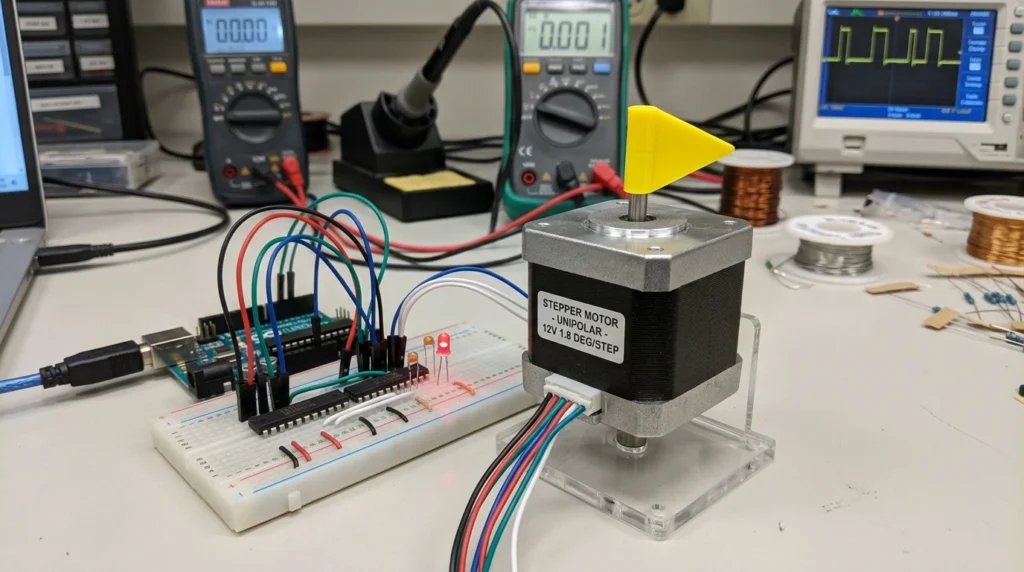
When electrical pulses are applied to the stator windings in a controlled order, the rotor aligns itself step by step with the magnetic field, providing accurate control of position and speed. Due to its simple driver circuitry and easy control method, the unipolar stepper motor is widely used in low-power applications such as printers, small robotics, cameras, and positioning systems. However, it generally produces less torque compared to bipolar stepper motors because only half of the winding is used at a time.
- Simple driving circuit
- Easier control
- Lower torque compared to bipolar
Bipolar Stepper Motor
A Bipolar Stepper Motor is a type of stepper motor that uses a single winding per phase without a center tap. In this motor, the direction of current in the windings must be reversed using an external driver circuit, such as an H-bridge, to create the required magnetic field for rotation. When electrical pulses are applied in a specific sequence, the stator windings are energized alternately in opposite directions, producing a rotating magnetic field that moves the rotor in fixed step angles.
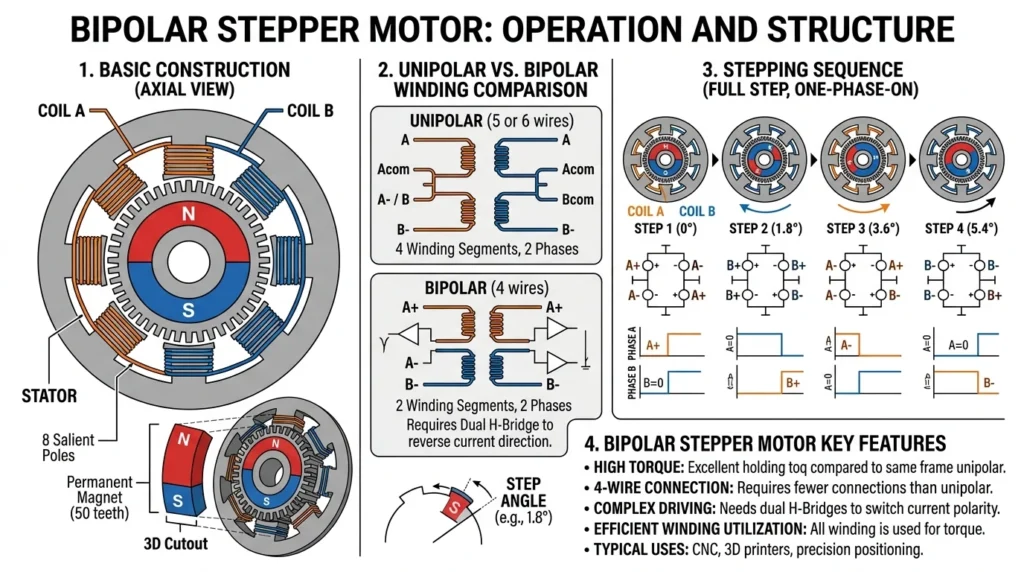
Because the entire winding is used in both directions, a bipolar stepper motor generates higher torque compared to a unipolar stepper motor of the same size. It also offers better efficiency and stronger magnetic performance. However, it requires a more complex driver circuit to control current direction. Bipolar stepper motors are widely used in applications such as CNC machines, 3D printers, robotics, industrial automation, and precision positioning systems where higher torque and accurate control are required.
- Uses full winding for higher torque
- Requires complex driver
- More efficient performance
5. Main Components
Key Components of Stepper Motor
Stator
- Stationary part
- Contains multiple windings
- Creates magnetic field
Rotor
- Rotating part
- Moves in steps
- Made of magnets or iron
Windings (Coils)
- Carry current
- Produce magnetic fields
Driver Circuit
- Sends pulses to motor
- Controls direction and speed
Controller (Microcontroller)
- Generates control signals
- Determines step sequence
6. Advantages
Stepper Motor Advantages and Disadvantages (Benefits)
- High precision positioning
- No feedback system required in many cases
- Simple control using pulses
- Good low-speed torque
- Reliable and durable
- Easy integration with electronics
- Cost-effective for precision systems
7. Disadvantages / Limitations
Stepper Motor Disadvantages
- Low efficiency at high speed
- Can lose steps under heavy load
- Vibrations at certain speeds
- Not suitable for very high-speed applications
- Generates heat during operation
- Requires proper driver circuit
8. Applications
Stepper Motor Applications
Home Applications
- Printers
- Cameras (zoom control)
- Home automation devices
Industrial Applications
- CNC machines
- Robotics arms
- Packaging machines
- Textile machines
Modern Technology
- 3D printers
- Medical equipment
- Surveillance systems
- Aerospace instruments
Stepper motors are essential where precision control is required.
9. Comparison Section
Difference Between Stepper Motor and Servo Motor
| Feature | Stepper Motor | Servo Motor |
| Movement | Fixed steps | Continuous smooth motion |
| Accuracy | High (open loop) | Very high (feedback system) |
| Cost | Lower | Higher |
| Control | Simple pulses | Complex control system |
| Speed | Moderate | High |
| Applications | Printers, CNC | Robotics, automation |
10. Selection Guide
How to Choose a Stepper Motor
Key Factors
- Required torque
- Speed range
- Load type
- Accuracy requirement
- Driver compatibility
Tips for Beginners
- Use hybrid stepper motors for best performance
- Choose proper driver IC
- Avoid overloading motor
- Use cooling for long operation
- Match voltage and current ratings
11. Common Problems & Solutions
Why does my stepper motor skip steps?
Due to overload or insufficient torque.
Why is the motor vibrating?
Incorrect stepping sequence or low speed operation.
Can stepper motors run continuously?
Yes, but they are more efficient at controlled movements.
Why is the motor heating?
Continuous current flow in coils generates heat.
How to increase accuracy?
Use microstepping drivers and proper calibration.
12. Future Trends
Stepper motor technology is evolving with modern systems:
- Microstepping Drivers: Smoother motion
- Smart Controllers: AI-based movement control
- Energy Efficient Designs
- Integration with IoT Systems
- Hybrid Systems with Servo Features
These improvements make stepper motors more precise and efficient.
13. Conclusion
The Stepper Motor explained concept shows how controlled motion is achieved in modern electrical systems. Stepper motors provide precise, step-by-step movement, making them ideal for applications like CNC machines, 3D printers, and robotics.
By understanding their working principle, types, components, and limitations, engineers and students can choose the right motor for the right application. Although they are not suitable for high-speed operations, their accuracy and simplicity make them extremely valuable in automation systems.
As technology advances, stepper motors will continue to improve in efficiency, precision, and smart control integration, making them even more important in modern engineering.