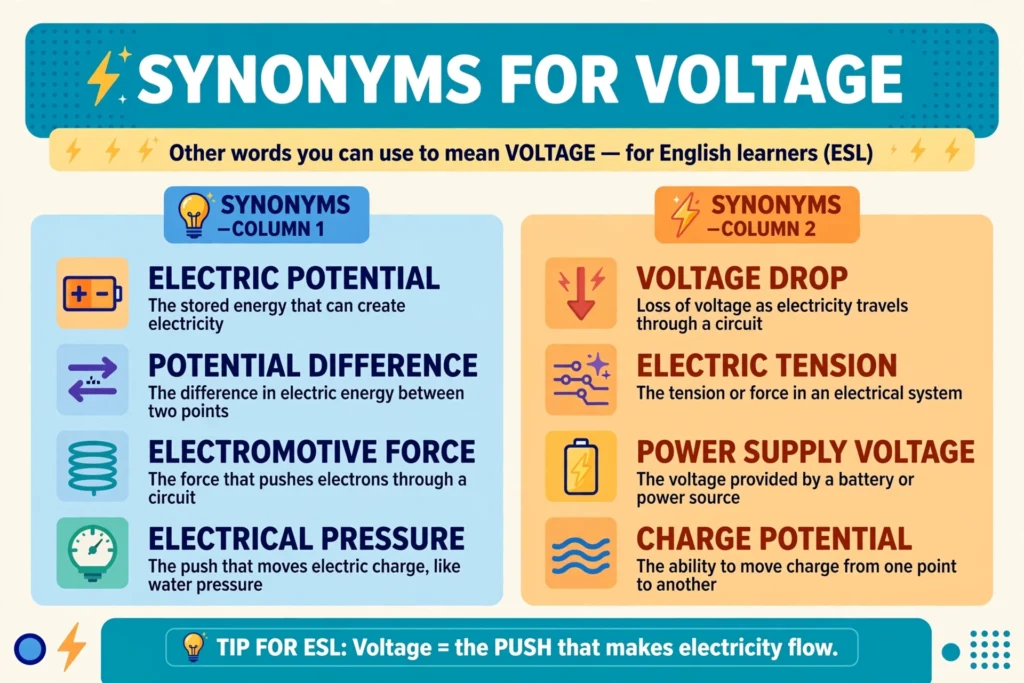

Voltage is technically a nickname — the proper name of the quantity is electric potential difference, and “voltage” is just the everyday short form named after Alessandro Volta. Engineers, textbooks, and old-timers each have their own preferred alternatives, and knowing them helps you read datasheets, exam questions, and classic texts without stumbling.
Here are seven technical alternatives for voltage, with meanings and examples. For the concept itself, see what is voltage.
Potential Difference
Meaning: The formal scientific name — the difference in electric potential between two points, which is what drives current to flow. This is the term examiners expect.
Example: The potential difference across the resistor is 12 volts.
Another example: A voltmeter measures potential difference between its two probes.
Electromotive Force (EMF)
Meaning: The voltage generated by a source — a battery, generator, or solar cell — before any losses. Despite the word “force,” it is measured in volts, not newtons.
Example: The battery’s EMF is 12.6 V, but the terminal voltage drops under load.
Another example: A spinning generator produces EMF by electromagnetic induction.
Electric Potential
Meaning: The potential energy per unit charge at a single point — voltage is the difference between two such potentials. Common in physics and in our guide to electric potential.
Example: The electric potential at the live terminal is 230 V above earth.
Another example: Birds can sit on high-voltage lines because the electric potential is the same under both feet.
Potential
Meaning: The shortened form engineers use in speech — “what’s the potential on that busbar?” Always means electric potential in context.
Example: The neutral should sit at zero potential.
Another example: A floating potential on the chassis means the earthing has failed.
Voltage Drop
Meaning: The portion of voltage “used up” across a component or cable — the difference between the sending and receiving ends. Key in cable sizing.
Example: Keep the voltage drop under 5 percent for lighting circuits.
Another example: A large voltage drop along the cable made the motor overheat.
Tension
Meaning: The classic term, still alive in phrases like “high-tension lines” — common in older books and in South Asian and European usage.
Example: High-tension transmission lines carry power at 132 kV and above.
Another example: Old manuals rate insulators by their tension class.
Electrical Pressure
Meaning: The water-analogy description — voltage as the “pressure” pushing charge through a circuit. Excellent for teaching beginners, never used in formal specs.
Example: Think of voltage as electrical pressure and current as the water flow.
Another example: Raising the electrical pressure lets the same power flow at lower current.
How to Choose the Right Word
In exams and lab reports, potential difference is the gold standard — it is the quantity’s real name, and it matches the marking scheme. Use EMF only when you mean the source’s generated voltage specifically; writing “the EMF across the resistor” is a classic mistake, because resistors do not generate EMF, they drop voltage.
Electric potential and potential belong to physics-style explanations and fault analysis (“the chassis rose to a dangerous potential”). Voltage drop is essential vocabulary for installation work — cable sizing is really voltage-drop sizing. Tension is for reading older literature and understanding phrases like “HT line.”
Keep electrical pressure for teaching and for your own mental model. It is the fastest way to build intuition — just remember to translate it back to “voltage” before writing anything formal. And when units get confusing, our volt, amp, and watt guide sorts them out.
Voltage Vocabulary in Real Devices
These synonyms stop being abstract once you meet them on real nameplates. A 12 V car battery lists its EMF indirectly — the “12 V” is the nominal terminal voltage, while the true EMF is a touch higher. Your phone charger promises “5 V” of potential difference at its output pins, and the thin cable inside the charger is designed so the voltage drop stays tiny.
On the grid side, substation boards in India and Pakistan still label transformers “11 kV / 433 V” and old-timers call them “HT/LT” — high-tension to low-tension. Reading those boards is easier once you know tension is just vintage vocabulary for voltage.
And the water analogy behind electrical pressure pays off every time you troubleshoot: no pressure (voltage), no flow (current) — a dead battery and an open switch fail for the same fundamental reason. Keep that picture in your head and half of circuit theory feels like common sense.
FAQs
What is the formal name for voltage?
Potential difference (or electric potential difference). “Voltage” is the widely used short form named after Alessandro Volta, but textbooks and exam marking schemes use potential difference for the quantity itself.
What is the difference between EMF and voltage?
EMF is the voltage a source generates internally; terminal voltage is what you actually measure at its terminals under load. Internal resistance always makes the terminal voltage slightly lower than the EMF when current flows.
Why do people say “high-tension” lines?
Tension is the historical word for voltage, and “high-tension” (HT) stuck as the name for high-voltage transmission. You will still see HT and LT (low-tension) on transformers, switchgear, and utility documents across South Asia.
Is “electrical pressure” technically correct?
It is an analogy, not a technical term. The water-pipe model (pressure = voltage, flow = current) is genuinely useful for building intuition, but no datasheet or standard uses “electrical pressure” — always write “voltage” in formal work.
When should I write “voltage drop” instead of “voltage”?
When you mean the voltage lost across something — a cable, a resistor, a connection. “The cable has a voltage drop of 6 V” tells an engineer the far end receives 6 V less than the near end, which plain “voltage” does not convey.
Conclusion
Voltage answers to many names: potential difference in the exam hall, EMF at the battery terminals, tension on the old transmission towers, electrical pressure in the classroom analogy. Each name highlights a different face of the same quantity. Learn all seven, use each where it belongs, and you will read — and write — electrical English like a professional.