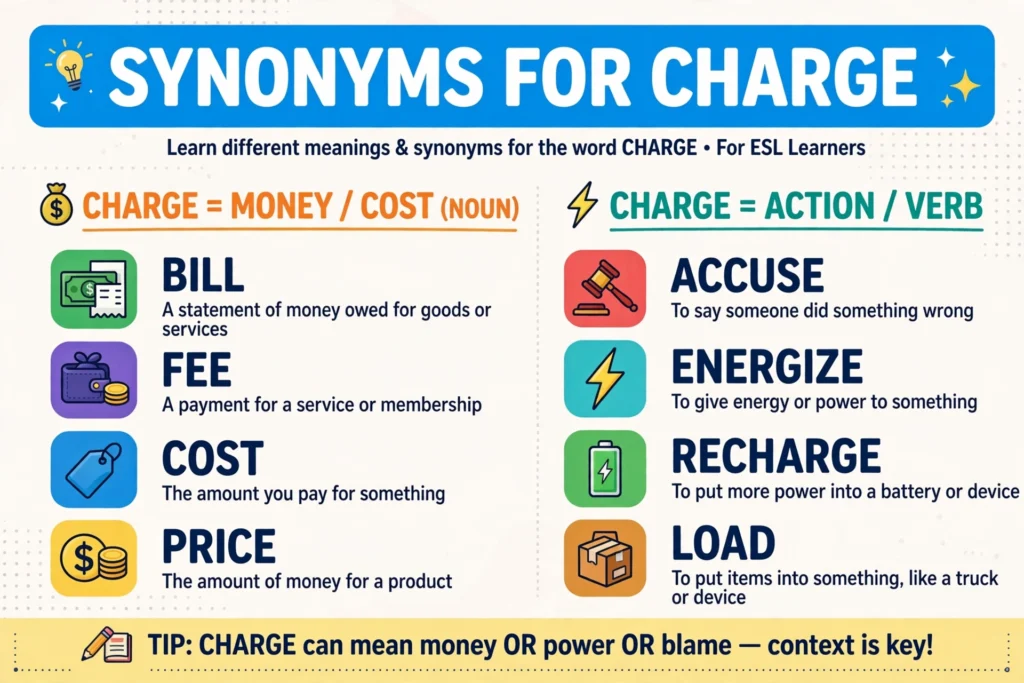

Charge is a busy word: you charge a phone, face criminal charges, and lead a cavalry charge. In electrical English, only one meaning matters — stored electrical energy held in a battery or capacitor, ready to be released. Phone at 2%? “No charge.” Capacitor bank humming? “Holding its charge.”
This guide collects eight precise alternatives for charge in the battery-and-capacitor sense, each with meanings and examples from real electrical contexts. For the devices themselves, see lithium-ion battery technology and battery types for home use.
Stored Energy
Meaning: The most literal alternative — electrical energy kept in a device until needed. Works for batteries, capacitors, and UPS systems alike.
Example: The flywheel stores energy mechanically, but the battery bank stores it electrically.
Another example: A fully charged EV holds about 60 kWh of stored energy.
State of Charge (SoC)
Meaning: The technical measurement — the remaining charge as a percentage of full capacity. The number your phone and your EV both display.
Example: The BMS disconnects the load when the state of charge falls below 20 percent.
Another example: Check the SoC before starting a long drive.
Capacity
Meaning: The total amount of charge a battery can hold, usually in ampere-hours (Ah) or milliampere-hours (mAh). Describes the size of the “tank,” not how full it is.
Example: This power bank has a capacity of 20,000 mAh.
Another example: Battery capacity fades a little with every charge cycle.
Top-Up
Meaning: A partial recharge — adding some charge without filling to 100 percent. Common for EVs, phones, and opportunity charging.
Example: A ten-minute top-up gave me enough range to reach home.
Another example: Forklift batteries get a quick top-up during the lunch break.
Reserve
Meaning: Charge deliberately kept back for emergencies — the backup portion of a battery or the energy in a standby UPS.
Example: The UPS switches to its reserve the instant the mains fail.
Another example: Keep a 30 percent reserve in the battery during load-shedding season.
Accumulation
Meaning: The gradual build-up of charge, especially on capacitors — the process word for charging in electronics contexts.
Example: Accumulation of charge on the capacitor plates creates the electric field.
Another example: Static accumulation on the conveyor belt was discharging into the sensors.
Recharge
Meaning: As a noun, a fresh filling of charge — one complete charging session or the energy it delivers.
Example: One recharge lasts the laptop through a full working day.
Another example: The solar array provides a free daily recharge for the home battery.
Energization
Meaning: The formal engineering term for putting charge or power into equipment — used in commissioning and safety procedures.
Example: Energization of the panel is scheduled after the insulation tests pass.
Another example: Never open the enclosure within five minutes of de-energization — the capacitor bank may still hold charge.
How to Choose the Right Word
For everyday use, stored energy and recharge are the safest all-rounders — clear in any context from phones to power plants. When you need numbers, switch to the technical pair: state of charge for “how full” (percentage) and capacity for “how big” (Ah). Mixing these two up is the most common vocabulary mistake in battery discussions: a phone can have large capacity but low state of charge.
Top-up and reserve describe charging strategy — partial fills and emergency buffers — and both are essential vocabulary for EV owners and anyone running a UPS. Accumulation belongs to electronics and electrostatics, while energization is strictly professional language for commissioning reports and safety documents.
One warning: in a formal report, do not write “the battery has no charge left” when you mean a measurement — write “the state of charge is 0 percent” or “the battery is depleted.” Precision in small words is what separates student writing from professional writing.
Charge Words in the EV and Solar World
Electric vehicles and home solar systems have made battery vocabulary mainstream. EV drivers talk about state of charge the way fuel-car drivers talked about the fuel gauge — “I left home at 90 percent SoC.” Charging stations advertise speed in kilowatts, but what you actually buy is a top-up: twenty minutes for roughly 200 km of range.
Solar homes add another layer. The daytime accumulation of charge in the battery bank becomes the evening’s reserve, and the system’s capacity — say 10 kWh — decides how many cloudy hours the house can ride through. Installers size that capacity from the family’s nightly stored energy needs, which is exactly the load-calculation thinking behind every off-grid design.
Even the humble phone follows the same script: overnight it gets a full recharge, during the day it survives on top-ups, and the battery meter is nothing but a friendly state of charge display. One vocabulary, from pocket to power plant.
FAQs
What is the difference between charge and capacity?
Charge is the energy currently stored (“the battery has little charge left”); capacity is the maximum the battery can ever hold (“a 100 Ah capacity”). Think of capacity as the size of the tank and charge as how full it is right now.
What does “state of charge” mean?
It is the remaining battery charge expressed as a percentage of full — the number shown on your phone’s battery icon. Engineers abbreviate it as SoC, and battery management systems use it to decide when to stop charging or disconnect the load.
Is “top-up” correct English for partial charging?
Yes — it is standard in both British and technical English. “Top-up charging” even has a formal role in battery care: lithium batteries last longer with frequent shallow top-ups than with full 0–100% cycles.
Can “charge” also mean the act of charging?
Yes, and that is exactly why these synonyms matter. “Charge” is both the stored energy (“holds its charge”) and the process (“takes two hours to charge”). Words like recharge, top-up, and accumulation let you specify which meaning you intend.
Conclusion
Battery language is really the language of stored energy: charge in conversation, state of charge and capacity on the datasheet, top-up and reserve in daily use, energization in the commissioning report. Master these eight words and you will describe batteries and capacitors with the precision of a professional — whether you are writing an exam answer, a product manual, or just explaining to a friend why their phone died at 2%.