
How Long Does It Take to Charge a Battery?
Whether it is your solar home system, inverter or UPS battery, the first question is always: how long until it is full? The answer is simple — capacity divided by charging current, times 1.4. That 1.4 is the efficiency factor: charging is not 100% efficient, and some energy becomes heat instead of stored charge. Skip it and your estimate will be about 40% too optimistic.
The Formula: Charging Time = Capacity ÷ Current × 1.4
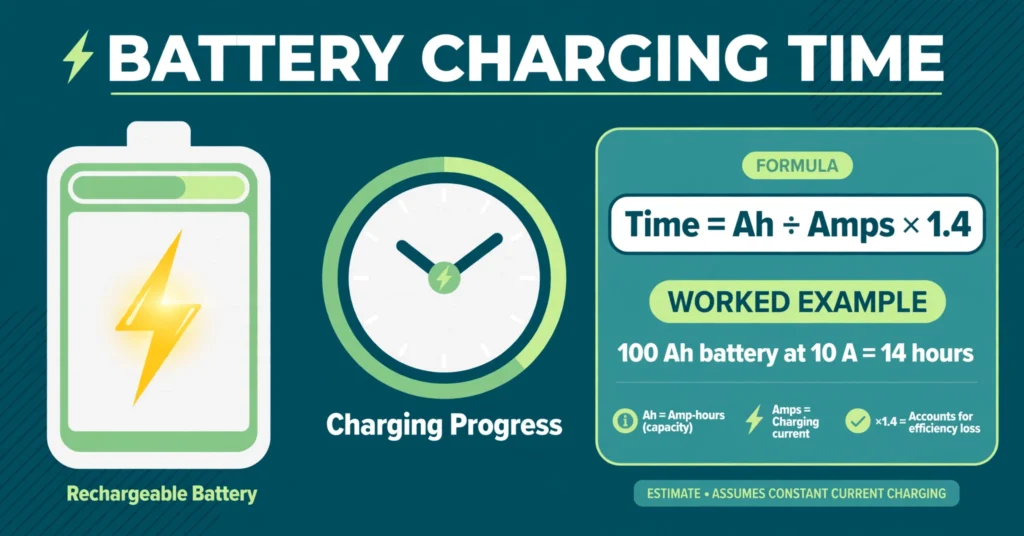
Charging time (hours) = battery capacity (Ah) ÷ charging current (A) × 1.4
Capacity is measured in amp-hours (Ah): a 100 Ah battery can deliver 100 amps for one hour, or 10 amps for ten hours. Divide capacity by the charger’s current in amps to get the ideal time, then multiply by 1.4 for the energy lost as heat. Lead-acid batteries are about 70–85% efficient — that is where 1.4 comes from (1 ÷ 0.7 ≈ 1.4). Lithium is around 95% efficient, so its factor is closer to 1.1, but 1.4 is the safe number to plan with.
Battery Charging Time Table
Charging times from empty, using the 1.4 factor.
| Battery capacity | Charging current | Charging time (from empty) |
|---|---|---|
| 7 Ah | 1 A | 9.8 hours |
| 12 Ah | 2 A | 8.4 hours |
| 100 Ah | 10 A | 14 hours |
| 100 Ah | 20 A | 7 hours |
| 150 Ah | 15 A | 14 hours |
| 200 Ah | 10 A | 28 hours |
| 200 Ah | 20 A | 14 hours |
Doubling the charger current halves the time; doubling the battery size doubles it. A 200 Ah battery on a 10 A charger takes over a day — the charger, not the battery, is the bottleneck.
Worked Example: How Long to Charge a 100 Ah Battery at 10 A?
Take a 100 Ah lead-acid battery — the most common size in home solar and inverter systems — on a 10 A charger.
Step 1 — Ideal time: 100 Ah ÷ 10 A = 10 hours.
Step 2 — Allow for losses: 10 × 1.4 = 14 hours from completely empty to fully charged.
Step 3 — From half discharge: batteries are rarely run completely flat. From 50% discharge you only need to replace 50 Ah: 50 ÷ 10 × 1.4 = 7 hours.
So a 100 Ah battery on a 10 A charger needs an overnight charge — 14 hours from empty, 7 from half. If that is too slow, the fix is a bigger charger: 20 A cuts the same job to 7 hours from empty.
What Changes Charging Time?
Charger size. A charger should be about 10–20% of the battery’s Ah rating: 10–20 A for a 100 Ah battery. Below 10% the battery takes over a day; above 20% a lead-acid battery overheats and loses life — bigger is not always better.
Battery type. Lithium (LiFePO4) charges faster than lead-acid: it accepts high current right up to nearly full, and at ~95% efficiency its factor is about 1.1 — a 100 Ah lithium at 20 A takes roughly 5.5 hours instead of 7. Lead-acid slows sharply in the last 20%, which is why the final stretch always feels slow.
Depth of discharge. A battery drained to 20% takes far longer to refill than one at 70%. Deep discharges also shorten a lead-acid battery’s life — keeping it above 50% is the best habit for a long life.
Temperature. Cold batteries charge slowly and accept less current; hot ones charge faster but age faster. Ideal is around 25 °C — in winter, expect longer charging times.
Charger quality. A multi-stage charger (bulk, absorption, float) is faster and safer than a fixed-voltage charger: full current while the battery is low, tapering off as it fills.
Can a Solar Panel Charge a Battery Faster?
Only if the panel, through its charge controller, delivers more current than your present charger. A 100 W panel gives about 5–6 A at 12 V in full sun — roughly 28 hours of sunshine to fill a 100 Ah battery from empty, or 4–5 sunny days in practice. A 300 W panel (about 16 A) does it in roughly 9 hours of sun. Before buying panels, work out how many you need in our solar panel sizing guide, and size the panel-to-battery cable with our cable sizing calculation.
Frequently Asked Questions
At 10 A: 14 hours from empty, 7 hours from half. At 20 A: 7 hours from empty. A lithium 100 Ah at 20 A takes about 5.5 hours.
Only about 70% of the energy you put into a lead-acid battery comes back as stored charge — the rest becomes heat. Multiplying by 1.4 (1 ÷ 0.7) gives the real time instead of the ideal one.
Yes, up to a point: 10–20% of the battery’s Ah is ideal. Above 20% a lead-acid battery overheats, gasses and loses life. Lithium accepts higher currents — check the manufacturer’s limit.
Only if it delivers more current than your charger. A 100 W panel gives about 5–6 A — slower than a 10 A mains charger. Size the panel to the current you need, not just the battery size.
A good charger switches to float mode and its light turns green. Without one, rest the battery an hour and check voltage: 12.7 V means full, 12.0 V means about half. Never rely on time alone.
Conclusion
Charging time is capacity divided by current, times 1.4: a 100 Ah battery at 10 A needs 14 hours from empty, 7 from half. The charger is usually the bottleneck — match it at 10–20% of the Ah rating. Lithium charges faster, cold slows everything down, and keeping the battery above 50% discharge adds years to its life.