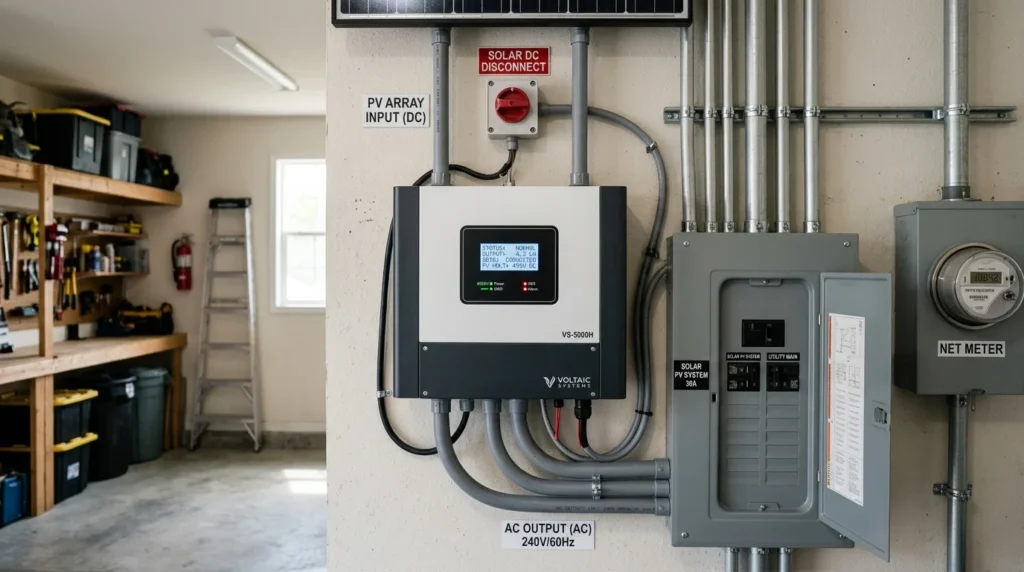

Imagine a home with solar panels installed on its roof on a bright sunny day. The panels generate electricity from sunlight, but the television, refrigerator, fans, and other household appliances cannot use this electricity directly. This is because solar panels produce Direct Current (DC), while most homes and businesses operate on Alternating Current (AC). The device that performs this important conversion is called a Solar Inverter System.
A Solar Inverter System is the heart of every solar power installation. It not only converts DC electricity into usable AC electricity but also monitors system performance, improves energy efficiency, protects electrical equipment, and ensures safe operation. Whether it is a small residential solar setup or a large utility-scale solar farm, the inverter plays a critical role in delivering reliable electrical power.
Understanding the Solar Inverter System working principle is essential for electrical students, engineers, technicians, and beginners. It provides the foundation for learning about renewable energy, power electronics, and modern electrical power systems. In this article, you will learn what a Solar Inverter System is, how it works, its types, components, advantages, disadvantages, applications, selection guide, troubleshooting methods, and future trends in solar energy technology.
What is a Solar Inverter System?
A Solar Inverter System is an electrical device that converts the Direct Current (DC) produced by solar panels into Alternating Current (AC) used by household appliances, commercial equipment, and industrial machinery.
Besides converting power, modern solar inverters also regulate voltage, synchronize with the electrical grid, monitor system performance, and provide safety protection against electrical faults.
Simple Explanation
Solar panels generate electricity that flows in only one direction (DC). However, most electrical devices require electricity that changes direction continuously (AC). A Solar Inverter System acts like a translator, converting DC electricity into AC electricity that homes and businesses can safely use.
Practical Example
Suppose a rooftop solar system produces 400V DC from its solar panels. The Solar Inverter System converts this into 230V AC (or 120V AC in some countries), allowing lights, air conditioners, computers, and other appliances to operate normally.
Solar Inverter System Working Principle
The Solar Inverter System working principle involves collecting DC power from solar panels, processing it through electronic circuits, and producing clean AC power suitable for electrical loads or the utility grid.
Step-by-Step Working Principle
Solar Panels Generate DC Electricity
Solar panels generate DC (direct current) electricity by converting sunlight into electrical energy through the photovoltaic (PV) effect. Each solar panel is made up of multiple photovoltaic cells that absorb sunlight and create a flow of electrons, producing direct current. The amount of electricity generated depends on factors such as sunlight intensity, panel size, temperature, and efficiency. Since most homes, businesses, and electrical appliances operate on alternating current (AC), the DC electricity produced by solar panels is typically sent to an inverter, which converts it into AC for everyday use or for supplying power to the electrical grid. This clean and renewable method of electricity generation helps reduce energy costs and minimizes environmental impact.
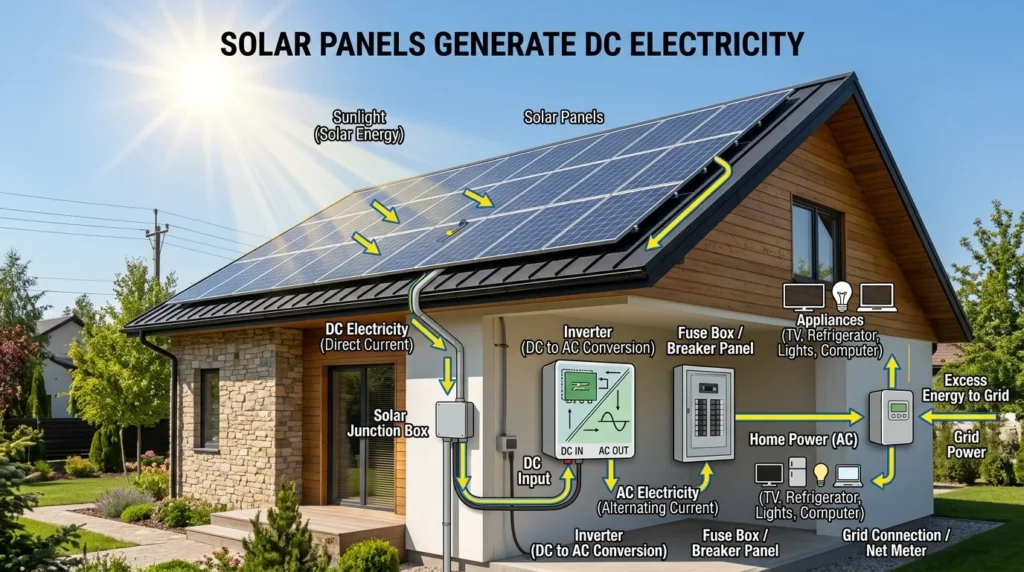
When sunlight strikes photovoltaic (PV) cells, they generate direct current (DC).
The amount of electricity depends on:
- Sunlight intensity
- Panel size
- Temperature
- Panel efficiency
DC Power Enters the Inverter
The DC electricity produced by the solar panels is sent to the inverter through DC cables.
Protection devices such as DC isolators and fuses ensure safe operation.
Maximum Power Point Tracking (MPPT)
Most modern inverters include Maximum Power Point Tracking (MPPT) technology.
MPPT continuously adjusts the operating point of the solar panels to extract the maximum available power under changing weather conditions.
DC to AC Conversion
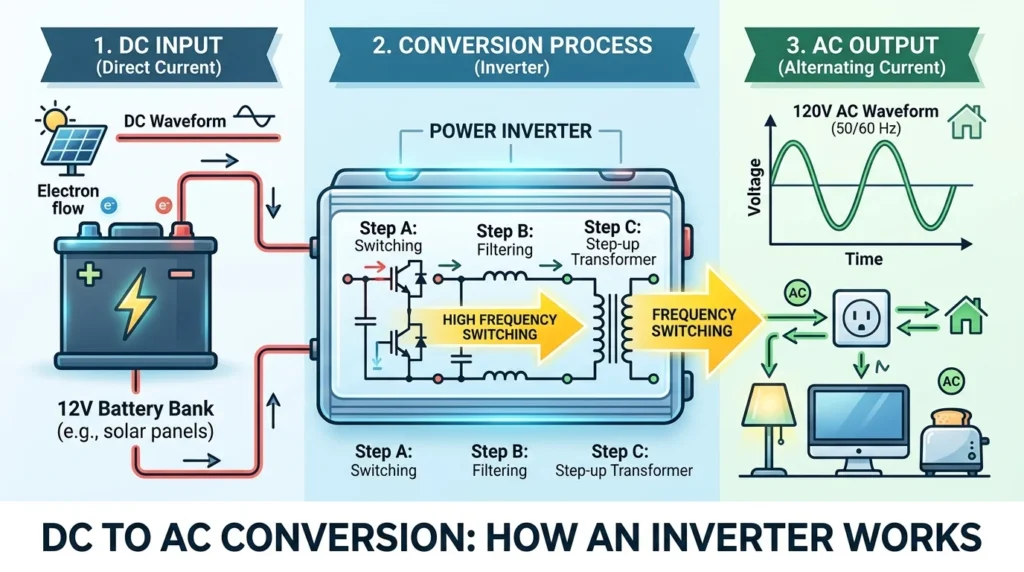
DC to AC conversion is the process of converting direct current (DC) into alternating current (AC) using an electronic device called an inverter. The inverter rapidly switches the DC supply to produce an AC waveform with the required voltage and frequency, such as 50 Hz or 60 Hz. This conversion is essential because most household appliances, industrial equipment, and electrical grids operate on AC power, while sources such as solar panels, batteries, and fuel cells produce DC electricity. Modern inverters use advanced electronic components and control techniques to generate a stable and efficient AC output. DC to AC conversion is widely used in solar power systems, uninterruptible power supplies (UPS), electric vehicles, battery storage systems, and backup power applications.
Power electronic switches such as MOSFETs or IGBTs rapidly switch the DC voltage on and off to create an AC waveform.
This switching process converts DC into alternating current.
Filtering and Voltage Control
Electronic filters smooth the generated waveform and reduce electrical noise.
The inverter regulates voltage and frequency to match the requirements of connected equipment or the utility grid.
AC Output
The inverter supplies clean AC electricity to:
- Household appliances
- Industrial loads
- Commercial buildings
- The electrical grid
- Battery storage systems (in hybrid installations)
Easy Analogy
Think of a Solar Inverter System as a language interpreter. Solar panels “speak” DC electricity, while your home appliances “understand” AC electricity. The inverter translates the energy into a form that electrical devices can use safely and efficiently.
Types of Solar Inverter System
Different solar installations require different inverter designs.
String Inverter
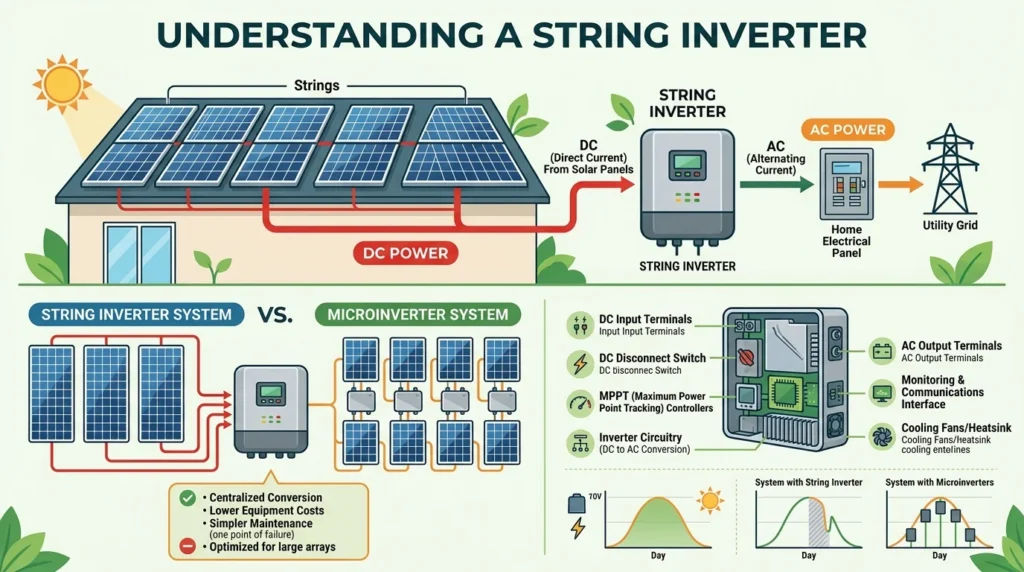
A string inverter is a type of solar inverter that converts the DC (direct current) electricity generated by a group, or string, of connected solar panels into AC (alternating current) electricity for use in homes, businesses, or the electrical grid. In this system, several solar panels are connected in series to form a single string, and all the panels share one inverter. String inverters are popular because they are cost-effective, easy to install, and require less maintenance than systems with multiple inverters. However, if one panel in the string is shaded or performs poorly, the output of the entire string can decrease. String inverters are widely used in residential and commercial solar power systems where the panels receive similar sunlight conditions.
A string inverter connects several solar panels in series (a string).
Features
- Most commonly used
- Cost-effective
- Easy installation
- Simple maintenance
Applications
- Residential rooftops
- Small commercial buildings
Micro Inverter
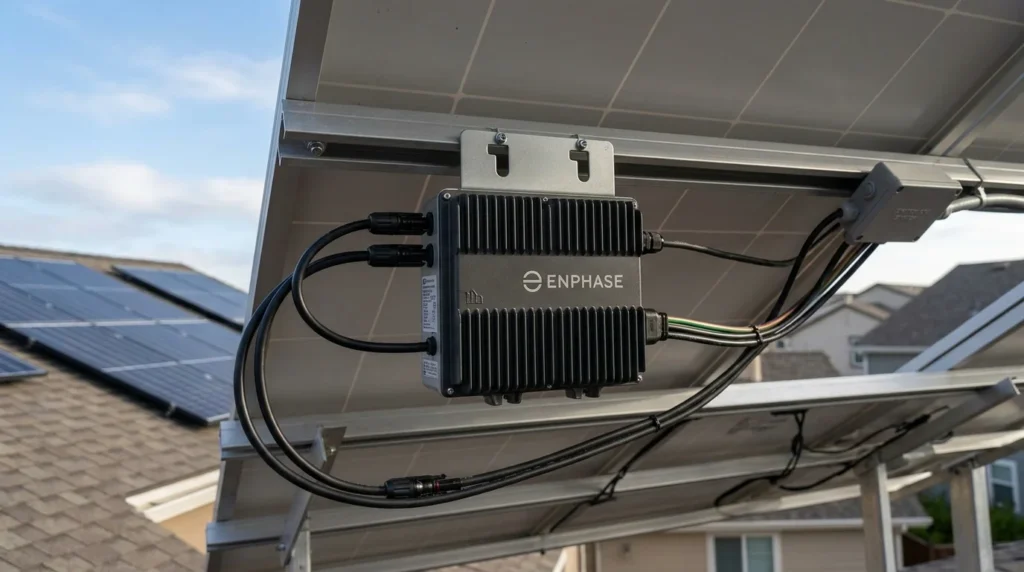
A micro inverter is a small solar inverter that is installed on each individual solar panel to convert its DC (direct current) electricity into AC (alternating current) electricity. Unlike a string inverter, where multiple panels share one inverter, each solar panel operates independently with its own micro inverter. This allows every panel to perform at its maximum efficiency, even if one panel is shaded, dirty, or facing a different direction. Micro inverters improve overall energy production, simplify system monitoring, and increase the reliability of solar power systems. Although they have a higher initial cost than string inverters, they offer better performance and flexibility, making them an excellent choice for residential and commercial solar installations with complex roof layouts or partial shading.
Each solar panel has its own inverter.
Features
- Maximum energy production
- Better shading performance
- Independent operation
- Easy system expansion
Applications
- Residential systems
- Roofs with partial shading
Central Inverter
A single large inverter handles electricity from many solar panel strings.
Features
- High power capacity
- Lower cost per kilowatt
- Centralized maintenance
Applications
- Solar farms
- Utility-scale power plants
Hybrid Solar Inverter
Hybrid inverters work with both solar panels and battery storage.
Features
- Battery charging capability
- Backup power support
- Energy management
- Grid interaction
Applications
- Smart homes
- Residential battery systems
- Commercial backup power
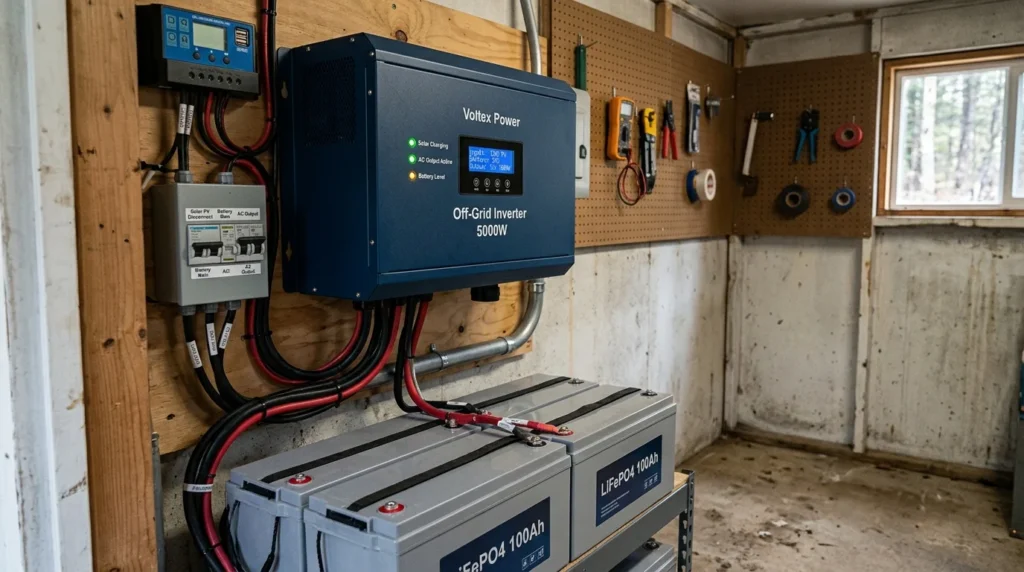
Off-Grid Inverter
A micro inverter is a small solar inverter that is installed on each individual solar panel to convert its DC (direct current) electricity into AC (alternating current) electricity. Unlike a string inverter, where multiple panels share one inverter, each solar panel operates independently with its own micro inverter. This allows every panel to perform at its maximum efficiency, even if one panel is shaded, dirty, or facing a different direction. Micro inverters improve overall energy production, simplify system monitoring, and increase the reliability of solar power systems. Although they have a higher initial cost than string inverters, they offer better performance and flexibility, making them an excellent choice for residential and commercial solar installations with complex roof layouts or partial shading.
Designed for locations without utility grid access.
Features
- Battery-based operation
- Independent power supply
- Supports remote locations
Applications
- Rural homes
- Remote communication stations
- Agricultural systems
Main Components
A Solar Inverter System consists of several important components that work together to provide safe and reliable power conversion.
DC Input Section
Function:
- Receives power from solar panels
- Includes DC isolators and protection devices
MPPT Controller
Function:
- Maximizes solar panel output
- Improves energy harvesting
- Enhances system efficiency
Power Switching Devices
Function:
- Convert DC into AC
- Usually use MOSFETs or IGBTs
- Operate at high switching frequencies
Control Circuit
Function:
- Controls inverter operation
- Regulates voltage and frequency
- Synchronizes with the electrical grid
Output Filter
Function:
- Smooths the AC waveform
- Reduces harmonic distortion
- Improves power quality
Cooling System
Function:
- Removes excess heat
- Maintains safe operating temperature
- Extends inverter life
Protection Circuit
Function:
- Protects against overvoltage
- Detects overload
- Prevents short circuits
- Monitors overheating
Display and Monitoring Unit
Function:
- Displays operating status
- Shows energy production
- Reports faults and alarms
Solar Inverter System Advantages
Understanding the Solar Inverter System advantages and disadvantages helps users evaluate the suitability of different inverter types.
Advantages
- Converts solar DC into usable AC power
- Improves overall system efficiency
- Supports Maximum Power Point Tracking (MPPT)
- Reduces electricity bills
- Enables renewable energy use
- Synchronizes with the utility grid
- Supports battery charging in hybrid systems
- Provides real-time performance monitoring
- Built-in safety protection
- Low operating costs
- Long service life with proper maintenance
- Reduces carbon emissions
- Improves energy independence
Solar Inverter System Disadvantages / Limitations
Although solar inverters provide many benefits, they also have some limitations.
- Initial installation cost can be high.
- Efficiency decreases slightly at very low loads.
- Electronic components age over time.
- Cooling is required for high-power models.
- Battery systems increase overall system cost.
- Grid-tied systems stop operating during utility outages unless backup functionality is provided.
- Professional installation is recommended.
- Periodic maintenance improves long-term reliability.
Solar Inverter System Applications
The wide range of Solar Inverter System applications makes them an essential part of renewable energy systems.
Home Applications
- Rooftop solar systems
- Home battery storage
- Backup power systems
- Smart homes
Commercial Applications
- Office buildings
- Shopping malls
- Hotels
- Schools
- Hospitals
Industrial Applications
- Manufacturing plants
- Warehouses
- Industrial automation
- Large production facilities
Agricultural Applications
- Solar water pumps
- Irrigation systems
- Livestock farms
- Remote agricultural equipment
Utility Applications
- Solar power plants
- Grid-connected renewable energy
- Utility-scale solar farms
Modern Technology
- Electric vehicle charging stations
- Microgrids
- Data centers
- Smart cities
- Telecom towers
Comparison: Solar Inverter System vs Normal Inverter
Understanding the difference between Solar Inverter System and Normal Inverter helps beginners choose the right solution.
| Feature | Solar Inverter System | Normal Inverter |
| Input Source | Solar panels (DC) | Battery (DC) |
| Main Function | Converts solar power into AC | Converts battery power into AC |
| MPPT Technology | Available | Not available |
| Battery Charging | Available in hybrid models | Uses external charger or built-in charger depending on design |
| Grid Synchronization | Yes (grid-tied models) | Usually No |
| Renewable Energy Support | Yes | Limited |
| Best Application | Solar energy systems | Backup power systems |
Selection Guide
Choosing the correct Solar Inverter System depends on your energy requirements and installation type.
Determine System Size
Calculate:
- Daily energy consumption
- Solar panel capacity
- Peak load demand
Choose the Correct Inverter Type
- String inverter for standard residential systems
- Micro inverter for shaded roofs
- Central inverter for solar farms
- Hybrid inverter for battery backup
- Off-grid inverter for remote locations
Check Efficiency
Higher efficiency means:
- More usable electricity
- Lower energy losses
- Better long-term savings
Verify Input Voltage Range
Ensure the inverter is compatible with your solar panel array voltage.
Consider Future Expansion
Choose an inverter that allows additional solar panels or batteries if future expansion is planned.
Look for Safety Features
Select systems with:
- Overvoltage protection
- Surge protection
- Ground fault detection
- Overtemperature protection
- Anti-islanding protection for grid-connected systems
Monitoring Features
Modern inverters should provide:
- LCD display
- Mobile application support
- Wi-Fi or Ethernet connectivity
- Energy production reports
- Fault notifications
Common Problems & Solutions
Why is the inverter not producing power?
causes:
- Low sunlight
- DC disconnect switched off
- Internal fault
Solution:
Check panel output, inspect DC connections, and review the inverter status display.
Why is the inverter overheating?
causes:
- Poor ventilation
- High ambient temperature
- Cooling fan failure
Solution:
Improve airflow and inspect the cooling system.
Why is the inverter showing a grid fault?
causes:
- Grid voltage outside allowable limits
- Frequency mismatch
- Utility outage
Solution:
Verify the grid supply and follow local utility connection requirements.
Why is energy production lower than expected?
causes:
- Dirty solar panels
- Shading
- Faulty MPPT operation
- Damaged panels
Solution:
Clean the panels, remove shading where possible, and inspect the system for faults.
Why is the inverter displaying an error code?
causes:
- Communication problem
- Sensor fault
- Internal protection activated
Solution:
Refer to the manufacturer’s manual, reset the system if appropriate, and inspect the affected components.
Future Trends
Solar inverter technology continues to advance rapidly with the growth of renewable energy and smart electrical networks.
Future developments include:
- Artificial intelligence for energy optimization
- Improved MPPT algorithms
- Higher conversion efficiency
- Silicon Carbide (SiC) and Gallium Nitride (GaN) semiconductor technology
- Cloud-based remote monitoring
- Smart grid integration
- Vehicle-to-home (V2H) and vehicle-to-grid (V2G) compatibility
- Advanced battery management systems
- Predictive maintenance using data analytics
- Compact, lightweight, and modular inverter designs
These innovations will make solar power systems more reliable, efficient, and capable of meeting future energy demands.
Conclusion
A Solar Inverter System is the core component that makes solar energy practical for everyday use by converting direct current from solar panels into alternating current for homes, businesses, and industries. Understanding the Solar Inverter System working principle helps students, engineers, and technicians build a strong foundation in renewable energy and power electronics. With several inverter types available—including string, micro, central, hybrid, and off-grid models—users can choose the solution that best matches their energy needs and installation requirements. Although solar inverters require careful selection, proper installation, and periodic maintenance, their benefits include higher energy efficiency, lower electricity costs, improved system monitoring, and greater energy independence. As renewable energy technologies continue to evolve, Solar Inverter Systems will remain a key element in building cleaner, smarter, and more sustainable electrical power systems.