

What Is Transformer kVA Sizing?
A transformer is rated in kVA, not kW, because it must supply both the real power your loads use and the reactive power they demand. Sizing means working out the kVA your load needs, then picking the next standard size up. An oversized transformer costs more to buy and wastes energy running half-empty; an undersized one overheats, trips and can burn out years early.
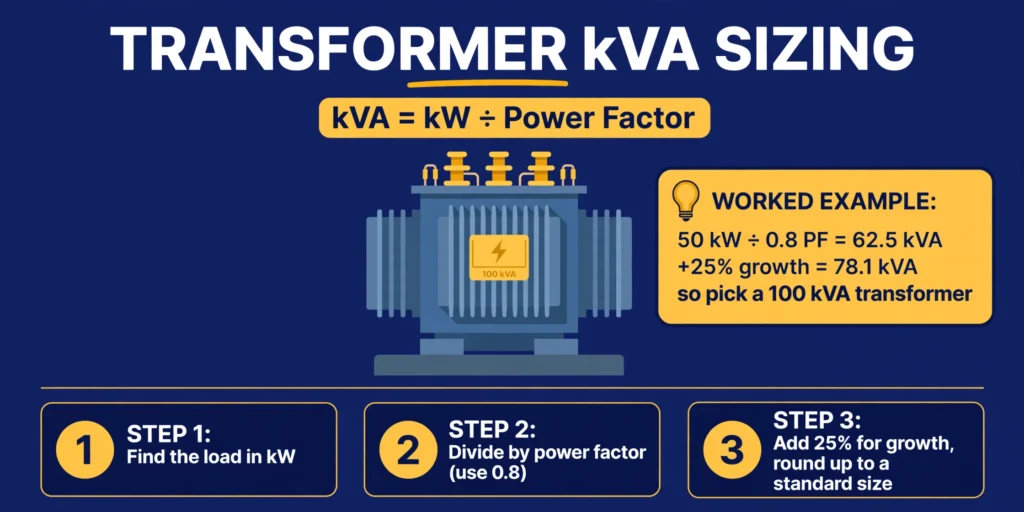
The Formula: kVA = kW ÷ Power Factor
The only formula you need is:
kVA = kW ÷ power factor
Add up the real power (kW) of everything the transformer will supply, then divide by the load’s power factor (pf). Most mixed loads have a power factor of about 0.8; a home with mostly lights, heaters and electronics is closer to 0.9. If you do not know the real value, use 0.8 — it is the standard safe assumption. Then add 25% for future growth and pick the next standard size above your answer. Transformers come in standard steps, and you always round up, never down.
Standard Transformer Sizes
If your calculated size falls between two steps, always choose the larger one.
| Standard size (kVA) | Typical use |
|---|---|
| 10 | Small home, single-phase supply |
| 15 | Home with air conditioning |
| 25 | Large home or small shop |
| 50 | Small workshop, farm, or apartment block |
| 75 | Medium workshop or commercial building |
| 100 | Workshop with several motors |
| 150 | Small factory or large commercial building |
| 200 | Factory or multi-building site |
Worked Example 1: What Size Transformer for a 50 kW Workshop Load?
A small workshop has a 50 kW load at 0.8 power factor.
Step 1 — Apparent power: kVA = kW ÷ power factor = 50 ÷ 0.8 = 62.5 kVA.
Step 2 — Future expansion: add 25% for growth: 62.5 × 1.25 = 78.1 kVA. A workshop almost always adds a machine sooner or later, so this margin is money well spent.
Step 3 — Pick the standard size: 78.1 kVA is above the 75 kVA standard size, so choose the next size up — a 100 kVA transformer.
The raw load is only 62.5 kVA, but after the growth margin and rounding up, the correct purchase is 100 kVA — a 75 kVA unit would leave no room for growth.
Worked Example 2: What Size Transformer for an 8 kW Home?
A home has an 8 kW load at 0.9 power factor.
Step 1 — Apparent power: kVA = kW ÷ power factor = 8 ÷ 0.9 = 8.9 kVA.
Step 2 — Future expansion: add 25%: 8.9 × 1.25 = 11.1 kVA.
Step 3 — Pick the standard size: 11.1 kVA is above the 10 kVA standard size, so choose the next size up — a 15 kVA transformer.
A 15 kVA unit supplies this home comfortably and leaves room for another air conditioner later; a 10 kVA unit would overload the first time everything ran at once.
Demand Factor: Not Everything Runs at Once
The examples above use the total connected load — everything switched on at once. In real life that rarely happens. The demand factor — the share of the load that actually runs at once — is usually 0.6 to 0.8 for homes and small workshops. If your 50 kW workshop never runs more than 35 kW at once, you can size for 35 kW — but only if you are sure; when in doubt, size for the full load.
Motor Starting: The Hidden Trap
Motors draw 5 to 7 times their normal current for a few seconds when they start. A transformer sized exactly for the running load can still dip badly — lights dim and the motor may fail to start — when a large motor kicks in. If your load includes a motor bigger than about a third of the transformer size, size one step larger or use a star-delta starter or soft starter to cut the starting current.
What Happens If You Pick the Wrong Size?
An undersized transformer runs hot: its insulation ages twice as fast for every 8–10 °C above rated temperature, so a 25-year transformer can fail in 5. An oversized transformer wastes money twice: it costs more to buy, and its no-load losses run 24 hours a day. The right size — calculated kVA plus 25%, rounded up — is the cheapest size over the life of the installation.
Frequently Asked Questions
Add up your load in kW, divide by the power factor (use 0.8 if unsure), add 25% for growth, and pick the next standard size above the answer.
Divide kW by the power factor: kVA = kW ÷ pf. At 0.8 pf, 10 kW = 12.5 kVA. At pf = 1 (purely resistive load), kW and kVA are equal.
Use 0.8 for a mixed load with motors and 0.9 for a home. If unsure, 0.8 is the standard safe assumption — see our kW vs kVA guide.
Because it supplies both real power (kW) and reactive power, and the total (kVA) does not depend on the load’s power factor.
Yes, but only one size up — a much bigger one costs more and wastes energy on no-load losses; three sizes above is wasted money.
Conclusion
Sizing is three steps: divide kW by the power factor, add 25% for growth, and round up to the next standard size. The 50 kW workshop needs 100 kVA and the 8 kW home needs 15 kVA — both leave room to grow without wasting money. Check motor starting current too, and confirm the final size against your local code. To pick the cable from the transformer to your load, see our cable sizing calculation guide.