
Imagine a water tank at home that keeps filling from a pump. If nobody switches the pump off, the tank can overflow and waste water. A float switch provides a simple automatic solution. It detects the water level and changes an electrical circuit when the level reaches a certain point.
Float switches are widely used in water tanks, sump pumps, sewage systems, industrial tanks, cooling systems, and automatic pumping equipment. They are especially useful where a system needs to start or stop equipment according to liquid level.
For electrical students, technicians, and engineers, understanding a float switch is important because it combines a simple mechanical movement with electrical switching. Correct installation can also help prevent pump dry running, tank overflow, and unnecessary equipment operation.
In this guide, you will learn what a float switch is, its working principle, major types, components, advantages and disadvantages, applications, selection methods, common problems, and future developments.
What Is a Float Switch?
A float switch is an electrical switching device that detects the level of a liquid and opens or closes an electrical circuit when the liquid reaches a preset level.
The device normally contains a floating part that moves up or down with the liquid. This movement operates an internal switch or sensor.
In simple words, a float switch acts like an automatic electrical ON/OFF control based on liquid level.
For example, consider a household water tank. When the water level becomes low, the float moves downward and can switch a pump ON. As the tank fills, the float rises. At the selected high level, it switches the pump OFF.
A float switch does not normally measure the exact amount of liquid like a digital level meter. Instead, it is mainly used to detect one or more specific levels and control equipment.
Float Switch Working Principle
The float switch working principle is based on the movement of a floating body as the liquid level changes.
The float moves because its density allows it to remain at or near the surface of the liquid. This movement is transferred to an electrical switching mechanism.
Step-by-Step Working
- Liquid level changes
The level of water or another suitable liquid rises or falls inside a tank. - Float moves
The float follows the liquid level and moves upward or downward. - Internal mechanism operates
The float movement changes the position of a mechanical switch, magnetic switch, or electronic sensing element. - Electrical contact changes
The switch either opens or closes its electrical contacts. - Control equipment responds
The connected pump, valve, alarm, relay, or control system turns ON or OFF according to the circuit design.
Simple Analogy
Think of a float switch like a toilet tank mechanism. As water rises, a floating part also rises. At a certain point, its movement tells the system that enough water is present.
The main difference is that a float switch uses this movement to control an electrical circuit.
Normally Open and Normally Closed Contacts
Many float switches use normally open (NO) and normally closed (NC) contacts.
- Normally Open: The circuit remains open until the float reaches the switching position.
- Normally Closed: The circuit remains closed until the float reaches the switching position.
- Changeover contact: Some models can switch between NO and NC contacts.
The correct contact arrangement depends on whether the system needs the equipment to start or stop when the liquid level changes.
Types of Float Switches
Float switches are available in several designs. The best type depends on the tank, liquid, installation method, and control requirement.
Mechanical Float Switch
A mechanical float switch uses physical movement to operate electrical contacts.
As the liquid level changes, the float moves a lever, rod, or other mechanism. This movement changes the switch position.
Mechanical float switches are simple, easy to understand, and widely used for basic level control.
Magnetic Float Switch
A magnetic float switch contains a magnet inside the moving float and a reed switch inside a fixed stem.
When the float moves near the reed switch, the magnetic field changes the contact position.
These switches have relatively simple construction and are commonly used in tanks and equipment where compact level detection is required.
Tethered Float Switch
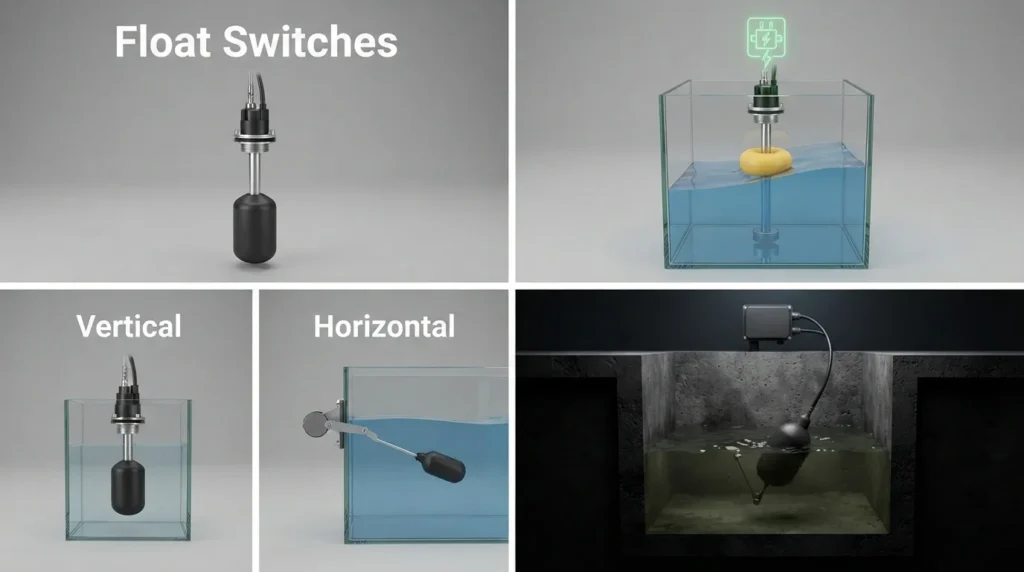
A tethered float switch is attached to a cable that hangs inside the tank.
The float changes its angle as the liquid level rises or falls. This movement operates an internal switch.
Tethered switches are commonly used in sump pumps, sewage systems, and larger tanks.
Vertical Float Switch
A vertical float switch moves along a vertical rod or stem.
The float travels up and down as the liquid level changes. A magnetic or mechanical mechanism detects the movement.
This type is useful where installation space is limited and a vertical mounting arrangement is suitable.
Multiple-Level Float Switch
Some systems use more than one float switch to detect different liquid levels.
For example:
- Low-level float for pump start
- High-level float for pump stop
- Extra-high float for overflow alarm
This arrangement provides better control and protection than a single switching point.
Electronic Float-Level Switch
Some modern devices combine floating level detection with electronic control circuits.
They may provide switching signals to a controller, alarm system, or automation system. These designs are useful where monitoring and control need to be integrated.
Main Components of a Float Switch
Although float switches can have different designs, most contain several important parts.
Float
The float is the part that moves with the liquid level.
It must have suitable buoyancy and material resistance for the liquid being measured.
Switch
The electrical switch changes the circuit condition when the float reaches a specific position.
It may use mechanical contacts, a reed switch, or another switching method.
Cable
The cable provides the electrical connection between the float switch and the control circuit.
The cable insulation should be suitable for the liquid, temperature, and installation environment.
Rod or Stem
Vertical float switches may use a rod or stem to guide the float.
It keeps the float moving along a controlled path.
Magnet
Magnetic designs often contain a small magnet inside the float.
Its magnetic field operates a nearby reed switch as the float moves.
Housing
The housing protects internal components from mechanical damage and, depending on the design, from contact with the liquid.
Advantages of Float Switches
Float switches remain popular because they provide simple and reliable level control.
- Simple construction: Most models are easy to understand and install.
- Automatic control: They can automatically start or stop pumps.
- Low power requirement: Many switches only control a small control circuit.
- Cost-effective: Basic float switches are usually economical.
- Easy maintenance: Mechanical designs can often be inspected and replaced easily.
- Useful for pump protection: They can help prevent overflow and low-level operation.
- Wide range of applications: They work in residential, commercial, and industrial systems.
- Easy troubleshooting: A technician can usually test the switch and wiring with basic electrical tools.
- Flexible control: NO and NC contacts allow different control arrangements.
Disadvantages and Limitations of Float Switches
Understanding the float switch advantages and disadvantages is important before selecting one.
- Mechanical wear: Moving parts can wear over time.
- Float blockage: Dirt, deposits, or nearby equipment can restrict float movement.
- Limited accuracy: A basic float switch provides level switching rather than continuous level measurement.
- Cable damage: In submerged applications, damaged cable insulation can cause electrical problems.
- Liquid compatibility: Some materials may not be suitable for chemicals or aggressive liquids.
- Turbulence problems: Strong liquid movement can cause unwanted switching.
- Space requirements: Tethered and mechanical designs may need sufficient room to move.
- Maintenance requirements: Dirty tanks may require periodic cleaning and inspection.
- Switch rating limitations: The switch may not be suitable for directly controlling a large motor.
For larger pumps, the float switch is often connected to a relay, contactor, or control panel instead of switching the motor directly.
Float Switch Applications
Float switches are used wherever automatic liquid-level control is needed.
Home Water Tanks
A float switch can control a water pump according to the water level.
It can help stop the pump when the tank is full and start it when the water level falls.
Sump Pump Systems
In basements and drainage systems, float switches can automatically start sump pumps when water reaches a selected level.
Sewage Systems
Float switches are commonly used in sewage and wastewater pumping stations.
They can provide pump start, pump stop, and high-level alarm signals.
Industrial Tanks
Factories use float switches for water, process liquids, storage tanks, and drainage systems.
The switch can provide a simple level signal to a control panel.
Cooling Systems
Cooling-water tanks and equipment can use float switches to maintain a suitable liquid level.
Irrigation Systems
Agricultural and irrigation systems can use float switches to control water pumps and storage tanks.
HVAC Systems
Float switches are also used in air-conditioning equipment to detect condensate water.
If a drain pan becomes too full, the switch can interrupt equipment operation or generate an alarm.
Modern Automation Systems
A float switch can provide an ON/OFF level signal to a PLC or other control system.
This allows a simple mechanical level device to become part of a larger automated process.
Difference Between Float Switch and Level Sensor
Float switches and level sensors both detect liquid level, but they are not always used for the same purpose.
| Feature | Float Switch | Level Sensor |
|---|---|---|
| Main function | Detects preset level | Measures or detects liquid level |
| Output | Usually ON/OFF | Can provide continuous or digital output |
| Construction | Often mechanical | Often electronic |
| Cost | Usually lower | Can be higher |
| Accuracy | Limited | Can provide higher measurement accuracy |
| Installation | Generally simple | Depends on sensor technology |
| Best use | Pump and alarm control | Monitoring and process control |
| Maintenance | Usually simple | Depends on technology |
A float switch is a good choice when the system only needs a simple level decision. A level sensor is more suitable when the actual liquid level needs to be monitored continuously.
Selection Guide for a Float Switch
Choosing the correct float switch requires more than checking the tank size.
Check the Liquid Type
First identify the liquid.
Water, wastewater, oils, chemicals, and other liquids may require different materials and switch designs.
Check the Switching Level
Determine the exact level where the equipment should turn ON or OFF.
For a pump system, you may need separate low and high switching points.
Check Electrical Rating
Never assume a float switch can directly control a large pump.
Check:
- Voltage rating
- Current rating
- AC or DC operation
- Contact arrangement
- Motor load requirements
For larger loads, use a properly rated relay or contactor.
Check Installation Method
Choose between vertical, tethered, side-mounted, or other designs according to the tank arrangement.
Make sure the float has enough room to move freely.
Check Temperature
The switch material and cable must tolerate the operating temperature of the liquid and surrounding environment.
Check Environmental Conditions
For outdoor, wet, dusty, or industrial installations, select a switch with suitable protection and construction.
Consider Maintenance
If the tank contains dirt or solid material, select a design that is less likely to become blocked.
For beginners, a simple and well-rated float switch is usually preferable to an unnecessarily complicated device.
Common Float Switch Problems and Solutions
Why Is the Float Switch Not Turning the Pump ON?
The float may be stuck, the cable may be damaged, or the electrical contacts may have failed.
Solution: Inspect the float movement, check wiring, and test the switch contacts with a suitable meter after safely isolating the circuit.
Why Does the Pump Keep Turning ON and OFF?
Rapid switching can occur when the float moves in turbulent water or when the ON and OFF levels are too close.
Solution: Reduce turbulence, check the float position, and use an appropriate switching range.
Why Does the Float Switch Stop Working?
Dirt, corrosion, mechanical damage, worn contacts, or water entering a damaged housing can cause failure.
Solution: Inspect and clean the device if permitted by the manufacturer. Replace damaged components rather than using an unsafe repair.
Can a Float Switch Control a Large Pump?
It depends on the switch’s electrical rating.
A small float switch should generally not directly switch a large motor. A relay or contactor can be used so that the float switch controls only the control circuit.
Why Does the Float Get Stuck?
The float may contact the tank wall, pipe, cable, pump, or accumulated deposits.
Solution: Provide adequate clearance and keep the tank area around the float clean.
Future Trends in Float Switch Technology
Float switches are simple devices, but their role is changing as industrial systems become more automated.
Smart Level Monitoring
Modern systems can combine traditional level switching with electronic monitoring.
This allows operators to receive information about tank conditions through a control system.
IoT-Based Monitoring
Connected systems can send level and pump-status information to remote monitoring platforms.
This can help technicians identify abnormal conditions without visiting the installation immediately.
Better Materials
Manufacturers are developing more durable materials for harsh environments, wastewater systems, chemicals, and high-temperature applications.
Predictive Maintenance
When float switches are integrated with automation systems, repeated switching and equipment behavior can be monitored.
This data can help identify possible failures before they cause a major shutdown.
Hybrid Level-Control Systems
Future installations may combine float switches with pressure, ultrasonic, capacitive, or other level-sensing technologies.
A float switch can provide a simple backup or safety signal while another sensor provides continuous level information.
Conclusion
A float switch is a simple but useful electrical device for detecting liquid levels and controlling equipment automatically. Its basic operation depends on the movement of a float as the liquid level rises or falls.
Float switches are widely used in water tanks, sump pumps, sewage systems, industrial tanks, HVAC equipment, irrigation, and automation. Their main benefits are simple construction, low cost, easy troubleshooting, and automatic control.
However, technicians must consider switching ratings, liquid compatibility, float movement, installation space, and environmental conditions. For large pumps, a properly rated relay or contactor is often required.
Understanding the float switch working principle, types, components, applications, and limitations gives electrical students and technicians a strong foundation for practical level-control systems.