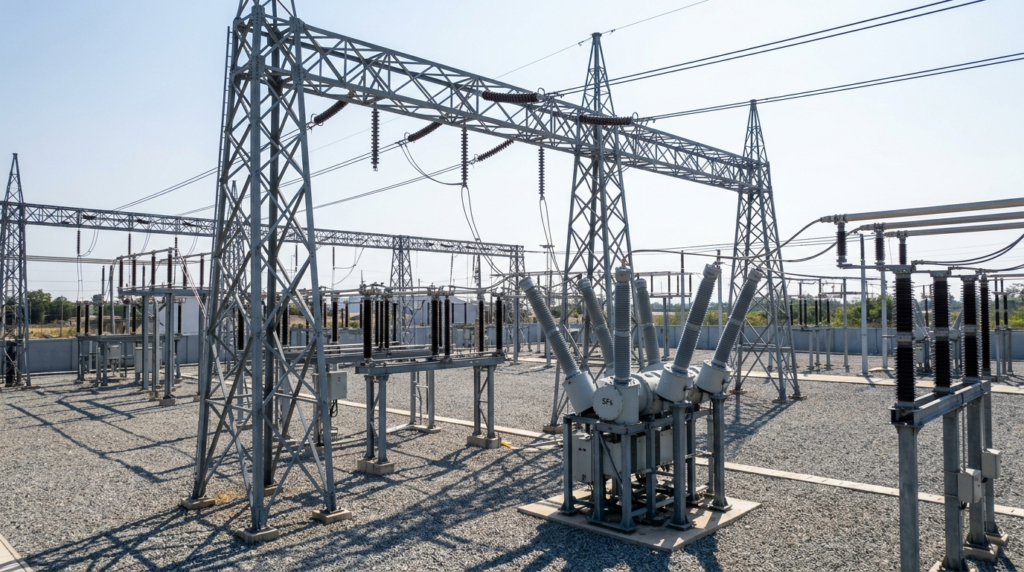

Imagine a large city suddenly losing electricity because a major power station fails to control or distribute electrical energy properly. Hospitals, factories, schools, offices, and homes would all be affected within minutes. To prevent such situations, power systems rely on grid stations that safely receive, control, protect, and distribute electricity. One of the most important facilities in the transmission network is the 132kV grid station.
A 132kV grid station is a key part of the electrical power system. It receives high-voltage electricity from generating stations or transmission networks, manages power flow, protects equipment from electrical faults, and reduces voltage for further distribution. Without these grid stations, reliable and efficient power delivery would not be possible.
Understanding 132kV Grid Station Components and Working is essential for electrical students, engineers, technicians, and beginners because it builds a strong foundation in power system engineering. In this article, you will learn how a 132kV grid station works, its major components, different types, advantages, disadvantages, applications, comparison with similar substations, selection tips, troubleshooting methods, and future developments in modern electrical networks.
What is 132kV Grid Station Components and Working?
132kV Grid Station Components and Working refers to the design, equipment, and operating process of a grid station that handles electrical power at 132 kilovolts (kV). The grid station receives high-voltage electricity, protects the power system, controls power flow, transforms voltage levels, and distributes electricity to lower-voltage substations.
In simple words, a 132kV grid station works like a central traffic control point for electricity. It ensures power flows safely and efficiently from transmission lines to distribution networks.
The major purposes of a 132kV grid station include:
- Receiving electrical power
- Controlling power flow
- Reducing voltage levels
- Protecting electrical equipment
- Ensuring continuous power supply
Practical Example
Think of a large railway junction.
Many trains arrive from different cities. The station organizes train movement, prevents collisions, directs trains to the correct tracks, and sends passengers toward their destinations.
Similarly, a 132kV grid station manages electrical energy by directing, controlling, protecting, and distributing it throughout the power network.
132kV Grid Station Working Principle
The 132kV Grid Station Components and Working principle is based on safely receiving high-voltage electricity, monitoring electrical conditions, protecting equipment, transforming voltage, and distributing electrical power.
The complete process follows several steps.
Receiving High-Voltage Power
Electricity generated at power plants is transmitted through high-voltage transmission lines.
The incoming voltage at the grid station is generally 132kV.
Isolation and Switching
Before electricity enters the main equipment, isolators and circuit breakers control the incoming supply.
These devices:
- Allow safe maintenance
- Disconnect faulty equipment
- Protect personnel
Measuring Electrical Quantities
Current Transformers (CTs) and Voltage Transformers (VTs) continuously measure:
- Current
- Voltage
- Power conditions
These measurements are used for protection and monitoring.
Voltage Transformation
The incoming power enters the main power transformer.
Depending on system requirements, voltage is stepped down from:
- 132kV to 66kV
- 132kV to 33kV
- 132kV to 11kV
Lower voltage makes electricity suitable for regional distribution.
Protection Against Faults
Protective relays constantly monitor the electrical system.
If they detect:
- Short circuits
- Earth faults
- Overloads
- Equipment failures
they immediately send a signal to the circuit breaker.
The breaker disconnects the faulty section to prevent damage.
Distribution of Electrical Power
After voltage transformation and protection, electricity flows through outgoing feeders toward:
- Distribution substations
- Industrial areas
- Commercial buildings
- Residential communities
Easy Analogy
Imagine a water distribution system.
- The reservoir represents the generating station.
- Large pipelines represent transmission lines.
- The grid station acts like a water control center.
- Valves control flow.
- Pressure regulators reduce pressure.
- Smaller pipes deliver water to neighborhoods.
A 132kV grid station performs the same function with electricity instead of water.
Types of 132kV Grid Stations
Different types of grid stations are selected according to available space, environmental conditions, and operational requirements.
Air Insulated Substation (AIS)
AIS uses atmospheric air as insulation between electrical equipment.
Features
- Lower installation cost
- Easy maintenance
- Large land requirement
- Widely used
Applications
- Rural areas
- Utility substations
- Open-field installations
Gas Insulated Substation (GIS)
GIS uses sulfur hexafluoride (SF₆) gas as insulation.
Features
- Compact design
- High reliability
- Excellent weather protection
- Minimal maintenance
Applications
- Urban areas
- Underground substations
- Industrial facilities
Indoor Grid Station
Most electrical equipment is installed inside buildings.
Advantages
- Better protection from weather
- Improved equipment lifespan
- Higher operational safety
Outdoor Grid Station
Equipment is installed in open air.
Advantages
- Lower construction cost
- Easier future expansion
- Better accessibility
Main Components of a 132kV Grid Station
Understanding these components is the key to learning 132kV Grid Station Components and Working.
Power Transformer
The power transformer is the heart of the grid station.
Function
- Reduces voltage
- Transfers electrical energy
- Maintains system efficiency
Circuit Breaker
The circuit breaker interrupts fault current automatically.
Function
- Fault isolation
- Equipment protection
- Personnel safety
Isolator (Disconnect Switch)
The isolator disconnects equipment during maintenance.
Function
- Safe isolation
- Maintenance support
Busbar
Busbars distribute electrical power throughout the station.
Function
- Connect incoming and outgoing circuits
- Simplify power distribution
Current Transformer (CT)
Current transformers safely reduce high current for measurement.
Function
- Metering
- Protection
- Monitoring
Voltage Transformer (VT)
Voltage transformers reduce voltage to safe values.
Function
- Voltage measurement
- Relay operation
- Instrument supply
Protective Relays
Protective relays monitor electrical conditions continuously.
Function
- Detect abnormal conditions
- Trigger circuit breakers
Lightning Arresters
Lightning arresters protect equipment from surge voltages.
Function
- Divert lightning surges
- Prevent insulation damage
Earthing System
Earthing safely carries fault current into the ground.
Function
- Personnel safety
- Equipment protection
Control Room
The control room supervises the complete operation.
Function
- Monitoring
- Remote control
- Alarm management
- Data recording
Advantages
The following are important 132kV Grid Station Components and Working advantages and disadvantages, beginning with the benefits.
Advantages
- Reliable electrical power transmission
- Efficient voltage transformation
- Improved system protection
- Reduced transmission losses
- Better voltage regulation
- Continuous power supply
- High operational reliability
- Supports industrial development
- Easy fault isolation
- Enables future system expansion
Real-World Benefits
- Fewer power interruptions
- Better electricity quality
- Improved industrial productivity
- Increased consumer satisfaction
- Safer electrical networks
Disadvantages / Limitations
Although highly efficient, 132kV grid stations have several limitations.
Limitations
- High installation cost
- Expensive equipment
- Skilled workforce required
- Regular maintenance necessary
- Large land requirement for AIS
- Protection systems increase project cost
- Complex fault diagnosis
- Environmental effects on outdoor equipment
Understanding these limitations helps engineers design more reliable substations.
132kV Grid Station Applications
The 132kV Grid Station Components and Working applications extend across many sectors.
Residential Power Distribution
Provides electricity to:
- Cities
- Housing societies
- Residential colonies
Commercial Facilities
Supplies electrical power to:
- Shopping malls
- Hospitals
- Universities
- Airports
Industrial Applications
Supports:
- Steel plants
- Cement factories
- Textile industries
- Oil refineries
- Manufacturing facilities
Renewable Energy Integration
Connects renewable energy sources such as:
- Solar power plants
- Wind farms
- Hydroelectric stations
Modern Smart Grid Applications
Supports:
- Smart grid automation
- Remote monitoring
- Load balancing
- Digital protection
- Real-time system control
Comparison Section
Many students ask about the difference between 132kV grid station and 220kV grid station.
| Feature | 132kV Grid Station | 220kV Grid Station |
| Operating Voltage | 132kV | 220kV |
| Power Capacity | High | Very High |
| Coverage Area | Regional | Large regional transmission |
| Installation Cost | Lower | Higher |
| Transformer Size | Medium | Large |
| Land Requirement | Moderate | Large |
| Primary Use | Transmission and distribution | Bulk power transmission |
| Expansion Capability | Good | Excellent |
Selection Guide
Choosing a suitable 132kV grid station depends on several engineering considerations.
Evaluate Load Demand
Estimate:
- Present load
- Future expansion
- Peak demand
Select Transformer Capacity
Choose transformer ratings based on:
- Load growth
- Efficiency
- Reliability
Decide Between AIS and GIS
Choose AIS when:
- Land is available
- Budget is limited
Choose GIS when:
- Space is limited
- Reliability is critical
Consider Protection Requirements
Install proper protection against:
- Short circuits
- Lightning
- Overloads
- Earth faults
Plan for Future Expansion
Always reserve space for:
- Additional transformers
- New feeders
- Extra switchgear
Tips for Beginners
- Learn the single-line diagram.
- Understand transformer ratings.
- Study protection schemes.
- Follow safety procedures.
- Visit operational grid stations whenever possible.
Common Problems & Solutions
Transformer Overheating
Cause
- Excessive loading
- Cooling failure
Solution
- Reduce load
- Inspect cooling system
Frequent Breaker Tripping
Cause
- Faulty feeder
- Relay malfunction
- Short circuit
Solution
- Test protection system
- Locate the fault
Low Output Voltage
Cause
- Heavy load
- Incorrect transformer tap
Solution
- Adjust tap changer
- Balance feeder load
Lightning Damage
Cause
- Failed surge protection
Solution
- Inspect lightning arresters
- Replace damaged equipment
Relay Not Operating
Cause
- Incorrect settings
- Wiring fault
Solution
- Verify relay settings
- Inspect control wiring
Busbar Heating
Cause
- Loose joints
- Excessive current
Solution
- Tighten connections
- Inspect for overload
Future Trends
Modern power systems are making 132kV grid stations smarter, safer, and more efficient.
Digital Substations
Digital sensors replace many conventional measurement systems, improving accuracy and reducing maintenance.
Smart Grid Integration
Future substations will communicate automatically with centralized control centers for better power management.
Predictive Maintenance
Advanced monitoring systems will detect equipment deterioration before failures occur.
Remote Monitoring and Automation
Operators can monitor and control substations from remote control rooms, reducing response time and improving reliability.
Renewable Energy Integration
Future 132kV grid stations will handle larger amounts of solar, wind, battery storage, and hybrid renewable energy with advanced control systems.
Environmentally Friendly Equipment
New eco-friendly switchgear and insulation technologies will reduce environmental impact while maintaining excellent operational performance.
Conclusion
Understanding 132kV Grid Station Components and Working is essential for anyone involved in electrical power systems. A 132kV grid station is much more than a voltage transformation facility—it is the backbone of safe, reliable, and efficient power transmission and distribution. Its transformers, circuit breakers, busbars, relays, instrument transformers, and protection systems work together to ensure continuous electricity supply while protecting equipment and personnel from faults. By learning the 132kV Grid Station Components and Working principle, different types, applications, advantages, limitations, and maintenance practices, students and professionals develop a strong understanding of modern substations. As power systems continue evolving with digital technologies, smart grids, automation, and renewable energy integration, the importance of well-designed 132kV grid stations will continue to grow, making this knowledge invaluable for every aspiring electrical engineer.


Pingback: Types of Electrical Substations: Full Classification