
A short circuit is one of the most common and most dangerous electrical faults. It happens when current finds a low-resistance path it was never meant to take, usually between two conductors, or between a conductor and earth, and the result is a surge of current many times the normal load. In a fraction of a second, wires can overheat, insulation can melt, and a fire can start.
Understanding what causes short circuits, what they do to equipment and people, and how protection devices stop them is essential for anyone who works with electricity. This guide covers the causes, the effects, and the protection that keeps short circuits from becoming disasters.
What Is a Short Circuit?
A short circuit is an unintended connection of low resistance between two points of different potential in a circuit. Normally, current flows through a load, a lamp, a motor, a heater, which limits it to a safe value. In a short circuit, the load is bypassed, so the only thing limiting the current is the tiny resistance of the wires themselves. By Ohm’s law, the current becomes enormous: a 230 V supply with 0.1 ohms of loop resistance would drive 2,300 A.
Short circuits are classified by where they happen: a line-to-line fault between two live conductors, a line-to-earth fault between a conductor and earth, and a line-to-neutral fault. Line-to-earth faults are the most common in homes, while three-phase line-to-line faults carry the highest currents in industrial systems.
What Causes a Short Circuit?
Short circuits have many causes, and most of them are preventable:
- Damaged insulation: aging, heat, rodents, or nails through cables expose live conductors
- Loose connections: a wire that works free can touch a neighboring terminal or the enclosure
- Water ingress: moisture across terminals creates a conductive path
- Overloaded circuits: heat from overload degrades insulation until it fails
- Faulty appliances: an internal failure can short the supply inside the device
- Human error: drilling into a wall, or connecting wires to the wrong terminals
Effects of a Short Circuit
The effects of a short circuit are fast and severe. The huge current heats conductors in milliseconds. The heat grows with the square of the current, so a fault current 20 times normal produces 400 times the heating. Insulation melts, copper can vaporize, and the arc can reach thousands of degrees, igniting nearby material.
The magnetic forces are just as violent. Parallel conductors carrying fault current repel each other with enormous force, which can bend busbars and tear cables from their supports. Sensitive electronics can be destroyed by the voltage dip that accompanies a fault, and people nearby face arc flash burns and shock.
Short Circuit Current and Fault Levels
The fault level of a system is the maximum short circuit current it can deliver, and it sets the ratings of every protective device on it. A device that cannot interrupt the fault current will fail, possibly explosively, so breakers and fuses are rated by their breaking capacity.
| Location | Typical fault current | Typical protection |
|---|---|---|
| Domestic socket circuit | 1 to 6 kA | MCB, 6 kA breaking capacity |
| Domestic main switch | 6 to 10 kA | Main breaker, 10 kA |
| Small commercial board | 10 to 25 kA | MCCB, 25 kA |
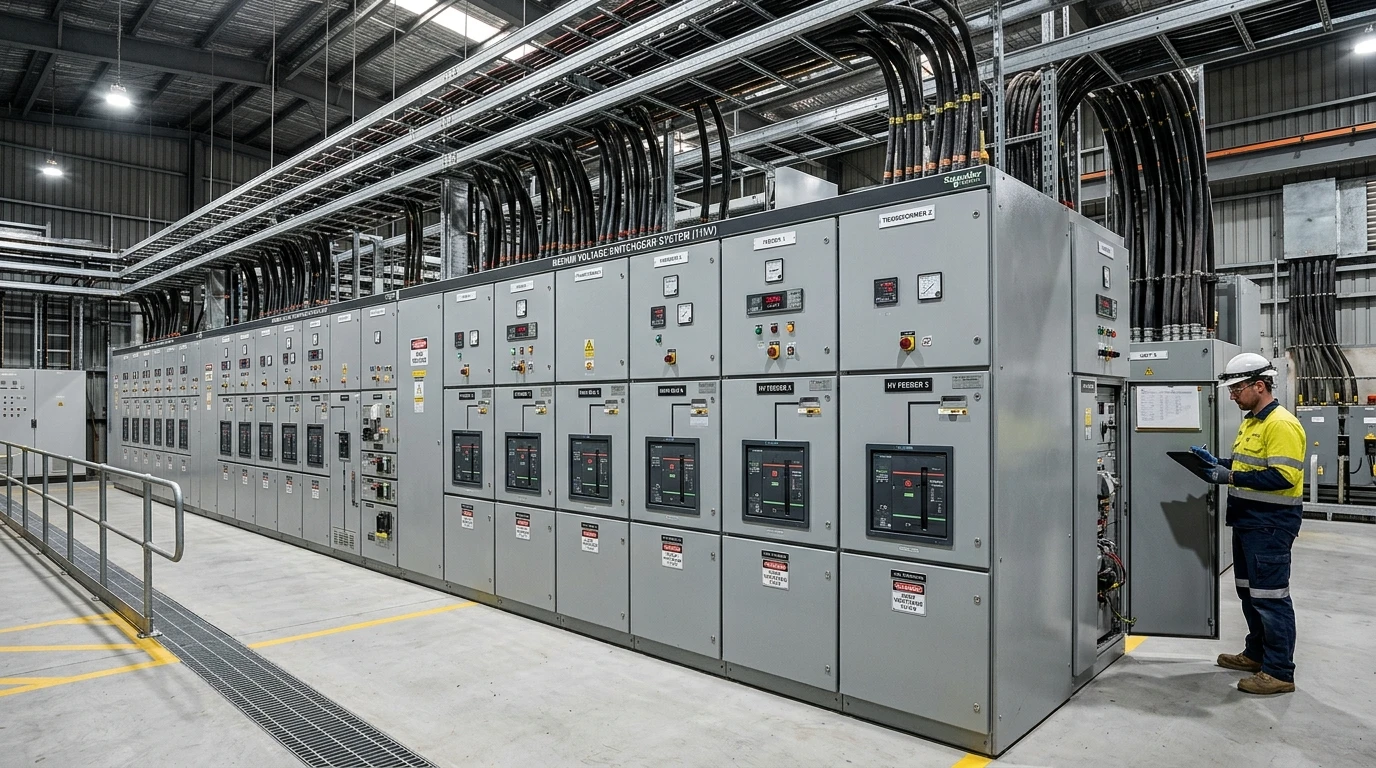
| Industrial switchboard | 25 to 65 kA | ACB or MCCB, 50 kA and above |
Short Circuit Protection Devices
Protection works by detecting the fault current and breaking the circuit faster than the damage can spread. The main devices are:
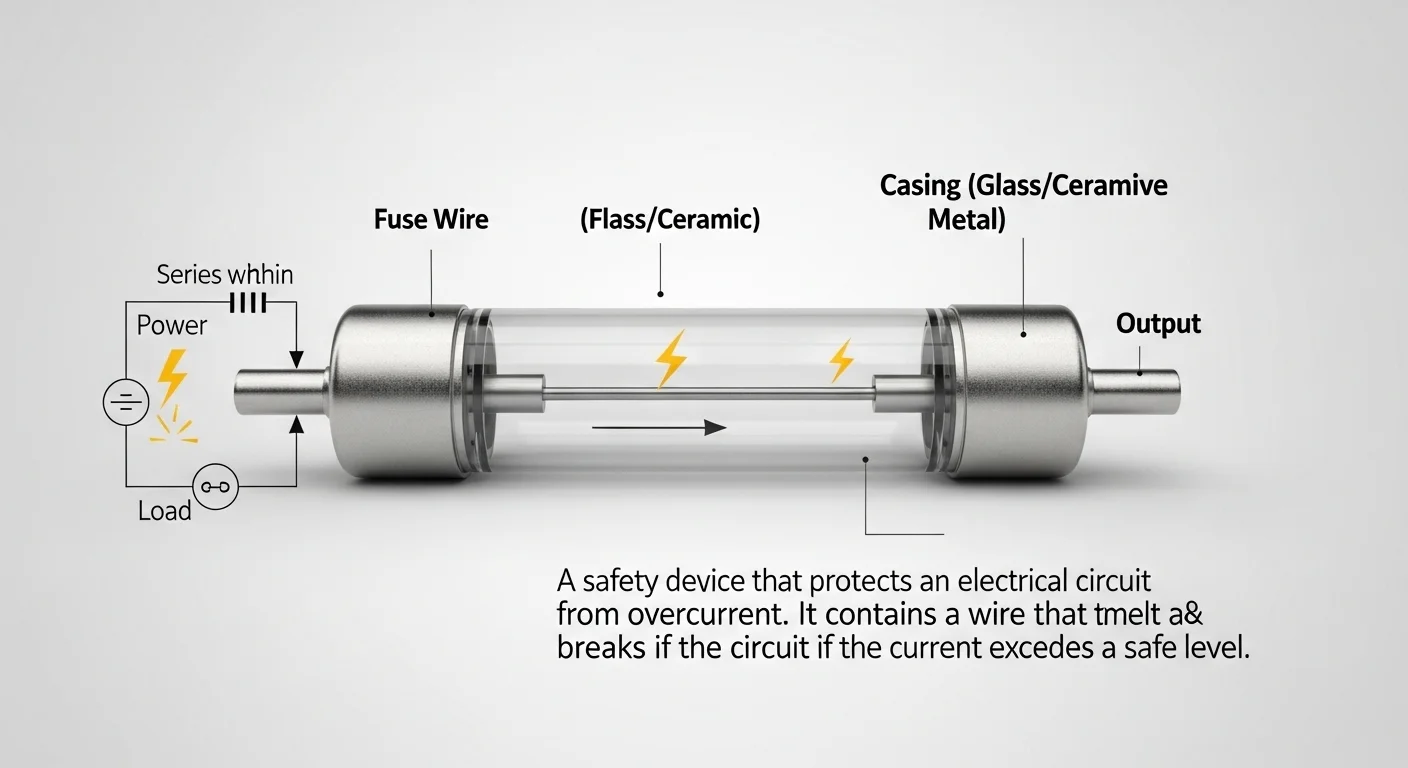
- Fuses: a metal element that melts when the current exceeds its rating. A fuse is cheap, fast, and reliable, but it must be replaced after it operates.
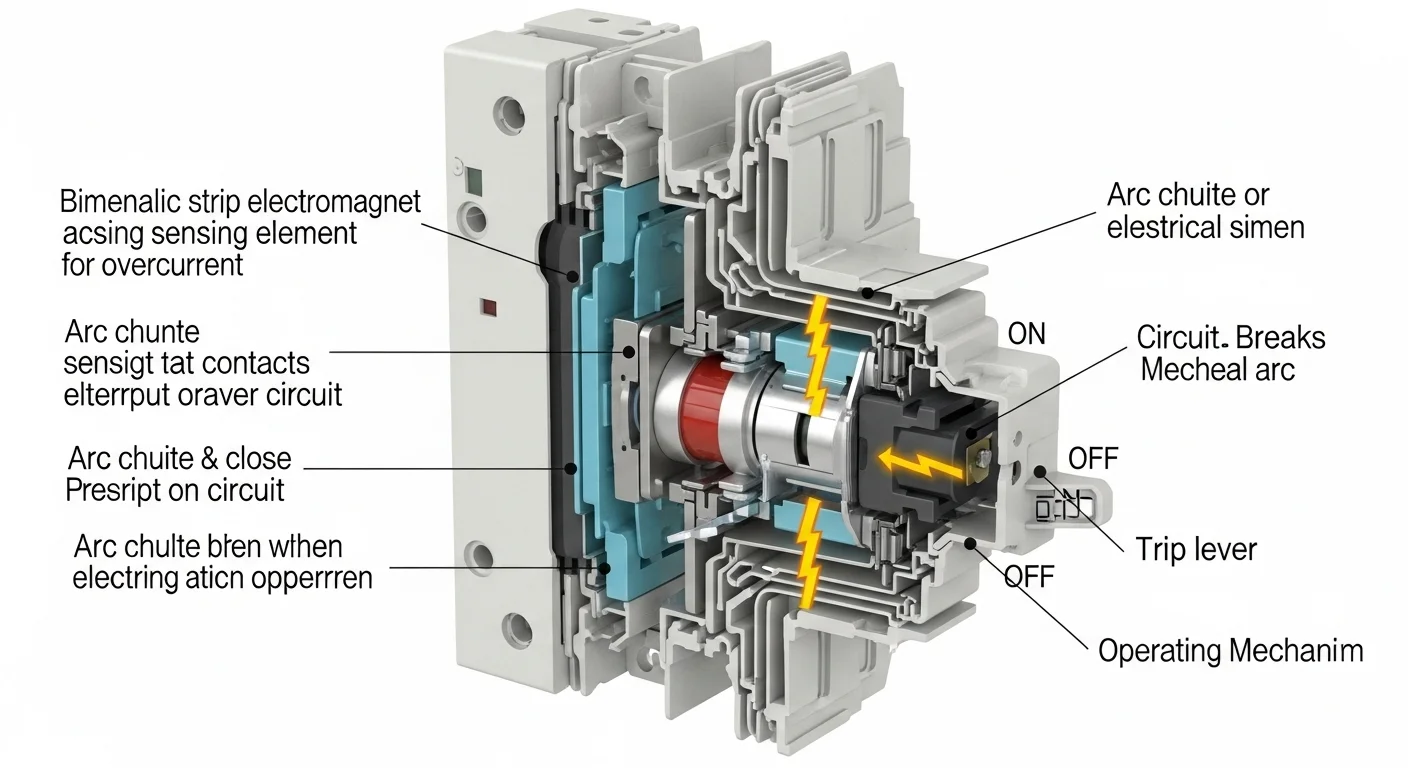
- Miniature circuit breakers (MCBs): the standard protection in homes, tripping on overload and short circuit. Our guide to the circuit breaker explains how they detect and interrupt faults.
- Molded case and air circuit breakers (MCCBs and ACBs): larger breakers for commercial and industrial boards, with adjustable trip settings and higher breaking capacities.
- Residual current devices (RCDs): protect against earth faults and shock by detecting current leaking to earth.
How to Prevent Short Circuits
Prevention is cheaper than protection. Keep insulation in good condition, replace damaged cables, and do not overload circuits. Use the right protective devices, sized to the fault level, and test them regularly. Keep water away from electrical equipment, and make sure enclosures are closed and intact.
Good design matters too: proper cable sizing, correct torque on terminations, and separation of live parts all reduce the chance of a fault. For a broader look at the devices that guard a system, see our guide to electrical protection devices.
Frequently Asked Questions
What is the difference between a short circuit and an overload?
An overload is a current moderately above the rated value, usually caused by too many loads, and it heats conductors slowly. A short circuit is a current many times the rated value, caused by a fault, and it heats conductors in milliseconds. Both are dangerous, but a short circuit acts far faster.
Can a short circuit cause a fire?
Yes, it is one of the leading causes of electrical fires. The fault current heats conductors and can ignite insulation, and the arc itself can reach thousands of degrees. That is why protection must act in milliseconds, before the heat can spread.
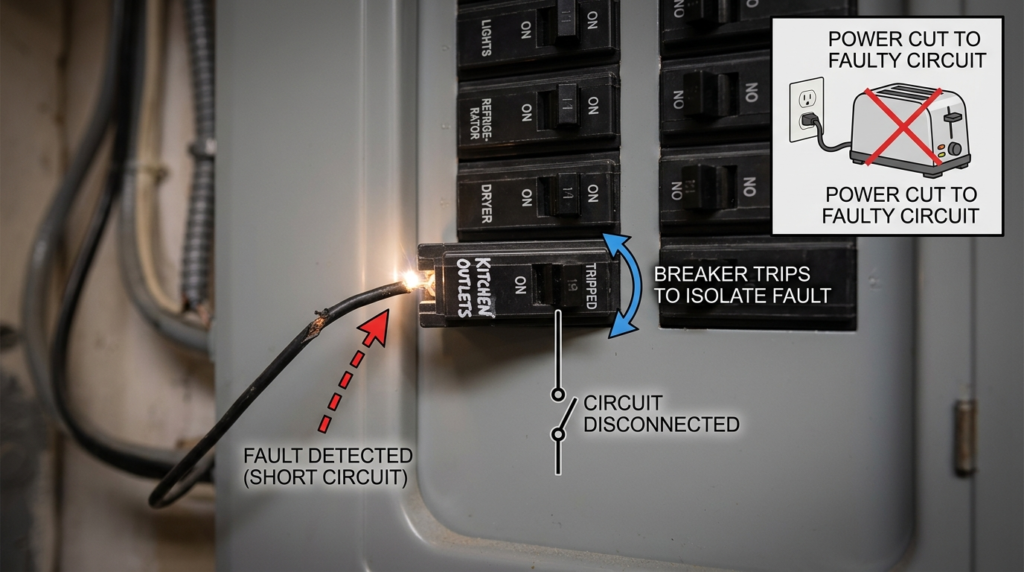
Why does a short circuit trip the breaker?
The breaker detects the very high fault current and opens its contacts, cutting off the supply. That is exactly what it is designed to do. A breaker that trips on a short circuit should not be reset until the fault has been found and fixed.
How do I find a short circuit in my home?
Switch off all circuits, then switch them on one at a time until the breaker trips again. That identifies the faulty circuit. Then disconnect the appliances on that circuit one by one. If the fault remains with everything disconnected, the wiring itself is faulty and needs a qualified electrician.
What is the difference between a short circuit and an earth fault?
A short circuit is a fault between live conductors, or between live and neutral, while an earth fault is a fault between a live conductor and earth. Both produce high currents, but an earth fault can also energize metal enclosures, which is why earthing and RCD protection matter.
Conclusion
A short circuit is a low-resistance fault that lets current surge far beyond its design value, with heat, magnetic force, and arc flash as the consequences. The causes are usually mundane, damaged insulation, loose connections, water, overload, and the protection is well understood: fuses and breakers sized to the fault level, installed correctly and tested regularly.
For the safety rules that govern electrical work, the U.S. Occupational Safety and Health Administration’s electrical safety pages are the authoritative reference.