


A diode is a two-terminal semiconductor device that allows electric current to flow in one direction only. It acts like a one-way valve for electricity: current passes easily from the anode to the cathode, but is blocked in the opposite direction. This simple property makes the diode one of the most widely used components in electronics, from phone chargers and power supplies to radios, solar panels, and LED lighting.
Almost every electronic device you own contains diodes. They convert the alternating current (AC) from a wall outlet into the direct current (DC) your devices need, protect circuits from reversed power connections, and turn electrical energy into light in LEDs. Understanding how a diode works is the first step toward understanding all semiconductor electronics, including the transistor and the MOSFET.
How a Diode Works
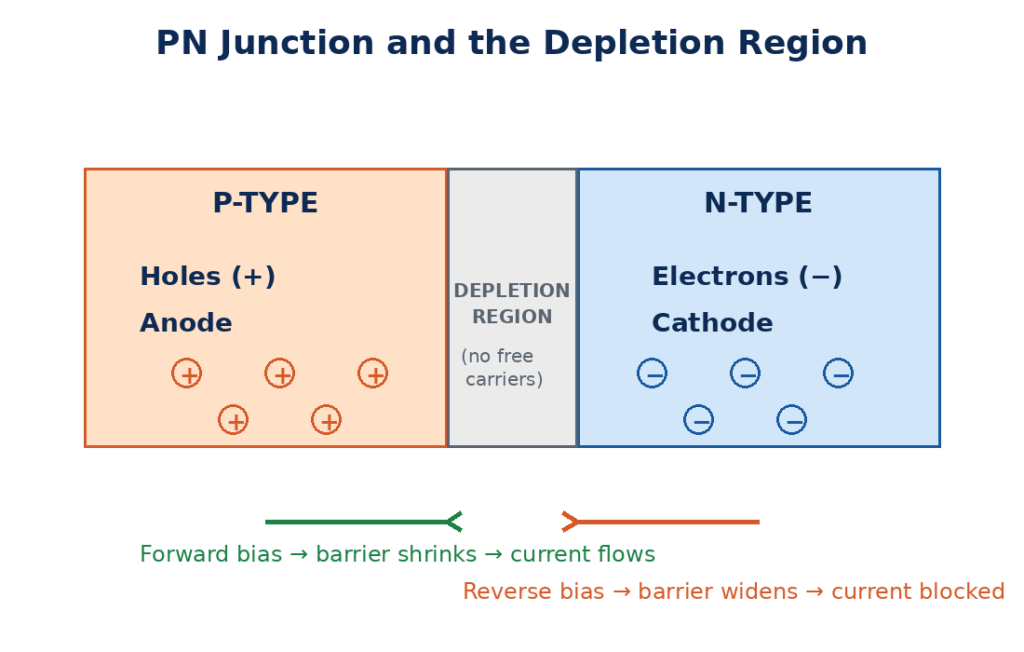
A standard diode is made by joining P-type and N-type semiconductor material, usually silicon. The P-type material has an abundance of holes (positive charge carriers) and the N-type material has an abundance of free electrons. Where the two materials meet, they form a PN junction. At this junction, some electrons and holes combine and leave behind a narrow zone with almost no free charge carriers. This zone is called the depletion region, and it acts as a barrier to current flow.
When no voltage is applied, the depletion region stays in place and no current flows. When an external voltage is applied, the width of the depletion region changes, and that change decides whether the diode conducts or blocks. This is the whole secret of the diode: a voltage-controlled barrier inside a piece of silicon.
Forward Bias and Reverse Bias
In forward bias, the positive terminal of the power supply is connected to the anode (P-side) and the negative terminal to the cathode (N-side). The applied voltage pushes carriers toward the junction, the depletion region shrinks, and the barrier falls. Once the voltage reaches the knee voltage, current rises quickly. For a silicon diode the knee voltage is about 0.6 to 0.7 V. Germanium diodes need only about 0.3 V, and Schottky diodes conduct at about 0.2 to 0.4 V.
In reverse bias, the connections are swapped: the anode is negative and the cathode is positive. The depletion region widens, the barrier grows, and only a tiny leakage current flows — typically a few microamps or less. The diode acts like an insulator. If the reverse voltage keeps rising, it eventually reaches the breakdown voltage (typically 50 to 1000 V depending on the type), where reverse current rises sharply and an ordinary diode can be damaged. Special diodes such as Zener diodes and TVS diodes are designed to operate safely in controlled reverse breakdown.
| Bias Condition | Connection | Depletion Region | Current Flow |
|---|---|---|---|
| Forward bias | Anode positive, cathode negative | Narrows | Flows easily after ~0.7 V (silicon) |
| Reverse bias | Anode negative, cathode positive | Widens | Blocked, except tiny leakage current |
| Breakdown | Reverse voltage above rating | Collapses | Large reverse current; damages ordinary diodes |

The V-I Characteristic Curve
The voltage-current (V-I) curve of a diode shows exactly how it behaves. In the forward direction, the current stays near zero until the knee voltage, then climbs steeply — a small increase in voltage produces a large increase in current. In the reverse direction, the curve stays almost flat at a tiny leakage current until breakdown voltage, where it drops sharply downward.
This curve is why a diode cannot be treated as an ordinary resistor. Its resistance is high in reverse, very low in forward conduction, and changes with voltage. Circuit designers use the curve to choose the right diode for a job: a rectifier diode is chosen for its forward current and peak inverse voltage ratings, while a Zener diode is chosen for its breakdown voltage.
Worked Example: LED Resistor
A red LED drops about 2 V and needs about 20 mA. Connected to a 5 V supply, the resistor must drop the remaining 3 V. Using Ohm’s law, R = V / I = 3 V / 0.02 A = 150 Ω. A standard 150 Ω resistor in series with the LED gives the correct current. Without the resistor, the LED would draw excessive current and burn out in seconds.
Types of Diodes
| Type | Main Use | Special Property |
|---|---|---|
| Rectifier diode (e.g. 1N4007) | AC to DC conversion in power supplies | Handles 1 A, up to 1000 V reverse |
| Signal diode (e.g. 1N4148) | Fast switching in low-current circuits | Switches in nanoseconds |
| Zener diode | Voltage regulation and protection | Conducts in reverse at a fixed voltage |
| Schottky diode | High-speed switching, low-voltage circuits | Very low forward drop, 0.2–0.4 V |
| Light-emitting diode (LED) | Lighting, indicators, displays | Emits light under forward bias |
| Photodiode | Light detection and sensors | Produces current when exposed to light |
| Varactor diode | Tuning in radios and TV tuners | Acts as a voltage-controlled capacitor |
| PIN diode | RF switching and attenuators | Wide intrinsic layer for high-frequency use |
Two types deserve special attention. The Zener diode is used in reverse breakdown on purpose: it holds a nearly constant voltage across itself, which makes it a simple voltage regulator and a protection device against surges. The Schottky diode uses a metal-semiconductor junction instead of a PN junction, which gives it a very low forward voltage and extremely fast switching, at the cost of higher reverse leakage current.
Rectification: Converting AC to DC
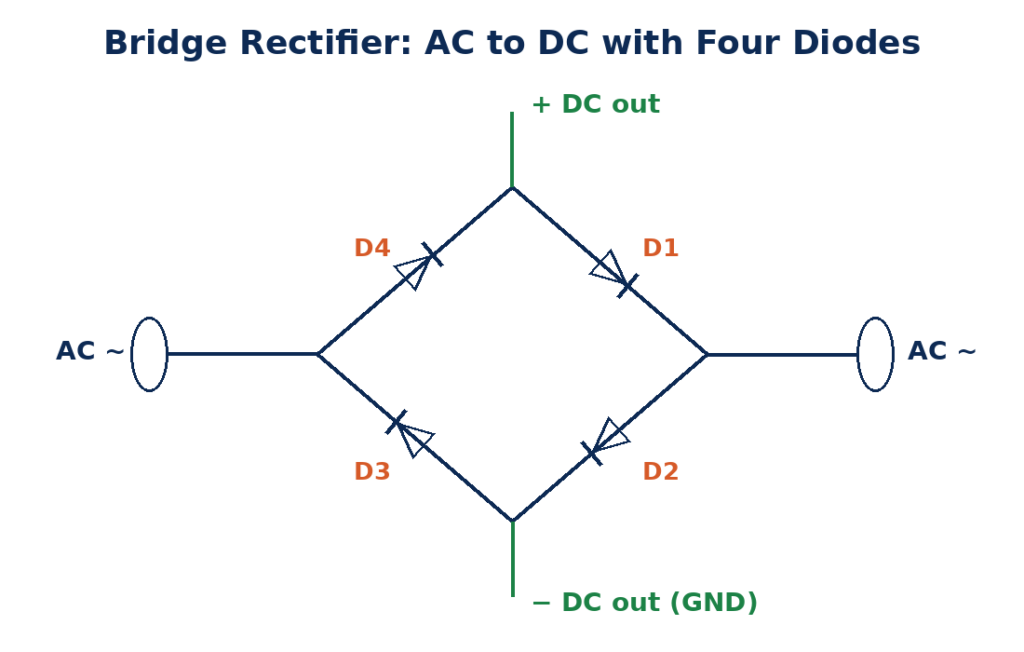
The most important application of the diode is rectification — converting AC into DC. A single diode makes a half-wave rectifier, which passes only one half of each AC cycle. The average DC output voltage is Vdc = 0.318 × Vm, where Vm is the peak AC voltage. A bridge rectifier uses four diodes in a diamond arrangement and passes both halves of the cycle, giving Vdc = 0.636 × Vm, roughly twice the output of a half-wave circuit.
Worked example: a 12 V RMS transformer secondary has a peak voltage of Vm = 12 × 1.414 ≈ 17 V. A bridge rectifier gives about Vdc = 0.636 × 17 ≈ 10.8 V before the filter capacitor, minus about 1.4 V lost across two conducting diodes, leaving roughly 9.4 V of unfiltered DC. A capacitor then smooths this into steady DC for the circuit.
Applications of Diodes
- Power conversion: rectifiers in adapters, chargers, and DC power supplies turn wall AC into usable DC.
- Reverse-polarity protection: a series diode stops damage if a battery or power supply is connected backwards.
- Flyback protection: a diode across a relay coil or motor absorbs the voltage spike produced when the coil switches off, protecting the driving transistor.
- Voltage regulation: Zener diodes hold a stable reference voltage for regulators and protection circuits.
- Signal demodulation: diodes extract audio from radio signals in receivers.
- Lighting: LEDs provide efficient light in homes, vehicles, screens, and indicators.
- Solar panels: bypass diodes let current flow around a shaded cell so one shaded cell does not shut down a whole panel.
- Clamping and clipping: diodes limit signal voltages to safe levels in measurement and audio circuits.
Diodes also appear inside larger circuits. The rectifier circuit article explains half-wave, full-wave, and bridge rectifiers in full detail, including filter capacitors and ripple calculations.
Frequently Asked Questions
What is a diode used for?
A diode is mainly used to control the direction of current flow. Its biggest jobs are converting AC to DC in power supplies, protecting circuits from reverse polarity and voltage spikes, regulating voltage with Zener diodes, and producing light in LEDs.
Why does a silicon diode drop 0.7 V?
The 0.7 V drop is the voltage needed to overcome the built-in barrier of the silicon PN junction. Below this knee voltage, the depletion region blocks current; above it, carriers cross the junction freely and current rises sharply.
What is the difference between a diode and a transistor?
A diode has two terminals and one PN junction, and it only controls the direction of current. A transistor has three terminals and two PN junctions, and a small control signal lets it switch or amplify a larger current.
Can a diode conduct in reverse?
An ordinary diode blocks reverse current except for a tiny leakage current. If the reverse voltage exceeds its breakdown rating, a large reverse current flows and the diode is usually destroyed. Zener diodes are the exception: they are designed to conduct safely in reverse breakdown at a fixed voltage.
How do I identify the anode and cathode of a diode?
On most through-hole diodes, the cathode is marked with a band printed around the body. In a circuit symbol, the cathode is the bar and the anode is the triangle. Current flows in the direction the triangle points, toward the bar.
Conclusion
The diode is the simplest semiconductor device, and also one of the most useful. One PN junction and one rule — current flows forward, not backward — is enough to build rectifiers, protect circuits, regulate voltage, and light up rooms. Once the PN junction, forward and reverse bias, and the main diode types are clear, the next step is the three-terminal devices that build on them: the transistor and the MOSFET. For a deeper technical reference on diode structure, characteristics, and types, see this guide from ROHM: What Is a Diode? How It Works, Types, and Applications.




Pingback: What Is a Semiconductor? Types, Properties and Applications
Pingback: Transformer EMF Equation: Derivation, Formula and Worked Examples
Pingback: Thyristor (SCR) Explained: Working, Characteristics, and Applications
Pingback: Zener Diode Explained: Working, Characteristics, and Applications