

A transistor is a semiconductor device that controls the flow of electric current in a circuit. It has three terminals and can work as an electronic switch or as an amplifier. A small signal at one terminal controls a much larger current between the other two terminals, which is why the transistor is the building block of almost all modern electronics.
Transistors were invented in 1947 at Bell Telephone Laboratories by John Bardeen, Walter Brattain, and William Shockley. Before transistors, electronic circuits used bulky vacuum tubes. The transistor replaced them because it is smaller, cheaper, more reliable, and uses far less power. Today, a single computer processor contains billions of transistors, and the same basic device also switches motors, drives LED lights, and amplifies audio signals.
In simple terms, a transistor is a tiny electrically controlled valve. A small control current or voltage at the middle terminal opens or closes the path for a large current through the device. This one idea — small input, large controlled output — is the foundation of amplifiers, digital logic, power supplies, and radio circuits.
How a Transistor Works
A bipolar junction transistor (BJT) is made from three layers of semiconductor material, usually silicon. The three layers form two PN junctions and three regions: the emitter, the base, and the collector. The emitter is heavily doped so it can inject many charge carriers. The base is very thin and lightly doped, so only a small fraction of carriers recombine there. The collector is wider and moderately doped so it can collect almost all the carriers that cross the base.
For normal operation, the emitter-base junction is forward biased and the collector-base junction is reverse biased. In an NPN transistor, the emitter injects electrons into the base. About 95 percent of these electrons pass through the thin base and reach the collector, while only about 5 percent form the small base current. The result is that a small base current controls a collector current many times larger.
The relationship between the three currents is simple and exact:
IE = IC + IB
Here IE is the emitter current, IC is the collector current, and IB is the base current. Because the base current is so small, the collector current is almost equal to the emitter current.
The current gain of a transistor, called beta (β), tells how much the base current is amplified:
β = IC / IB
Typical small-signal transistors have a beta between 50 and 300, although the range can extend from about 20 to 1000 depending on the type. For example, if a transistor has a beta of 100 and the base current is 1 mA, the collector current is about 100 mA.

Types of Transistors
There are two main families of transistors: bipolar junction transistors (BJTs) and field-effect transistors (FETs). A BJT is current-controlled, while a FET is voltage-controlled. The MOSFET, the most widely used FET, is covered in its own article.
NPN Transistor
An NPN transistor has a thin P-type base sandwiched between two N-type layers. Electrons are the majority carriers. It turns on when a positive voltage is applied to the base, and current flows from the collector to the emitter. NPN transistors are the most common type because they work easily with positive power supplies.
PNP Transistor
A PNP transistor has a thin N-type base between two P-type layers. Holes are the majority carriers. It turns on when the base is pulled lower than the emitter, and current flows from the emitter to the collector. PNP transistors are used where a negative control voltage or high-side switching is needed.
Other Types
- Field-effect transistor (FET): controlled by voltage at the gate; includes JFETs and MOSFETs. The gate draws almost no current.
- Darlington transistor: two BJTs connected together as one device with very high current gain, used for driving heavy loads.
- IGBT: a hybrid device that combines a MOSFET input with a BJT output, used in high-power motor drives and inverters.
- Phototransistor: a transistor whose base current is supplied by light, used in optocouplers and light sensors.
Transistor as a Switch
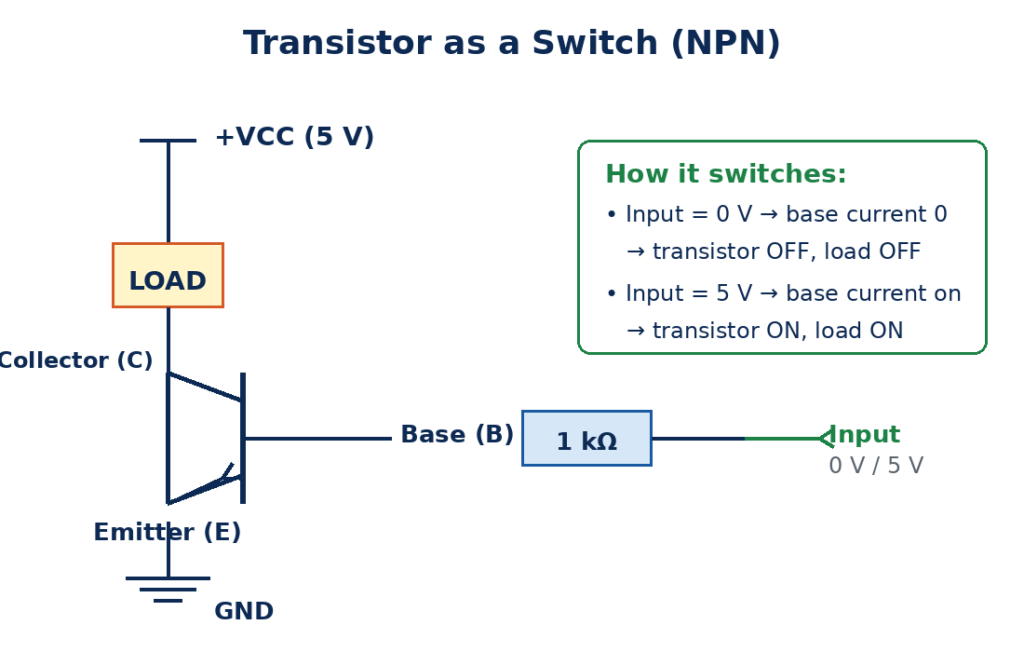
The most common use of a transistor is as an electronic switch. A microcontroller pin cannot directly drive a motor, a relay, or a bright LED strip, because those loads need far more current than the pin can supply. A transistor solves this: the microcontroller only supplies a small base current, and the transistor switches the full load current.
Worked example: suppose a 5 V microcontroller must switch a load that draws 100 mA, using a transistor with a beta of 100. The base current needed is IB = IC / β = 100 mA / 100 = 1 mA. The base resistor is RB = (5 V − 0.7 V) / 1 mA = 4.3 kΩ, so a standard 3.3 kΩ or 4.7 kΩ resistor works well. When the input is 0 V, the base current is zero and the transistor is off, so the load is off. When the input is 5 V, base current flows, the transistor saturates, and the load turns on.
Operating Modes of a Transistor
A BJT operates in one of three regions, depending on the bias of its two junctions:
| Mode | Emitter-Base Junction | Collector-Base Junction | Behavior |
|---|---|---|---|
| Cutoff | Reverse biased | Reverse biased | Transistor is off; acts as an open switch |
| Active | Forward biased | Reverse biased | Transistor amplifies; IC = β × IB |
| Saturation | Forward biased | Forward biased | Transistor is fully on; acts as a closed switch |
In the active region, the collector current is proportional to the base current, so the transistor works as an amplifier. In cutoff and saturation, it works as a switch. A transistor used as an amplifier must be biased in the active region, usually with a base-emitter voltage of about 0.6 to 0.7 V for silicon devices.

Common Transistor Types and Ratings
| Transistor | Type | Max Collector Current | Max Voltage | Common Uses |
|---|---|---|---|---|
| 2N3904 | NPN | 200 mA | 40 V | Low-power general-purpose circuits |
| 2N2222 | NPN | 800 mA | 40 V | Switching, small amplifiers |
| BC547 | NPN | 100 mA | 45 V | Audio and signal applications |
| 2N3055 | NPN | 15 A | 60 V | Power amplification, motor drivers |
| BC557 | PNP | 100 mA | 45 V | PNP general-purpose circuits |
Always check the datasheet before using a transistor. The maximum collector current, maximum collector-emitter voltage, and power dissipation rating must all be respected, and power transistors need a heatsink when they handle large currents.
Applications of Transistors
- Amplifiers: boosting weak signals from microphones, sensors, and radio antennas to a usable level.
- Switches: turning loads such as motors, relays, solenoids, and LED strips on and off from a microcontroller or logic signal.
- Digital logic: billions of transistors form the logic gates inside processors, memory chips, and microcontrollers.
- Oscillators: generating clock signals and radio-frequency signals in transmitters and timing circuits.
- Voltage regulation: controlling the output of power supplies and battery chargers.
- Motor control: driving DC motors and stepper motors in robots, fans, and home appliances.
Transistors also work closely with other semiconductor devices. A diode is often placed across a relay coil or motor to protect the transistor from voltage spikes, and transistors and diodes together form the rectifier circuits used in power supplies.
Frequently Asked Questions
What is a transistor in simple words?
A transistor is a small semiconductor device that works as an electronic switch or amplifier. A tiny current or voltage at its control terminal switches or controls a much larger current through the device.
What are the three terminals of a transistor?
A bipolar transistor has an emitter, a base, and a collector. The base is the control terminal. The emitter injects charge carriers and the collector collects them. A MOSFET instead has a gate, a source, and a drain.
What is the difference between NPN and PNP transistors?
An NPN transistor turns on with a positive base voltage and current flows from collector to emitter. A PNP transistor turns on when its base is lower than its emitter and current flows from emitter to collector. NPN types are more common in circuits with positive supplies.
Can a transistor amplify voltage?
Yes. In the active region, a small change in base current produces a much larger change in collector current, and that current flowing through a load resistor produces a larger voltage swing at the output than the input signal.
Why do transistors get hot?
A transistor dissipates power equal to the voltage across it times the current through it (P = V × I). In switching applications the power is low because the transistor is either fully on or fully off, but in linear or high-current use a heatsink is often needed.
Conclusion
The transistor is the most important electronic component ever invented. From a single switch driving an LED to billions of devices inside a processor, it does the same job everywhere: a small control signal governs a larger current. Understanding its three terminals, its NPN and PNP types, its operating modes, and its current-gain formula is the foundation for all electronics that follow, from the humble diode to the powerful MOSFET. Learn more about transistor working, types, and uses in this detailed guide: Actions of Transistors: Working, Types and Uses Explained.




Pingback: What Is a Diode? Working, Types and Applications
Pingback: MOSFET Explained: Working, Types and Applications
Pingback: Op-Amp Explained: Working, Configurations and Applications
Pingback: Logic Gates Explained: AND, OR, NOT, NAND, NOR, XOR with Truth Tables
Pingback: Microcontroller vs Microprocessor: Key Differences Explained
Pingback: Thyristor (SCR) Explained: Working, Characteristics, and Applications