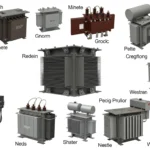
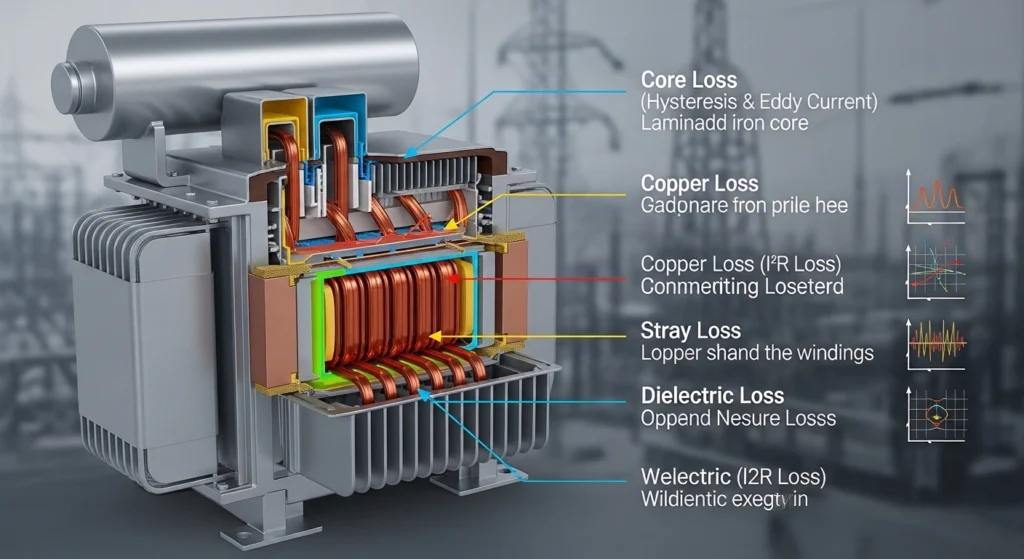

Every transformer loses some energy as heat in its iron core, even when it is doing its job perfectly. One of the biggest sources of that waste is eddy current loss: unwanted currents that circulate inside the core itself, heating it up and stealing energy that should have reached the load. In large power transformers, eddy current loss can amount to thousands of watts, running 24 hours a day.
Understanding eddy currents matters because they limit how efficient a transformer can be, how hot it runs, and how long it lasts. This guide explains what eddy currents are, how the loss arises in a transformer core, the formula engineers use to predict it, and the practical ways to reduce it.
What Are Eddy Currents?
An eddy current is a loop of electric current induced inside a conductor by a changing magnetic field. It is the same principle that makes a transformer work: a changing flux induces a voltage in a winding. The difference is that in the core, there is no winding to collect the energy. The induced voltage drives current in closed loops within the iron itself, and the resistance of the iron turns that current into heat.
The name comes from the way the currents swirl, like eddies in a stream. They flow in planes perpendicular to the magnetic flux, and their strength grows with the rate of change of the flux. That is why eddy current loss rises sharply with frequency, and why it is a much bigger problem in high-frequency transformers than in 50 Hz power transformers.
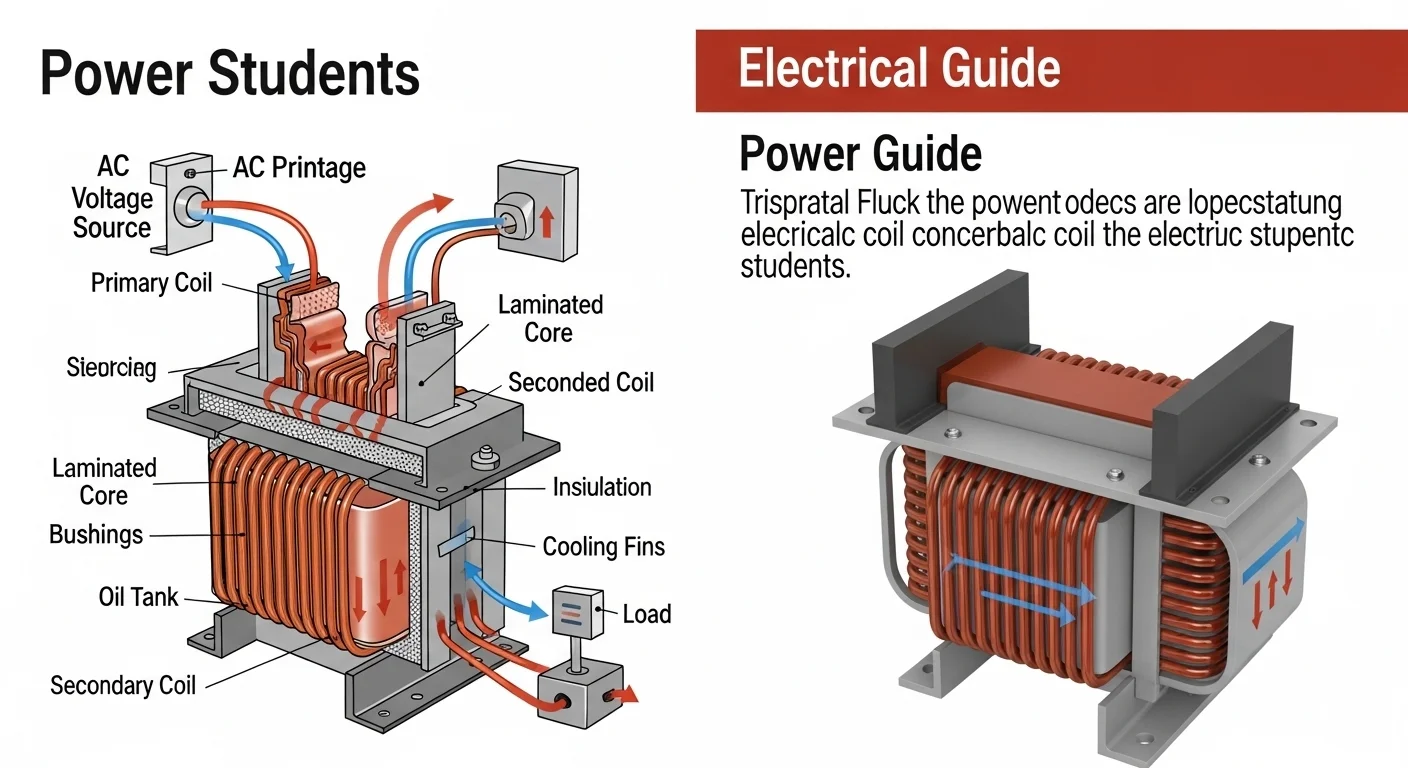
How Eddy Current Loss Happens in a Transformer Core
Inside a transformer, the core is a solid block of iron carrying a rapidly alternating magnetic flux. That flux induces voltages throughout the iron, and because iron conducts electricity, those voltages drive currents in closed loops. The power lost as heat in those loops is the eddy current loss. It happens whether the transformer is loaded or not, because the core flux is present whenever the transformer is energized.
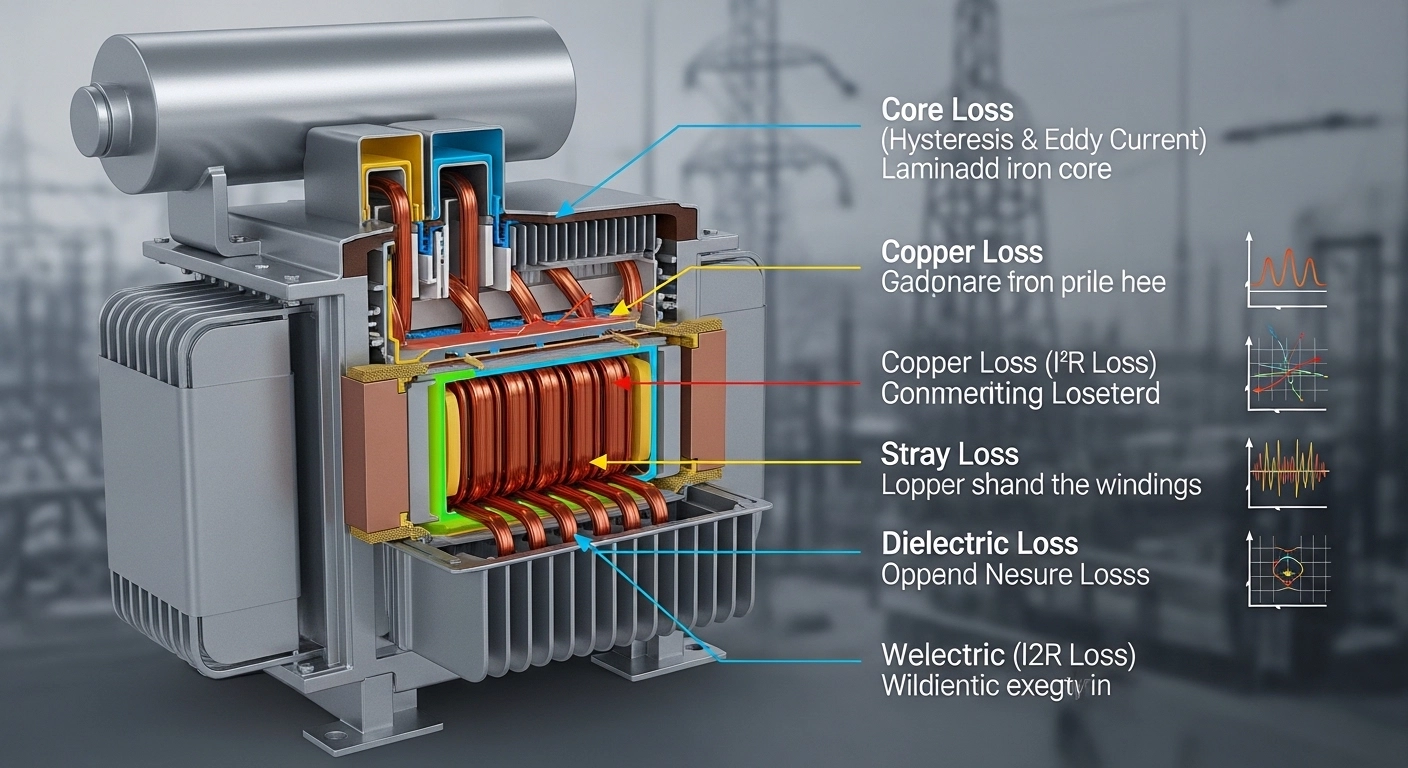
The loss is worse in a solid core than in a laminated one, for a simple reason: a solid block offers a large, low-resistance path for the eddy currents, so they grow large. Break the iron into thin sheets insulated from each other, and each sheet carries only a small loop with a much higher resistance. The total loss falls dramatically. Our guide to transformer losses puts eddy current loss alongside the other losses a transformer suffers.
Eddy Current Loss Formula
The eddy current loss in a core is given by Pe = Ke x Bmax squared x f squared x t squared, where Pe is the loss in watts, Ke is a constant that depends on the material and the volume of the core, Bmax is the peak flux density, f is the frequency, and t is the thickness of each lamination. The formula tells the whole story: loss grows with the square of the flux density, the square of the frequency, and the square of the lamination thickness.
That squared dependence on thickness is the reason lamination works so well. Halve the thickness of each lamination, and the eddy current loss falls to one quarter. Double the frequency, and the loss quadruples, which is why high-frequency transformers need very thin laminations or ferrite cores, which have almost no eddy currents at all.
Eddy Current Loss vs Hysteresis Loss
Eddy current loss and hysteresis loss are the two parts of core loss, but they behave differently:
| Feature | Eddy current loss | Hysteresis loss |
|---|---|---|
| Cause | Induced currents in the core | Repeated magnetization of the iron |
| Depends on | Frequency squared, lamination thickness squared | Frequency, flux density, material |
| Reduced by | Thin laminations, high-resistivity steel | Better core steel, lower flux density |
| Present at | Any frequency with changing flux | Any alternating magnetization |
How to Reduce Eddy Current Loss
Transformer designers have several tools to keep eddy current loss down:
- Laminated cores: the core is built from thin steel sheets, each insulated with a varnish or oxide coating, so the eddy current loops stay small
- Thin laminations: thinner sheets mean smaller loops and much lower loss, which is why high-frequency transformers use very thin steel
- Silicon steel: adding silicon raises the electrical resistance of the iron, which cuts the eddy currents without hurting the magnetic properties much
- Amorphous metal cores: the disordered atomic structure gives very high resistance and very low loss, at a higher price
- Lower flux density: designing the core to run at a lower peak flux reduces both eddy current and hysteresis loss
Where Eddy Currents Are Useful
Eddy currents are not always a nuisance. Induction cooktops heat a pan by driving eddy currents in its base. Induction furnaces melt metal the same way. Eddy current brakes slow down trains and roller coasters without any contact or wear, by pushing a metal plate through a magnetic field. Metal detectors work by sensing the eddy currents induced in buried objects. In each case, the heating or drag that is a loss in a transformer becomes the whole point.
Even in transformers, a small amount of eddy current loss is accepted as the price of using a solid, cheap, and mechanically strong core. The art of transformer design is keeping it small enough that it does not matter, by choosing the right core material and lamination for the job. The different types of transformers use different core designs for exactly this reason.
Frequently Asked Questions
What causes eddy current loss in a transformer?
The alternating magnetic flux in the core induces voltages in the iron itself, driving circulating currents in closed loops. The resistance of the iron turns those currents into heat, which is the loss. It is present whenever the transformer is energized, even at no load.
How is eddy current loss reduced?
By building the core from thin, insulated laminations instead of solid iron, and by using silicon steel, which has higher electrical resistance. Halving the lamination thickness cuts the loss to one quarter, because the loss depends on the square of the thickness.
What is the difference between eddy current loss and hysteresis loss?
Eddy current loss comes from induced currents circulating in the core, while hysteresis loss comes from the repeated magnetization and demagnetization of the iron. Eddy current loss grows with the square of frequency; hysteresis loss grows roughly in proportion to frequency. Together they make up the core loss.
Does eddy current loss depend on the load?
No. Eddy current loss is part of the no-load, or iron, loss. It depends on the core flux, which is set by the supply voltage, not on how much current the load draws. Copper loss is the part that changes with load.
Can eddy currents be useful?
Yes. Induction cooktops, induction furnaces, eddy current brakes, and metal detectors all use eddy currents on purpose. The heating or drag that is a waste in a transformer becomes the working principle in those devices.
Conclusion
Eddy current loss is the heat produced by currents swirling inside a transformer core, driven by the very flux that makes the transformer work. It grows with the square of frequency, flux density, and lamination thickness, which is why thin, insulated laminations of silicon steel are the standard cure. Keep the core loss low, and the transformer runs cooler, lasts longer, and wastes less energy.
For a detailed derivation of the eddy current loss formula and worked examples, see the guide at Electrical4U.