
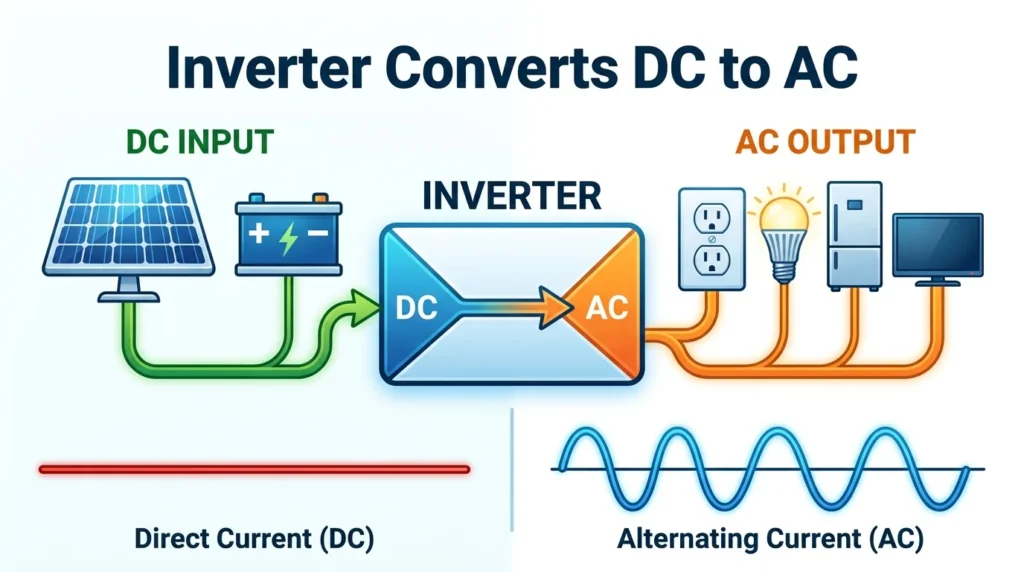
Inverters and converters both change one form of electricity into another, and their names sound so similar that they are often mixed up. Yet they do opposite jobs: an inverter turns direct current (DC) into alternating current (AC), while a converter usually turns alternating current into direct current, or changes DC from one voltage level to another.
If you choose the wrong device, your equipment will not work, and in some cases it can be damaged. Solar panels, batteries, laptops, phone chargers, and electric vehicles all depend on getting this choice right. In this guide, you will learn what each device does, how they differ, and which one you need for common jobs.
Inverter vs Converter Explained
The simplest way to remember the difference is the direction of the change. An inverter inverts DC into AC. A converter converts AC into DC, or converts DC at one voltage into DC at another voltage. Both devices handle power, but they solve opposite problems.
Think of a solar panel system. The panels produce DC, but your home runs on AC. An inverter sits between them and changes the DC into AC your appliances can use. Now think of your phone charger. It takes AC from the wall socket and converts it into the low-voltage DC your phone battery needs. That charger is a converter.
What Is an Inverter?
An inverter is an electronic device that converts direct current (DC) into alternating current (AC). It does this by switching the DC on and off very quickly to build a waveform that mimics the smooth sine wave of mains electricity.
Inverters are rated by their output power in watts and by the quality of their output waveform. The main types are:
- Pure sine wave inverters — produce a clean sine wave, safe for sensitive electronics such as laptops and medical equipment
- Modified sine wave inverters — cheaper and simpler, but can cause buzzing or overheating in some devices
- Grid-tie inverters — connect solar panels to the electricity grid and feed power back into it
Common uses include solar power systems, uninterruptible power supplies (UPS), electric vehicles, and off-grid cabins. Whenever you need mains-style AC from a battery or solar panel, you need an inverter.
What Is a Converter?
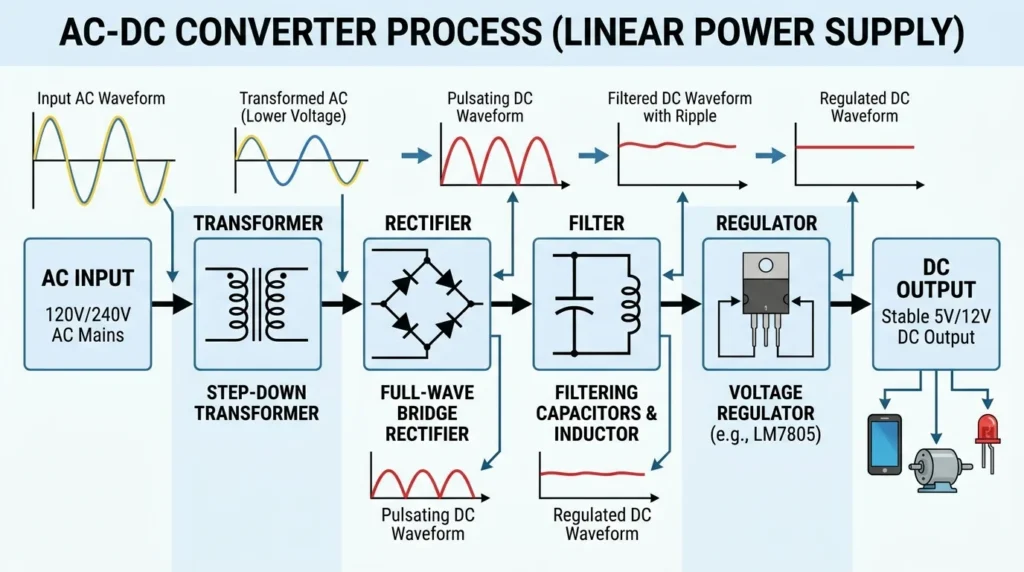
A converter is a device that changes electricity from one form to another, most often from AC to DC. The most common type is the AC-DC converter, also called a rectifier, which is found in almost every mains-powered charger and power supply.
Converters also include DC-DC converters, which change DC from one voltage to another. A DC-DC converter can step 12 volts down to 5 volts for a USB port, or step 5 volts up to 12 volts for a motor. The main types are:
- AC-DC converters (rectifiers) — change mains AC into DC for electronics
- DC-DC converters — change one DC voltage into another DC voltage
- Buck converters — step DC voltage down
- Boost converters — step DC voltage up
You use a converter every time you plug in a laptop charger, a phone charger, or a LED driver. The device takes the power available and converts it into the voltage and current your equipment needs.
Inverter vs Converter: Key Differences
The two devices differ in what they change and where they are used:
- Direction: an inverter changes DC to AC; a converter usually changes AC to DC or DC to a different DC voltage
- Output: an inverter produces alternating current; a converter produces direct current
- Typical source: inverters run from batteries or solar panels; converters run from the mains supply
- Typical load: inverters power AC appliances such as fridges and TVs; converters power DC electronics such as phones and laptops
- Waveform: inverters must create a clean AC sine wave; converters must smooth DC into a steady voltage
Which One Do You Need?
Choose an inverter when your power source is DC and your load needs AC. Examples include running household appliances from a solar battery bank, powering tools from a car battery, or keeping a computer running during a power cut with a UPS.
Choose a converter when your power source is AC and your load needs DC, or when you need a different DC voltage. Examples include charging a phone from a wall socket, powering a 5-volt circuit from a 12-volt battery, or running LED lights from the mains.
Some systems need both. A solar installation uses an inverter to feed AC into the home, while the phone chargers inside that home use converters to make DC again. The two devices often work as a team.
Common Mistakes With Inverters and Converters
- Calling a charger an inverter: a phone charger converts AC to DC, so it is a converter, not an inverter
- Using a modified sine wave inverter for sensitive equipment: some motors and medical devices need a pure sine wave and can overheat on a rough waveform
- Undersizing the inverter: an inverter must handle the peak power of everything connected to it, not just the average power
- Ignoring efficiency: both devices lose some energy as heat, so check the efficiency rating before buying
- Mixing up input and output: always match the input to your power source and the output to your load
Frequently Asked Questions
What is the difference between an inverter and a converter?
An inverter changes DC into AC, while a converter usually changes AC into DC or changes DC from one voltage to another. They work in opposite directions: inverters create mains-style AC from batteries or solar panels, and converters make the DC that electronics need.
Can an inverter also work as a converter?
Some devices do both. A UPS, for example, uses a converter to charge its battery from the mains and an inverter to supply AC during a power cut. Standalone inverters and converters, however, each do one job.
Is a phone charger an inverter or a converter?
A phone charger is a converter. It takes AC from the wall socket and converts it into low-voltage DC to charge the phone battery.
Do solar panels need an inverter or a converter?
Solar panels produce DC, so a solar system needs an inverter to change that DC into AC for the home. The panels themselves do not need a converter, though some systems add DC-DC converters to optimize each panel.
Which is better, an inverter or a converter?
Neither is better in general. Use an inverter when you need AC from a DC source, and use a converter when you need DC from an AC source or a different DC voltage. The right choice depends on your source and your load.
Further Reading
Conclusion
An inverter and a converter are partners, not rivals. The inverter turns DC into AC so batteries and solar panels can run household appliances, and the converter turns AC into DC so the mains can charge the electronics we use every day. Once you know which direction the power needs to flow, the choice is simple. For a deeper technical explanation of how inverters work, see the power inverter article on Wikipedia: https://en.wikipedia.org/wiki/Power_inverter