
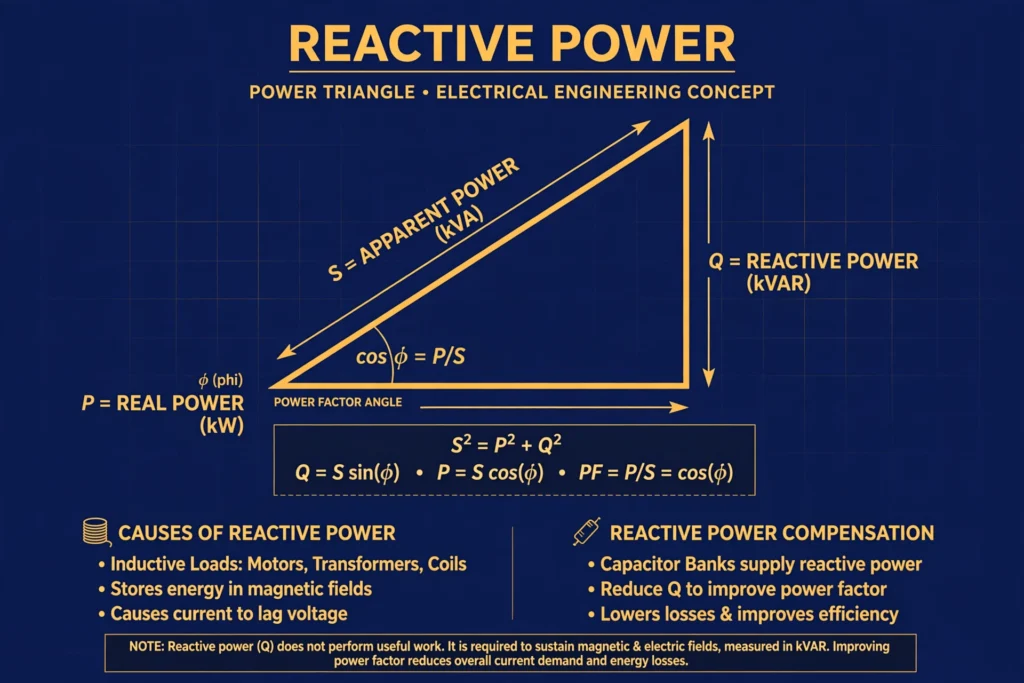

Reactive power is the most misunderstood idea in basic electrical engineering. Students can calculate it, yet many cannot say what it actually is. Here is the short version: reactive power is the power that flows back and forth between the source and the load without being consumed — power borrowed and returned 100 times every second, doing no useful work itself but absolutely necessary for the equipment to function.
This beginner-friendly guide explains what reactive power is, why it exists, how the power triangle ties it to real and apparent power, and why electricity companies care so much about it that they fine you for having too much of it.
What Is Reactive Power, Simply Put?
In an AC circuit, voltage and current are waves. When the load is a simple heater (a resistor), the two waves rise and fall together, and all the power delivered is consumed as heat. But most real loads — motors, transformers, fluorescent fittings — contain inductance or capacitance, which shifts the current wave out of step with the voltage wave.
Because of that shift, part of the power flows from source to load during one part of each cycle and flows back to the source during another part. That back-and-forth component is reactive power, measured in volt-ampere reactive (kVAr). It averages to zero over a full cycle — the load does not “use it up” — but the wires must still carry it, which is why it matters. For the formal definitions alongside real power, see our companion article on real power and reactive power.
Why Does Reactive Power Exist?
Reactive power exists because magnetic and electric fields need energy to build up and collapse every cycle. An induction motor cannot work without a magnetic field in its air gap, and creating that field requires reactive power from the supply. The field energy is returned to the supply when the field collapses — hence the continuous borrowing and returning.
Inductive loads (motors, transformers, induction furnaces, fluorescent lamp ballasts) draw lagging reactive power — current lags voltage. Capacitive loads (capacitor banks, long lightly-loaded cables, some electronic equipment) draw leading reactive power — current leads voltage. The two oppose each other, which is exactly why a capacitor bank can cancel a motor’s reactive demand. Our guide to capacitive vs inductive circuits shows this tug-of-war in detail.
The Power Triangle and the Formula
The relationship between the three kinds of power is drawn as a right-angled triangle:
- Real (active) power, P — the horizontal side, measured in watts (kW). This does the useful work: heat, light, rotation.
- Reactive power, Q — the vertical side, measured in volt-ampere reactive (kVAr). The borrowed-and-returned component.
- Apparent power, S — the hypotenuse, measured in volt-amperes (kVA). What the supply must actually deliver.
The formulas: S² = P² + Q², and power factor = P / S = cos φ, where φ is the angle between voltage and current. A power factor of 1 means no reactive power at all; 0.7 means nearly as much reactive as real power is sloshing back and forth. Our illustrated power triangle explained guide walks through worked examples, and apparent power explained covers the S side of the triangle.
A Simple Analogy: The Beer Mug
Engineers love this one. Imagine a mug of beer: the beer itself is real power (kW) — what you actually wanted. The foam on top is reactive power (kVAr) — you did not order it, you cannot drink it usefully, but the mug cannot be served without some foam. The whole mug — beer plus foam — is apparent power (kVA), and you pay for the size of the mug. Power-factor correction is the art of ordering beer with less foam.
Real vs Reactive vs Apparent Power
| Quantity | Symbol | Unit | What it does |
|---|---|---|---|
| Real power | P | kW | Useful work: heat, light, mechanical output |
| Reactive power | Q | kVAr | Builds magnetic/electric fields; returned each cycle |
| Apparent power | S | kVA | Total power the supply must carry |
| Power factor | cos φ | — | Ratio P/S; 1 is perfect, lower is worse |
Why Do Utilities Care? (And Fine You for It)
Reactive power may average to zero, but the current carrying it is very real: it heats cables, loads transformers, and causes voltage drops — all without doing useful work. A factory with power factor 0.7 needs cables and transformers roughly 40% larger than the same factory at unity power factor, for the same useful output.
That is why utilities in India, Pakistan and most countries penalize low power factor: below about 0.9 you pay a surcharge, and the fix — installing capacitor banks near the motors — is usually far cheaper than the fines. This whole subject is called power factor correction, and it is one of the highest-return investments in any plant.
How to Reduce Reactive Power Demand
- Install capacitor banks at the load or at the main panel to supply reactive power locally instead of dragging it across the network.
- Avoid oversized motors: a motor running at 30% load has terrible power factor; right-size motors to their actual duty.
- Switch off idle equipment: an unloaded transformer or motor still draws magnetizing (reactive) current.
- Use VFDs wisely: modern drives present near-unity displacement power factor to the supply.
- Consider synchronous condensers for very large installations needing dynamic correction.
FAQs
Is reactive power wasted power?
Not exactly. It is not consumed like real power — it oscillates between source and load. But it wastes capacity: it forces larger cables, transformers and generators to carry current that does no useful work, which is why utilities discourage it.
What is the unit of reactive power?
Volt-ampere reactive, abbreviated VAr (or kVAr for thousands). It uses the same dimensions as the watt but a different unit to keep the concepts distinct.
Can reactive power be negative?
By convention, inductive (lagging) reactive power is positive and capacitive (leading) is negative. They cancel each other, which is why capacitors correct inductive loads.
Do resistive loads produce reactive power?
No. Heaters, incandescent lamps and other pure resistances draw current in phase with voltage, so reactive power is zero and power factor is 1.
Why is my electricity bill higher with poor power factor?
Many utilities add a low-power-factor surcharge, and some bill large consumers on kVA (apparent power) rather than kW. Either way, excess reactive power costs real money.
What is a good power factor value?
Utilities typically want 0.9 or better. Most well-corrected industrial plants run between 0.95 and unity. Above 1 is impossible — that would mean more useful power than total power.
Conclusion
Reactive power is the necessary overhead of AC power systems: the energy that builds magnetic fields in motors and transformers, borrowed and returned every cycle. You cannot eliminate it, but you can manage it — understand the power triangle, keep power factor high with capacitor banks and right-sized motors, and the grid rewards you with lower losses, stable voltage and smaller bills. Master this one concept and half of industrial power engineering suddenly makes sense.
Further reading: AC power — Wikipedia.